

The Coverage Machinery
The .prm maps, the unified per-document report, the named-gap doctrine, the mutation proofs.
In this chapter: how the scheme answers “does this operation fulfil the corpus?” as a computation, the four
.prmmaps, the unified per-document coverage report, the named-gap doctrine, the mechanical type-conditioned discharges, and the mutation proofs that keep the gate a gate.
7.1 Why coverage
Chapters 3–6 made two kinds of claims: the corpus is modelled (every document, every provision, every pipeline), and parts of it are executed (the participant pipeline, the issuance gate, the operations runtime). Between those claims sits the auditor’s question: how much of the corpus does this platform actually fulfil? Volume I, chapter 5 gives the answer’s shape, a mapping A ⇒ B with description + justification per pair, and a calculus that computes cover levels (full / minimal / partial / none), inherits them down process trees, and aggregates them up. This chapter is that calculus pointed at the scheme itself: the platform and the corpus as mapping clients, the report as the audit view. The alternative, answering by document review, is the chase the scheme package exists to end.
7.2 The four maps
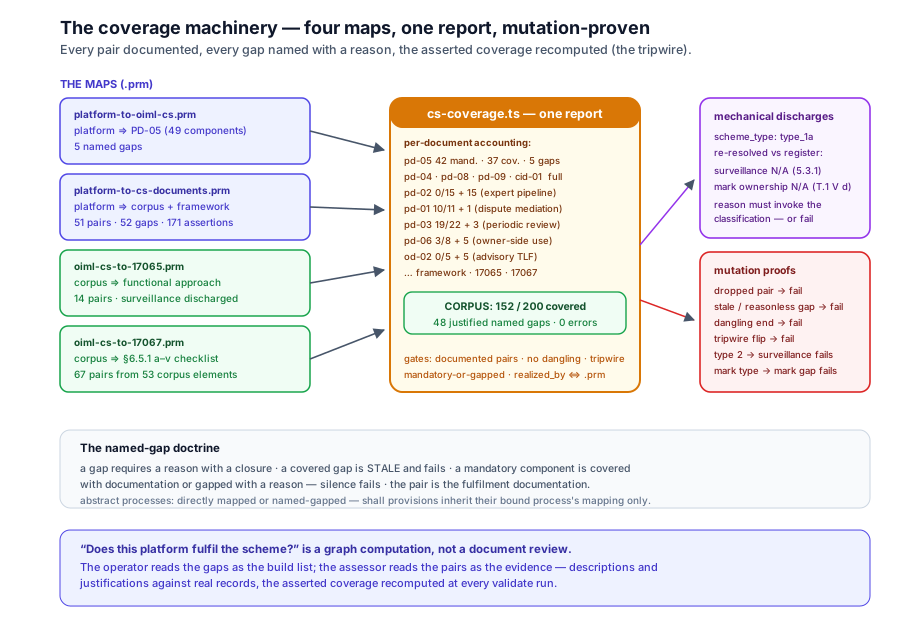
Four standalone mapping profiles (.prm) carry the fulfilment
documentation:
| Map | Direction | What it binds | Size |
|---|---|---|---|
data/core/evaluation/platform-to-oiml-cs.prm |
platform ⇒ PD-05 | the concrete Core processes ⇒ the 8-step chain, off-sequence flows, the 34 provisions | 49 reference components; 5 named gaps |
data/core/evaluation/platform-to-cs-documents.prm |
platform ⇒ the corpus + framework | 18 Core sources (the participant-approval set, the cs-operations set) ⇒ the document pipelines, provisions, framework executive rules | 51 pairs; 52 named gaps; 171 coverage assertions |
data/oiml-cs/oiml-cs-to-17065.prm |
corpus ⇒ ISO/IEC 17065 | the scheme’s processes ⇒ the clause-7 functional approach | 14 pairs; surveillance discharged |
data/oiml-cs/oiml-cs-to-17067.prm |
corpus ⇒ ISO/IEC 17067 | every /req/cs/* provision, abstract process and framework id ⇒ the §6.5.1 a)–v) checklist |
67 pairs from 53 corpus elements |
Two direction choices are worth reading twice. The platform maps up to the scheme (implementation → reference, the only direction the calculus allows); and the scheme maps sideways to its CASCO foundations, the 17067 map is the scheme’s own capstone: “is the OIML-CS a complete product certification scheme?” answered against the scheme-content checklist, with sources restricted to declared corpus elements (computed, never hand-listed).
7.3 The unified report
browser/build/cs-coverage.ts (a npm run validate section) folds all
four maps into one per-document mandatory/named-gap accounting. The
spine: every document lists its mandatory components, sequence
processes plus shall-obligation provisions, the covered count, and
the named gaps. Five gates, mirroring the PD-05 gate’s discipline:
- every pair carries description + justification;
- no dangling sources or targets;
- the tripwire, the asserted coverage block equals the computed one (coverage claims are computed, never authored);
- every mandatory component is covered at full|minimal or named- gapped with a reason, a gap that becomes covered is stale and fails, a reasonless gap fails;
- the
realized_by⇔.prmconsistency check, the modules’ declared realizations and the map’s pairs may not drift apart.
One inheritance rule keeps the accounting honest: a shall provision
inherits its bound process’s direct mapping (the provision↔process
binding is module-declared and linker-checked, so inheritance cannot
mask a dropped pair), but every abstract process must be directly
mapped or named-gapped itself.
The green baseline, as npm run validate prints it:
| Section | Mandatory | Covered | Named gaps | The gaps are |
|---|---|---|---|---|
| pd-05 | 42 | 37 | 5 | dispatch, TL-eligibility binding point, re-application linkage, the registration-fee lifecycle |
| pd-01 | 11 | 10 | 1 | dispute mediation (off-platform correspondence) |
| pd-02 | 15 | 0 | 15 | the expert pipeline, no expert case kind on ParticipantApplication |
| pd-03 | 22 | 19 | 3 | periodic review |
| pd-04 | 19 | 19 | 0 | , |
| pd-06 | 8 | 3 | 5 | owner-side use discipline |
| pd-07 | 7 | 4 | 3 | legacy import |
| pd-08 | 7 | 7 | 0 | , |
| pd-09 | 7 | 7 | 0 | , |
| cid-01 | 4 | 4 | 0 | , |
| od-01 | 11 | 6 | 5 | MC administration (the a–k census, scheme monitoring) |
| od-02 | 5 | 0 | 5 | the advisory TLF |
| framework | 9 | 6 | 3 | TLF, financing, legacy rules |
| iso-iec-17065 | 11 | 10 | 1 | surveillance, discharged (type 1a) |
| iso-iec-17067 | 22 | 20 | 2 | surveillance + mark ownership, discharged (type 1a) |
Corpus total: 152 of 200 mandatory components covered, 48 justified named gaps, zero errors. Read the zeros right: pd-04, pd-08, pd-09 and cid-01 at full mandatory cover are the admission pipelines and identity pins the runtimes of chapters 5–6 execute; pd-02’s 0/15 is not a failure, it is the honest state of an expert pipeline the runtime cannot yet hold (it needs an expert case kind), asserted as gaps with the closure path in the reason, and pinned by a unit test so the honesty itself cannot silently regress.
The same npm run validate section (1f) prints the corpus’s
source-discrepancy records (● smart 8651182, task 54; the
construct is Volume I, chapter 9’s discrepancy_record, the three live
records chapter 3, §3.7). A resolved record prints as DOCUMENTED, a
recorded conflict is known, never a new finding; an open record would
print at audit level, so an undispositioned conflict cannot hide. The
report treats the records as the corpus’s errata memory: coverage never
re-litigates a settled disagreement.
7.4 The named-gap doctrine
A named gap is not an admission of failure; it is the form honesty takes in a coverage calculus. Four rules govern it:
- a gap requires a reason, root-caused and naming the closure (a task, a missing case kind, an off-platform channel);
- a covered gap is stale, the moment a realization lands, the gap entry must go; the gate fails on the stale entry, so the map cannot accumulate historical excuses;
- a mandatory component needs one of the two, coverage with documentation, or a gap with a reason; silence fails;
- the pair is the documentation, dropping a pair fails even when inheritance would keep the computed cover full: an undocumented fulfilment is an assertion, not evidence;
- a source conflict names its record, a named gap whose root cause
is a documented source-vs-source discrepancy carries
discrepancy: <record-id>(the structured successor of a free-text reason, ● smart 8651182) instead of re-arguing the conflict in the reason string. The reference resolves against the corpus’s discrepancy-record registry on all four coverage gates and the dangling-ref gate: a dangling record reference fails the gate; a defined one prints DOCUMENTED through the record.
The doctrine is what lets the report serve two audiences at once: the operator reads “what must we build?” (the gaps with their closures); the assessor reads “what do you demonstrably do?” (the pairs with their justifications against real records).
7.5 Mechanical discharges, the classification pays off
Two of the 17067 checklist items and one 17065 item are N/A, and the
gate does not take the map’s word for it. The discharge is
mechanically re-checked against the scheme’s own classification
(chapter 2): the gate resolves the oiml-cs layer’s scheme_type: type_1a against the 17067 register, and
- fails the surveillance gap the moment the declared type requires surveillance (ISO/IEC 17067, 5.3.1, types 1a/1b require none);
- fails the mark-ownership gap the moment the declared type licenses marks (Table 1 V d, type 1a leaves it blank; licensing is the surveillance/batch-based attestation kinds);
- fails any such gap whose reason does not invoke the classification, “we don’t do surveillance” is not a reason; “type 1a requires none per 5.3.1” is.
The counterfactual proofs make it concrete: mapping against type 2 fails the surveillance discharge; a mark-licensing type fails the mark discharge; type 1b fails only the mark one. The scheme’s self-classification is load-bearing data, change the declaration and the audit changes with it, mechanically.
One documented interpretation rides the map: checklist item r) (contracts) reads the intergovernmental scheme as binding its parties by signed Declarations, endorsements and NDAs rather than private-law contracts, argued explicitly in the pairs, one line away from becoming a named gap if a reviewer reads the item differently.
7.6 Mutation proofs, a gate that cannot fail is not a gate
Every gate in this chapter ships with the proofs that it can fail , seeded-mutation suites that break the map in each way the doctrine forbids and watch the gate catch it:
- the unified report (
cs-coverage.test.ts, 17 tests): dropped pairs, stale gaps, reasonless gaps, dangling sources and targets, tripwire flips (asserted ≠ computed),realized_by⇔.prmdrift, the counterfactual surveillance-requiring scheme type, the pd-02 expert-pipeline honesty pin; - the 17067 scheme gate (
cs-scheme-coverage.test.ts, 21 tests): the same mutation matrix plus the counterfactual-type adjudications of §7.5 and a classification-free gap reason; - the PD-05 gate (
pd05-coverage.test.ts, 13 tests): the census pin (42 mandatory / 37 covered / 5 gaps) and the per-mutation failures, including the inheritance-cannot-mask-a-dropped-pair proof.
This is the same discipline the lab-coverage gate and the PRL round-trip kit use elsewhere in the platform: the gate’s value is exactly the set of mutations it is proven to detect.
7.7 Validation rules
- coverage claims are computed by the calculus, never authored, the asserted block equals the computed block or the tripwire fails;
- every pair: description + justification against real records; every gap: a reason with a closure; every mandatory component: one of the two;
- abstract processes are directly mapped or named-gapped, inheritance covers bound provisions only;
- type-conditioned discharges re-check the declared
scheme_typeagainst the register, and the reason must invoke the classification; - the maps’ sources are restricted to declared elements of their corpora, computed vocabularies, never hand-listed;
- a named gap’s
discrepancy:reference resolves to a declared discrepancy record, dangling fails; an open record prints at audit level, a resolved one DOCUMENTED; - the mutation suites stay green, a gate regression is a test failure, not a documentation drift.
7.8 Summary
- Four
.prmmaps carry the fulfilment documentation: platform ⇒ PD-05, platform ⇒ the corpus + framework, corpus ⇒ 17065, corpus ⇒ 17067. - One unified report renders the accounting per document: mandatory components, covered counts, named gaps, currently 152/200 covered with 48 justified gaps and zero errors.
- Named gaps are the calculus’s honesty form: reasoned, closed-world,
stale-proof; the zeros (pd-04/08/09, cid-01) and the honest zero
(pd-02) both say something true. A gap rooted in a source conflict
names its
discrepancy_record, the corpus’s errata memory, printed DOCUMENTED by validate section 1f. - The type-1a classification discharges the surveillance and mark-ownership items, re-checked mechanically against the register, counterfactual-proven.
- Every gate ships mutation proofs: the report is trustworthy because its failure modes are enumerated and tested.
Next: Chapter 1, The scheme architecture , or back to the volume overview for the chapter map.