

Invariants
INV-1..14: the metamodel’s laws, each with rationale, checks, and the shipped registry’s crosswalk.
In this chapter: INV-1..10, the metamodel’s laws, each with its statement, the rot it prevents, the enforcing check, and the R 60 evidence; then the shipped registry with its enforcement crosswalk (R38), the v0.6 additions INV-11..14, and the twin-direction candidates the frame adds.
9.1 Laws, not rules
Three kinds of “rule” live in an OIML SMART model, and the first discipline is not confusing them: a requirement judges an instrument (Module D1); a constraint checks the coherence of instrument facts (Module C); an invariant constrains what may be modelled at all, a law of the metamodel itself.
Invariants exist because each was learned from a failure mode: a model that
violated it once, and rotted. They have two homes, one truth: declared at the
head of the metamodel (ontology-remix/OIML Core Models/Ontology/ oiml-core-ontology.yaml, invariants, INV-1..14 as of v0.6) and registered as
first-class typed data in the core package (primmel-packages/oiml-smart-core/ specification/invariants.prl, INV-1..10, §9.12). They are enforced by the
schema validators, the model linker, the kernel checks, and the code
generators, not by reviewer vigilance. Each entry below gives the statement
verbatim, the rationale, the check, and the R 60 example.
9.2 INV-1, No bare numbers
“INV-1 No bare numbers: every physical quantity is a QuantityValue (value + unit [+ uncertainty]).”
Rationale. A number without a unit is an ambiguity with a decimal point;
bare numbers also make comparisons silently incoherent, d_max <= e_max in
grams vs tonnes.
Check. The JSON Schemas type every value field as a QuantityValue object;
the linker checks comparison coherence on quantity kinds (closed registry,
data/schemas/quantity-kinds.yaml), not on unit strings.
R 60 example. model.parameters.e_max = { value: 500, unit: kg }; test
forms record indications in counts, converted through conversion_factor_f
(counts/v). The historical violation, v_min misused as a unit on eight
form fields, is in the pitfalls catalog (Volume III, chapter 1).
9.3 INV-2, Schema/instance split
“INV-2 Schema/instance split: an attribute is DEFINED once (AttributeDefinition: symbol, clause, IRDI) and VALUED per Model or Sample (Parameter).”
Rationale. Two definitions of the same attribute are two attributes that happen to share a name; they drift. Definition never carries a value, value never carries a definition, Volume I, chapter 3’s duality, applied to the attribute register.
Check. Every attribute id resolves to exactly one entry in
data/<rec>/model/attributes.yaml; every binds_to path, form bind: path,
and OCL identifier resolves at a scope-appropriate level (model linker).
R 60 example. e_max is defined once in data/r60/model/attributes.yaml
(symbol E_max, R 60-1 §3.5.5, origin: design-fixed, scope: model), valued
per model in model.parameters.e_max; d_max is defined once (origin: test-dependent, scope: sample), valued per unit in
sample.test_context.d_max.
9.4 INV-3, Binding, never restating
“INV-3 Every D1 element references attribute paths into instrument-description; nothing physical is defined in conformity-specification.”
Rationale. This is the anchoring rule of the tier system (Volume I, chapter 1) stated as metamodel law: a secondary model owns no subject facts. A requirement that restates an instrument fact forks the truth, the copies drift, and the requirement stops surviving a revised subject model.
Check. The linker resolves every OCL identifier in limit expressions,
every binds_to entry, and every form bind: root against the primary model
(model|family|group.parameters.<attr>, *.classification.<dim>,
sample.test_context.<attr>, observable:, formula:, table:); an
instrument number inside a requirement is an error.
R 60 example. /req/metrological/measuring-range-max (R 60-1, clause 5.2):
binds_to: [sample.test_context.d_max, model.parameters.e_max]
limit:
  expression: "ocl{sample.test_context.d_max <= model.parameters.e_max}"
  uses: [sample.test_context.d_max, model.parameters.e_max]
9.5 INV-4, Reports contain no verdicts
“INV-4 D2 contains no verdicts. If a TestReport says ‘pass’, the schema is broken.”
Rationale. This is the fact/judgment firewall of the tier system, stated
for the report schema: a report that records “pass” freezes a judgment into the
evidence, and re-evaluation inherits a conclusion instead of computing one.
Nuance: a form’s pass_fail block is the lab’s recorded determination, a
fact about what the lab concluded; INV-4 forbids the judgment in the report
schema, not the lab’s recorded observation.
Check. The TestReport schema carries sample identity, case results (derived values + constraint checks), equipment traceability, and definition version pins, there is no outcome field to fill.
R 60 example. creep-dr.yaml (r60-3/table-6.8) closes with a pass_fail
display, the lab’s determination. The IA’s verdict on
/req/metrological/creep is re-executed at evaluation from the same evidence,
and may disagree (overrides recorded, never silent).
9.6 INV-5, Re-evaluation without re-testing
“INV-5 D3 consumes only definitions and reports; re-evaluation (new class limits, surveillance) requires no re-testing.”
Rationale. Evaluation is a pure function: verdicts = f(definitions, evidence). If it consumed anything else, re-judging would require the lab again; surveillance, amended limits, and changed classifications would be impossible to re-judge.
Check. The dependency rules make it structural, evaluation depends on D1
and D2 only (“touches nothing physical”); the verdict service
(browser/src/services/verdict.service.ts) re-executes limits against stored
evidence, preserving recorded overrides.
R 60 example. A sample tested against class C3 whose application is amended to C6: the verdicts are re-computed against the C6 MPE tiers from the same test report, no instrument touched. (Verdict re-execution: TODO.new-paradigm/08.)
9.7 INV-6, One sample, one report, one evaluation
“INV-6 One Sample = one TestReport = one SampleEvaluation. Type conformity is established ONLY by TypeEvaluation across Samples.”
Rationale. Two failure modes die here. Cherry-picking: test three samples, report the good one. Judgment inflation: one good sample carries the type. Tests run on samples; certificates issue to models; the only bridge is cross-sample synthesis.
Check. Cardinality in the entity graph, TestReport names exactly one
Sample; SampleEvaluation consumes one sample’s evidence; TypeEvaluation alone
holds a typeVerdict, ruled ALL samples × ALL requirements.
R 60 example. Work splits at (form × sample × lab) granularity, so one
sample’s complete evidence may arrive as several per-lab reports
(test_report_ids [1..*], PD-05 §4.5.1 k). The sample is still judged as a
whole, and the decision exists only across contributing samples, no single
report yields a type verdict; the certificate issues to the Model.
9.8 INV-7, Values, facts, judgments
“INV-7 Formula outputs are VALUES (instrument-description), Constraint results are FACTS (test-execution), Verdicts are JUDGMENTS (evaluation).”
Rationale. Three things every standards tool eventually confuses, a
computed number, a checked condition, a regulatory judgment. Fused, they make
re-execution impossible; each has one home: OCL derive → typed value; OCL
inv → Boolean fact; the Verdict entity → judgment.
Check. Formula declares stereotype: derive and a typed output
(QuantityValue); Constraint declares inv, executed in D2 as a ConstraintCheck
(satisfied | violated); Verdict is a D3 class (requirement,
factUnderJudgment, limit snapshot, outcome).
R 60 example, one of each: v_min is a value, ocl{(self.e_max - self.e_min) / self.y} (model/attributes.yaml); constr:r60:fig3-2b yields a
fact, the geometry 0.9 * E_max <= D_max <= E_max, whose violation
invalidates the run as a test; the verdict on /req/metrological/creep is a
judgment, pass / fail / indeterminate, computed at evaluation.
9.9 INV-8, Version pinning
“INV-8 Every definition executed in D2 is version-pinned in the TestReport.”
Rationale. Re-execution against “the requirement” is meaningless if the requirement changed since the test. Pinning makes every judgment reproducible: which method, which edition, which limits were in force at the bench.
Check. TestReport carries definitionVersions ({ recommendation, tests }); TestRun records method_version
(data/r60/entities/test-execution.yaml); a report without pins fails
validation.
R 60 example. Reports pin the R 60-1:2021 / R 60-2:2021 edition URNs and
the executed conformance-test ids, the same URNs every element carries as
source: provenance.
9.10 INV-9, OCL only
“INV-9 All derivations and rules are expressed in OCL (OMG Object Constraint Language, formal/2014-02-03)… The same statement executes identically in D2 (fact checks) and D3 (re-validation).”
Rationale. Two dialects, two semantics, and the lab and the office diverge:
the limit the lab applies differs subtly from the one the IA re-executes, and
nobody can say which is normative. One language for constraints (inv),
derivations (derive), guards, conditions, one parse, one evaluation,
everywhere. (The 2021 mini expression language is superseded.)
Check. The metamodel’s ExpressionLanguage enumeration has exactly one
member; data files wrap every rule as ocl{...}; the verdict registry parses
each derivation once at load, and both evaluators consume the same cached AST.
R 60 example. The creep limit, ocl{abs(c_c) <= 0.7 * abs(lookupMPE(sample.test_context.d_max, group.classification.accuracy_class, 0.7)) and …}, runs identically in the form’s acceptance display and in verdict
re-execution.
9.11 INV-10, Delegation never copies down
“INV-10 Encapsulation by delegation: a Sample resolves attributes through its Model, a Model through its Family; a value set at a lower level overrides the inherited one. Attribute values are never copied downward.”
Rationale. A copied-down value is a fork: the family value changes, the thirty model copies don’t, the classic data-rot move, and it is forbidden.
Check. Scope discipline, every attribute declares its scope, and the
linter rejects a value stated at the wrong level; sample-scope values live only
in test_context, “values under test, never inherited downward”
(data/r60/entities/instrument.yaml).
R 60 example. e_min, p_lc, rated_output are family scope;
accuracy_class, n_lc, y, z group scope; e_max model scope; d_min,
d_max, v, n sample test_context. Ask a sample for E_max and you receive
its model’s value, by delegation, not by copy.
9.12 The shipped registry and the enforcement crosswalk ●
Sections 9.2–9.11 are the normative prose. Phase 9 (task 57, ● smart
f51c5a9) gave the laws their second home: the core package ships INV-1..10
as first-class typed data ,
primmel-packages/oiml-smart-core/specification/invariants.prl, authored
with the kernel’s note-family construct:
note INV-1 {
  type NOTE
  message "No bare numbers: every physical quantity is a QuantityValue
           (value + unit [+ uncertainty]). | severity: error |
           applies_to: QuantityValue |
           source: docs/oiml-core/09-invariants.md#9.2 |
           enforcement: kernel:C32, kernel:C33, linker:quantity-coherence,
                        linker:pair-list-components, gate:schema-quantity-value"
}
Each entry carries the canonical statement, a severity, the metamodel
classes it applies to, a source pointer back to this chapter’s
normative section, and, the point of the registry, an enforcement
crosswalk: the named checks that enforce it, or the explicit marker
aspirational. What an invariant may not be is silently unenforced.
Linker rule R38 invariant-crosswalk proves the crosswalk honest. Every claim must resolve against real machinery, in one of three namespaces:
kernel:C<n>, aprimmel checkrule of the C-catalog (chapter 11 of Volume I); catalog absent ⇒ the kernel leg stubs, one informational note, never a failure (the R36 graceful-absence discipline);linker:<rule>, a rule of the model linker’s own catalog;gate:<name>, a registered platform gate (schema, codegen, service, or test-suite machinery), each registered with a repo-relative evidence path that must exist, a gate whose proof is gone is a stale claim, and an error.
The shipped crosswalk (INV-1..10, every row enforced, none aspirational):
| INV | Enforcing machinery |
|---|---|
| INV-1 no bare numbers | kernel C32/C33 · linker quantity-coherence, pair-list-components · gate schema-quantity-value |
| INV-2 schema/instance split | kernel C1 · linker requirement-binding-targets, bind-paths · gate codegen-entity-types |
| INV-3 binding, never restating | linker ocl-identifiers, requirement-targeting, bind-paths, requirement-binding-targets |
| INV-4 reports contain no verdicts | gate testreport-no-outcome, verdict-chain |
| INV-5 re-evaluation without re-testing | gate verdict-reexecution |
| INV-6 one sample, one report, one evaluation | gate testrun-sample-cardinality, evaluation-aggregator |
| INV-7 values, facts, judgments | kernel C84 · linker constraint-references, verdict-no-shadow · gate codegen-entity-types |
| INV-8 version pinning | kernel C18/C80 · gate testrun-method-version |
| INV-9 OCL only | linker ocl-identifiers · gate ocl-single-engine, verdict-registry-cache |
| INV-10 delegation never copies down | kernel C1/C17 · gate instance-delegation |
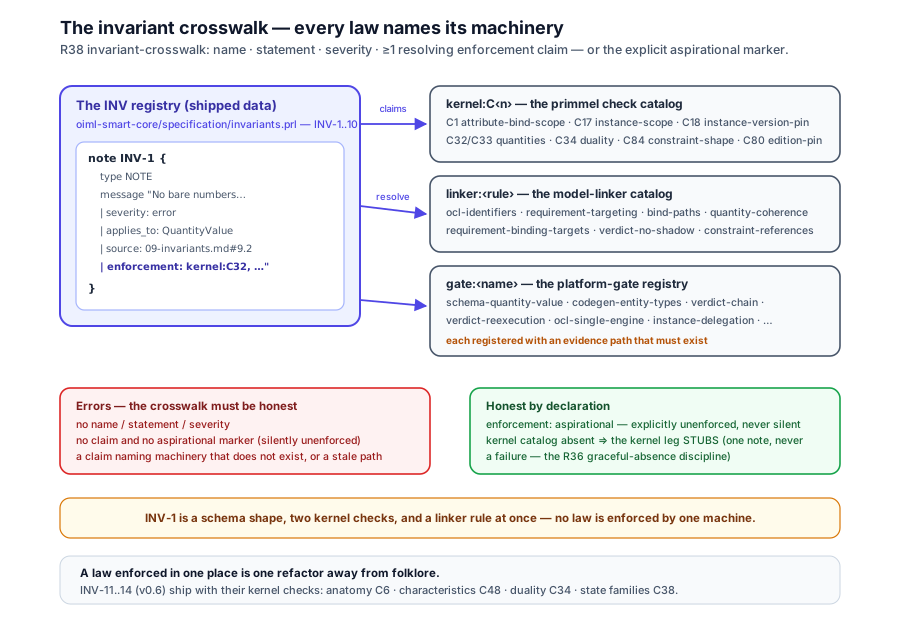
Read the table once, horizontally: no invariant is enforced by one check. INV-1 is a schema shape, a linker coherence rule, and two kernel checks at once, the law holds because four machines independently refuse its violation. That redundancy is the design: a law enforced in one place is one refactor away from folklore.
9.13 INV-11..14, the v0.6 additions ●
The metamodel v0.6 re-home (task 12) added four laws, each shipping with its named enforcing checks in the kernel catalog:
- INV-11, Anatomy families. Every aspect of a subject is declared under exactly one anatomy family: IS (identity/design, metadata, provenance, structure, design parameters, designed condition tiers, promises, artifact definitions), HAS (exhibition, attributes, dimensions, operational state, characteristics, environmental context, artifact instances), DOES (process, behaviors). A misplaced aspect silently changes meaning: an exhibited value authored as a design parameter freezes instance data into the type definition. Enforced by C6 anatomy-family (wrong-family and undeclared aspects are parse-time captures), completed by C7/C8.
- INV-12, Characteristics have one home. A characteristic, the symbol’d quantity derived from behavior I/O, is DEFINED once in instrument-description and only REFERENCED elsewhere; restated derivations drift (the R 60 MDLO defect class: one quantity computed three ways at three layers, diverging silently). Enforced by C48 characteristic-one-home (with C49/C50) and the linker VerdictQuantity discipline (verdict-inputs-resolve, verdict-no-shadow, verdict-restatement).
- INV-13, Duality coherence. A designed/exhibited dual is ONE value structure in two roles: the designed role carries tolerance, never uncertainty; the exhibited role carries uncertainty, never tolerance; both share one quantity kind with coherent units. Without it, as-found verification compares unlike quantities. Enforced by C34 duality-coherence (with C33 quantity-coherence).
- INV-14, State-family separation. The subject’s OPERATIONAL state machine (HAS, the instrument’s own modes: off/warming/ready/ measuring/fault) and the workflow LIFECYCLE machines (chapter 8’s artifact states) are disjoint families: no lifecycle transition cascades into an operational machine, no operational transition mutates workflow state. Enforced by C38 state-family-separation (with C40 anatomy-state-resolves).
Note the numbering discipline: these four are the metamodel’s canonical
INV-11..14, the earlier ○-candidate numbering of this chapter (which
had characteristics as INV-11 and duality as INV-12) is superseded by
the shipped ontology, and the registry’s source pointers follow the
sections, not the numbers.
9.14 Twin-direction candidates ○
The twin direction (Volume I, Chapter 14) adds two candidate laws the metamodel has not yet numbered, both arising the moment evidence is served rather than recorded:
- Freshness is semantics ○. Every served value carries a validity
window; a stale value degrades the verdict to
indeterminate, never a silent pass, never a metrological fail. The live-binding checks (freshness-required on live bindings, C63) already enforce the declaration half; the law itself awaits the twin program’s full adoption. - The firewall holds in streams ○. Evidence streams carry facts only; no verdict travels on the wire. INV-4 and INV-7 restated for continuous evidence: a stream record with an outcome field is the same schema defect as a TestReport that says ‘pass’.
9.15 Grammar sketch, the construct as shipped
The registry is data, declared with the package it governs; the
crosswalk grammar is kernel:C<n> | linker:<rule-name> | gate:<gate-name>
, or the single token aspirational:
note INV-3 {
  type NOTE
  message "Binding, never restating: every D1 element references
           attribute paths into instrument-description; nothing physical
           is defined in conformity-specification. | severity: error |
           applies_to: Requirement, ConformanceTest, FormSchema |
           source: docs/oiml-core/09-invariants.md#9.4 |
           enforcement: linker:ocl-identifiers, linker:requirement-targeting,
                        linker:bind-paths, linker:requirement-binding-targets"
}
The running system states INV-1..14 as normative prose (the metamodel
head), registers INV-1..10 as typed data (the core package), and
enforces them through schema + linker + kernel checks + codegen. A
fully executable check: per invariant, the invariant running its
own OCL against the model graph, remains the v3 elevation ○; the
crosswalk is what makes the registry honest today.
9.16 Validation rules
- Schema validation (
npm run validate): INV-1 (QuantityValue shape), INV-2 (no values in definitions), INV-4 (no outcome fields in reports), INV-8 (version pins required). - Model linker (static cross-reference resolution): INV-2/INV-3 (bind paths
and OCL identifiers resolve at scope-appropriate levels), INV-9 (
ocl{...}andtable:/lookupMPEtargets exist); R38 invariant-crosswalk, every registry entry carries name/statement/severity and ≥1 resolving enforcement claim (or the explicitaspirationalmarker). - Kernel checks (
primmel check, the C-catalog of Volume I chapter 11): INV-1 (C32/C33), INV-2 (C1), INV-7 (C84), INV-8 (C18/C80), INV-10 (C1/C17), INV-11 (C6–C8), INV-12 (C48–C50), INV-13 (C34), INV-14 (C38/C40). - Codegen + unit tests (
npm run build,npx vitest run): INV-2 (one generated type), INV-7 (distinct value/fact/judgment types), INV-10 (delegation over the generated graph). - Platform gates with evidence paths (the R38 gate registry): schema, codegen, service and test-suite machinery, each claim’s evidence path must exist, or the claim is stale.
9.17 Summary
- Invariants are laws about models, what may be modelled at all. Requirements judge instruments; constraints check facts; invariants keep models from rotting.
- INV-1/2/7 discipline values (no bare numbers; schema/instance split; values ≠ facts ≠ judgments); INV-3/4/5/6 are the tier firewalls (bind, never restate; no verdicts in reports; re-evaluation without re-testing; type conformity only across samples); INV-8/9/10 discipline execution (pin versions; one rule language; delegate, never copy).
- The registry is shipped data (INV-1..10, the core package’s
invariants.prl), and the R38 crosswalk makes it honest: every invariant names its enforcing machinery, kernel checks, linker rules, platform gates with evidence paths, or declares itselfaspirational. Silently unenforced is an error; a claim naming machinery that does not exist is an error. - The v0.6 re-home added INV-11..14 with their checks: anatomy families (C6), characteristics one home (C48), duality coherence (C34), state-family separation (C38).
- Every invariant has an enforcing check in schema, linker, kernel, or codegen, a law that depends on reviewer vigilance is already broken.
- The twin direction adds two un-numbered candidates ○: freshness as
semantics (stale ⇒
indeterminate, never a silent pass) and the fact/judgment firewall extended to live streams.
Next: Chapter 10, Shared modules: the seven parameterized test/form families between core and Recommendations.