

The twin-certification program (`oiml-twin-cert`)
The twin-certification program is the first kind certification_program package: the scheme that certifies a digital twin's fidelity, the claim that the twin accurately reflects the physical instrument, plus its governing document TW-1 and the surveillance regime.
What it is. The first kind certification_program package: the
scheme that certifies a digital twin’s fidelity, the claim that
the twin accurately reflects the physical instrument, plus its
governing document TW-1 (urn:oiml:pub:cs:twin-1:2027) and the
surveillance regime.
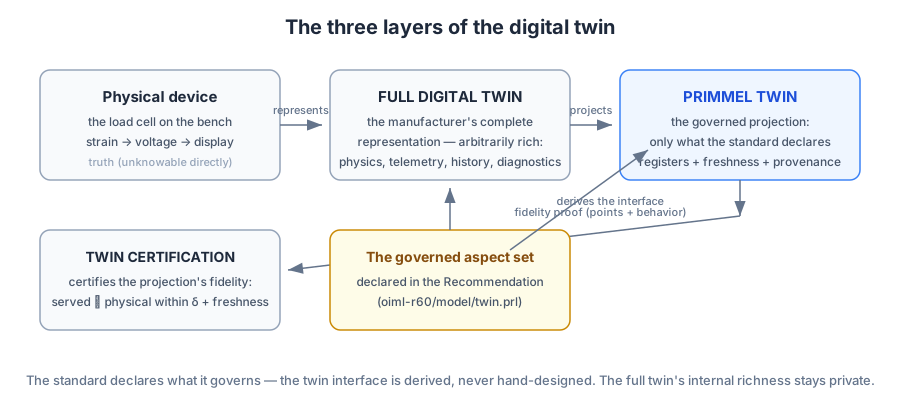
What it does. Six requirements, judged per served register:
- Static conformance (admission): the twin serves exactly the interface its certified product package declares.
- Indication band (value fidelity): |served − reference| ≤ δ at every probe point.
- Freshness and timestamp provenance: declared freshness windows, served-timestamp sources, inherited, never re-declared.
- State fidelity: the served operational state equals the physical state, a served fault truthfully reporting a fault is not infidelity; it passes and triggers service.
- Creep envelope (behavioral fidelity, the newest): the twin’s
dynamics track the physical’s, a constant-load dwell where drift
stays within the accuracy-class allowance computed from the
Recommendation’s own tables (
lookupMPE(load, class, p_lc)).
And the machinery around them:
- The probe channel closes the two-channel relation the monitor
cannot (the epistemic wall): three declared sources ,
reference_instrument(PREFERRED),observer_attestation(with the DECLARED limitation “twin ≡ display, not twin ≡ mass” riding the evidence),sim_ground_truth(acceptance only). A pairing skew beyond the window invalidates the setup, never a fail. - The verdict chain: per-probe → per-register → certification decision (all registers pass + admission + provenance + the type certificate ⇒ certify; unprovable ⇒ inconclusive, never a silent certify).
- The twin certificate: issued on the decision; validity CONDITIONAL on continuous surveillance.
- Surveillance: the fleet monitor re-judges the five continuously-judgeable requirements hourly; a fail flags the certificate (investigate ⇒ suspend ⇒ reinstate | withdraw); campaign-shaped requirements (creep) are re-judged from stored campaign snapshots (INV-5).
What it owns. The program’s normative content: TW-1, the requirements, the probe schedule, the forms (admission, probe, probe-creep), the validity policy, the monitor declaration.
How it proves it works. The acceptance suite: twin-cert-acceptance
(four scenarios against the live sim: the fault leg, the lie walk to
withdrawal, the stale-flip pin, re-certification), twin-cert-surveillance
(24 cycles + the fault-state service rule), behavior-probe (GOOD passes
inside 0.021 kg; creep-cell fails; a drifting reference invalidates),
twin-1-cite-integrity (every citation resolves, both directions).
Where it plugs in. It maps to the Recommendation (currently R 60), rides the core certificate machine (one machine, no second dialect), and consumes the twin runtime. The demo seed + console section make it visible in the app.
Peel deeper. AGENTS.d/14-twin-certification-program.md (the
complete doctrine), the TW-1 document itself
(primmel-packages/oiml-twin-cert/documents/tw-1/document.yaml).
Back to the index.