

The system map (fifteen minutes)
The platform lives in five repositories, of which smart is the system and the other four are its language, its instruments, its documentation, and its history.
The platform lives in five repositories. One of them, smart, is the
system; the other four are its language, its instruments, its
documentation, and its history.
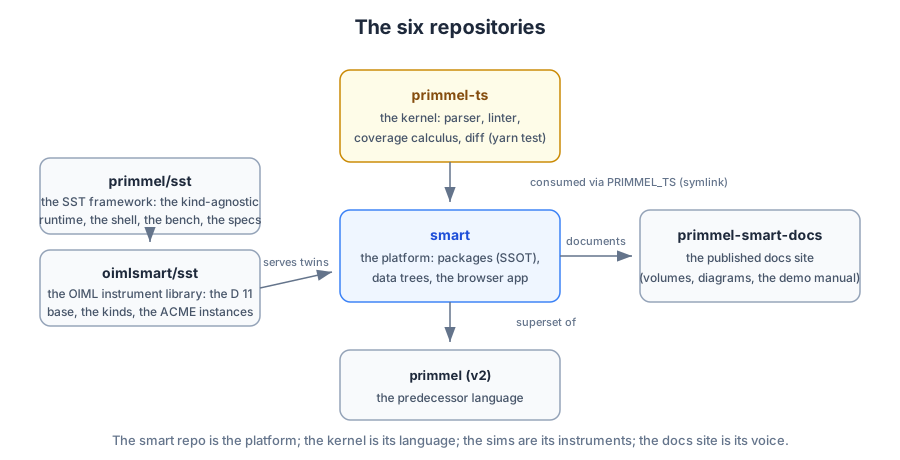
smart, the platform (this repository)
Everything the system is lives here:
primmel-packages/, the single source of truth: every Recommendation (R 60, R 91, R 129, R 144), the OIML-CS framework, the OIML-CS dataspace definition, the CASCO foundations, the core metamodel, the shared modules, the product reference packages (the fictional ACME products), and the twin-certification program. 29 packages, all.prl.data/, the generated YAML trees the app consumes. Never hand-edited; regenerated from the packages bynpm run gen:dataand proven byte-clean by the SSOT guard.browser/, the application: an Astro 7 shell with Vue 3 islands that runs the entire certification workflow in the browser , applications, laboratories, test runs, evaluations, certificates, the participant registry, the twin console, and the live monitor.scripts/, the pipelines: the.prdextractor (compiled OIML XML → clause fragments), the package builder, the validation runner.sources/, the compiled OIML source documents the extractor reads.analysis/, the working notes: audits, coverage summaries, design records (the honest record of how the models got here).AGENTS.d/+AGENTS.md, the operating manual for AI agents (and the conventions humans follow too).docs/, documents about the system, including this architecture site and thedocs/future/README.md.TODO.roadmap/,TODO.v2/,TODO.v3/, the work ledger: 63 done, 16 done, and the wave ahead.
primmel-ts, the kernel (the language)
The Primmel language toolchain: the .prl parser and serializer, the
linter (primmel check, 99+ rules), the map-profile coverage
calculus, the model diff, and the package registry tests (1062 of
them). The smart repo consumes it through a symlink (PRIMMEL_TS), so
the platform’s gates always run against the live kernel. Primmel v3 is
a strict superset of Primmel v2 (the predecessor at primmel/).
primmel/sst + oimlsmart/sst, the instruments
The Simulated SMART Measuring Instrument Twins (SSTs), in two
repositories since the pre-split sim-instruments repository was
archived (2026-08-01): primmel/sst is the framework, the
kind-agnostic runtime, the shell, the bench, and the specifications,
and oimlsmart/sst is the OIML instrument library, the D 11 base,
the kind packages (R 60, R 91, R 129, R 144, and the sampling line),
and the ACME instances including the composite. A strain-gauge load
cell (LC-500), a continuous gas monitor (CGM-200), a Doppler speed
meter (RS-180), and an optical dimensioner (MD-3xx), each serving a
governed /twin interface and a physical /world interface. They
exist so that everything in the platform that touches a twin can be
exercised, tested, and taught without hardware: the practice flows,
the probe channel, the monitor acceptance, the twin-certification
walks, and the demo.
primmel-smart-docs, the documentation site
The published volumes (Primmel kernel concepts, the OIML core, the per-Recommendation modeling guide, the demo manual) with 100+ diagrams, built with Astro and deployed to GitHub Pages. This architecture site lives in the smart repo instead, it documents the code, so it travels with the code.
primmel, the predecessor (v2)
The earlier language (MMEL v2) and its reference models. Primmel v3 is a strict superset; the v2 tree is kept for provenance.
primmel/editor, the Studio (the authoring boundary)
The authoring tool (primmel-editor): the canvas where an expert
models a Recommendation (reference model) or an organization’s own
process (implementation model, mapped onto references). The boundary
with the platform is one-way and total:
- The editor produces packages. Its output is
.prlcontent — the same SSOT the platform reads.primmel checkvalidates on the authoring side, exactly as the platform’s gates validate on the consumption side. - The platform consumes packages, never the editor. Nothing in
smartimportsprimmel-editor(verified: no dependency). The certification runtime reads the packages alone; the editor never ships to or embeds in the runtime. - The packages are the hand-off. Authoring in Studio lands in
primmel-packages/; the platform’s build discovers it there. The editor’s own development (features, UI, mappings) changes nothing in the platform until a package changes.
The public surface of this boundary today: the /studio minisite
documents the editor, and the published Recommendations are its
products. A public Studio build embeds this page when one exists;
until then the minisite says so plainly rather than faking an embed.
The data flow in one paragraph
Authors edit .prl packages in smart. npm run gen:data regenerates
the data/ trees from them through the kernel’s codecs. The app’s
build turns the trees into generated TypeScript (browser/src/data/ generated/). The app renders screens and computes verdicts from that.
The SSOT guard proves, on every gate, that packages ≡ data trees ≡
generated code, byte for byte, in both directions. Anything you see in
the app traces back to a package, and through the package’s own
source: provenance to a clause of a published OIML document.
Where to go next
Pick a component from the index, each page tells you what it is, what it owns, how it proves it works, and where it plugs in.