

Multi-standard projection
One implementation model, composed from several Primmel models, is read through several reference standards, each an independent lens with its own coverage and its own verdicts.
What it is. One implementation model, a tailor-designed model of a real device, composed from several Primmel models, read through several reference standards, each an independent lens with its own coverage and its own verdicts. The auditor always views through a single standard (or an approved set), never a merged claim.
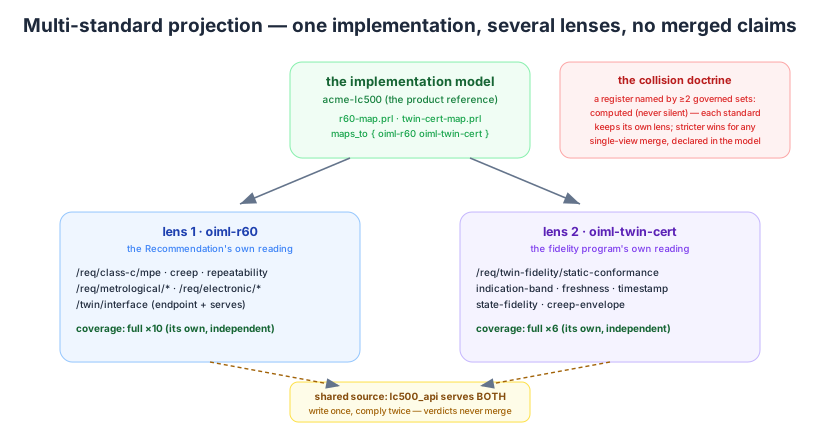
The worked example ships in the repo: the Steelyard LC-500 is governed
by TWO standards, OIML R 60 (the instrument Recommendation) and the
twin-fidelity certification program (oiml-twin-cert). Its package
carries two map_profiles (model/r60-map.prl, model/twin-cert-map.prl)
and its manifest declares maps_to { oiml-r60 oiml-twin-cert }.
The four pieces.
-
The worked implementation model. Each projection is explicit: the product’s twin surface maps node-to-node to each standard’s requirement set (the twin-cert map covers all six
/req/twin-fidelity/*requirements, endpoint → static-conformance, indication → indication-band, serves’ freshness/timestamp facets, state watch → state-fidelity, creep behavior → creep-envelope). The chain rule derives the multi-standard reality for free: a consumer’s live indication flows compliance to BOTH standards. -
The auditor lenses (
/app/lenses). The same implementation reads through each reference, the twin-cert lens (six requirements, full) side by side with the R 60 lens (ten, full), the composed fold’s per-standard summaries, and the shared source honestly visible: the endpoint serves BOTH standards (“write once, comply twice”, with both fulfilments shown, never collapsed). The union view says plainly: N separate standards, never one merged claim. -
The collision doctrine (
browser/src/lenses/collisions.ts). A register named by two governed sets is COMPUTED, never silent. Today the LC-500’s two standards govern disjoint registers, the detector proves it. If a future standard names a register another already serves: each standard keeps its own lens and verdicts; for any single-view merge the stricter limit wins unless the standards’ own provisions say otherwise, and that resolution must be declared in the implementation model (see the twin-cert map’s doctrine block), never assumed by the platform. -
The integrated reference (
primmel-packages/oiml-integrated-ref). The shared verification/traceability processes authored ONCE:probe_pairing(served ⇄ reference admitted within the declared window; an out-of-window pair is INADMISSIBLE, INVALID, never a fail) andreference_traceability_gate(the U:MPE ≤ 1:3 reference-quality rule). It iskind module, composed fromoiml-r60@2021andoiml-twin-cert@2027, an authoring convenience that DRYs the shared processes, never a verdict-merging device.
How it proves it works. The lens pins (lenses-page.test.ts: the
twin-cert lens’s six requirements at full, the fold’s side-by-side
summaries, the shared endpoint), the collision pins
(lens-collisions.test.ts: disjoint-today + the synthetic shared
case), the chain-rule pin (the quarry consumer’s indication chain
resolves into twin-fidelity/indication-band), the mutation proofs
(dropping BOTH projections uncovers the creep characteristic), and the
linters: primmel check 0 errors on all 29 packages, ssot byte-clean.
Where it plugs in. The view/lens runtime (TODO.v2/02–03) supplies
the projection machinery; the twin-cert program supplies the second
standard; the integrated reference is consumed by future probe/test
authoring (the program’s probe schedule reusing probe_pairing is the
named follow-up).
Peel deeper. AGENTS.d/12-twin-integration.md (the twin runtime
doctrine), AGENTS.d/14-twin-certification-program.md, and the
packages themselves, acme-lc500/model/{r60-map,twin-cert-map}.prl,
oiml-integrated-ref/.
Back to the index.