

The OIML-CS flow, end to end
The complete OIML-CS certification flow runs as one executable chain, from application and sample handling through test runs, evaluation, CNML-signed issuance, and BIML registration, in both the shared-platform and IA-operated deployment modes.
What it is. The complete OIML-CS certification flow as one executable chain: application → sample request → shipment → registration → review and acceptance → dispatch → test runs → test reports → evaluation (per-run marks, per-form determinations, per-model synthesis) → issuance (CNML-signed) → BIML registration, and both deployment modes (the shared platform, and the IA-operated instance that submits to the BIML by package or by API).
Every step is a model in the packages, every transition a declared state machine, every actor a role with its own console. The chain is drivable end to end, the e2e suite walks it, from the wizard to the public register, against the simulated instrument.
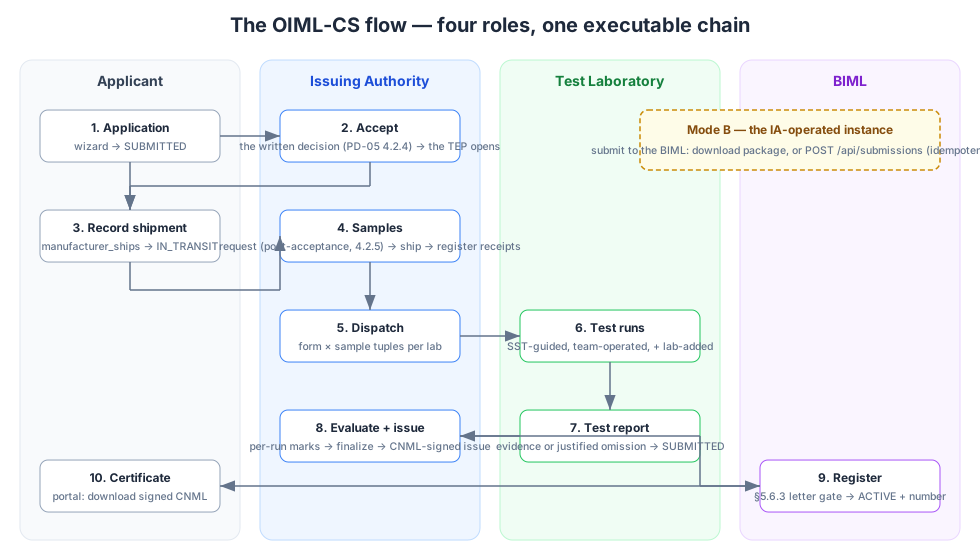
The cast
| Role | Console | Acts |
|---|---|---|
| Applicant (manufacturer) | /app/portal |
submits the application, ships the requested samples, tracks progress, downloads the certificate |
| Test laboratory (TL) | /app/lab |
accepts test requests, registers received samples, runs tests (guided by the SST), completes and issues test reports |
| Issuing Authority (IA) | /app/ia |
reviews, requests samples, registers receipt, dispatches test work, evaluates per run and per form, finalizes, issues |
| BIML | /app/cs/registration |
registers certificates (the public register’s operator side) |
The scheme’s organs (Executive Secretary, MC/RC, the participant registry) are their own chapter, the PD-08 Declaration signing gate discharges there, and the flow here consumes it (no issuance without a signed Declaration).
The chain, stage by stage
1. Application. The portal wizard builds the application with its
subject chain (family → groups → models) and the declared samples.
Status: SUBMITTED. The IA’s review actions stay gated, no decision
before the samples exist.
2. Sample request (PD-05 §4.3). The IA issues the request:
models × count, the routing (to_ia or to_each_tl), the receiving
laboratories, particulars. Stub samples spawn in REQUESTED (serials
PENDING-* until registration); the request persists on the
Application (sample_request); the machine walks
SUBMITTED → SAMPLES_REQUESTED. The applicant’s portal shows the
request card.
3. Shipment. The applicant records it: every requested stub hops
manufacturer_ships → IN_TRANSIT with a SHIPPED custody event
(from the manufacturer to the IA or the named laboratories).
4. Registration on receipt. Whoever receives, the IA or a TL ,
registers each sample: the real serial replaces the stub’s, condition,
markings, the custody RECEIVED event. The IA then dispatches samples
onward (ia_dispatches_to_lab) and, when every requested sample was
received at least once (wasReceivedOnce, an onward dispatch does
not un-register), logs ia_logs_samples → SAMPLES_RECEIVED. Only
now do the decision actions open. Registered samples, never stubs ,
are selectable for dispatch.
5. Dispatch. The dispatch builder assigns (form × sample) tuples to laboratories (the capability-ranked suggestion; multi-lab splits per form and per model). Each laboratory receives a TestRequest.
6. Test runs. The TL accepts, starts testing, and opens each
assignment’s run. Runs are team-operated (operators[], per-entry
signed_by_account) and may be SST-guided: the stepper walks the
test’s declared procedure against the simulated instrument, driving
/world one step at a time, recording /twin-served readings as real
evidence with sim_served_at in the conditions log. The epistemic
wall holds: verdicts consult /twin and the evidence service only.
The TL may also add tests of its own initiative (origin: lab_added
, flagged, never merged silently).
7. Test report. Drafted once testing starts (it accumulates form
instances as runs complete); every required form is either evidenced
or omitted with justification; then issued (SUBMITTED).
8. Evaluation. The IA marks every run Evaluated (approve/reject, the rejection with its mandatory reason), decides each TR’s admissibility, and reviews the per-form determinations; the aggregator rolls all three levels up, a rejected run’s form instance leaves the pass basis (recorded, never dropped), and finalization requires every run marked, every TR determined, every model complete.
9. Issuance (CNML-signed). On issue the certificate signs as CNML
(project → validate against the per-rec schema → serialize → XMLDSig
with the X.509 in KeyInfo, the officer’s browser key) and walks
DRAFT → PENDING_REGISTRATION. Unsigned issuance stays DRAFT,
honestly.
10. Registration. The §5.6.3 ANR validation letter gates Scheme-A
registration; then the BIML console (or the IA’s register action)
registers: the number derives, the certificate walks ACTIVE, the
registered copy joins the BIML’s validity source. The applicant’s
portal shows the certificate with the signed-CNML download; the
public register lists it.
The entity graph
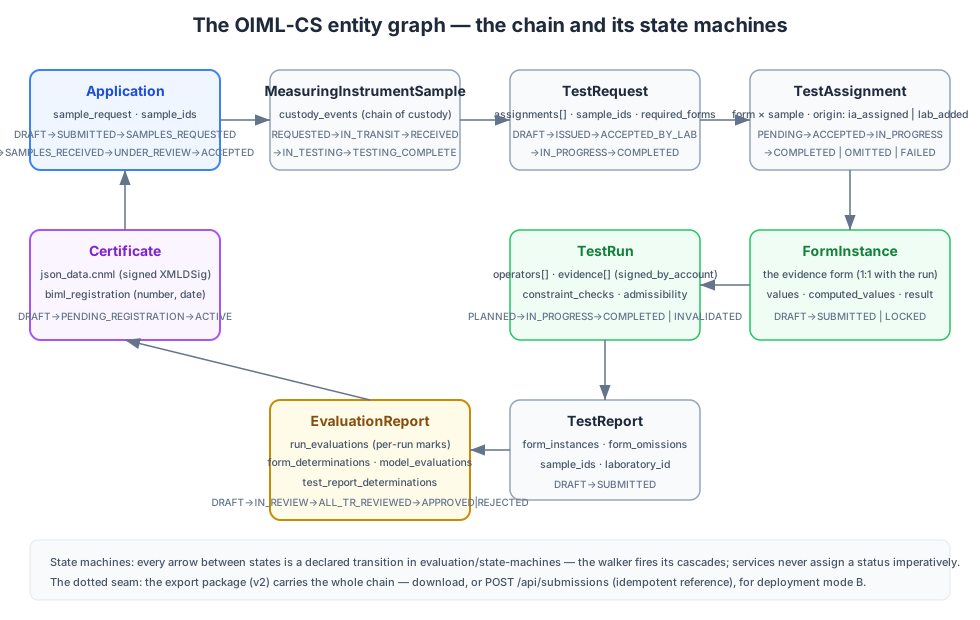
The spine: Application → (sample_request, samples) → TestRequests → TestAssignments → TestRuns → FormInstances → TestReports → EvaluationReport (run_evaluations, form_determinations, model_evaluations) → Certificate (cnml record) → BimlRegistration. Every entity class is authored in the Primmel packages and composed into every Recommendation’s data model, the layering gate proves the composition semantics-preserving (the D-series deltas).
The two deployment modes
- Mode A, the shared platform. BIML-operated: applicant, TLs, IAs, and the BIML all work on one instance. Everything above is in-process.
- Mode B, the IA-operated instance. The IA runs its own instance;
“Submit to the BIML” delivers the finalized chain as the v2 export
package: the download fallback (email workflow) or
POST /api/submissions(schema + signature + idempotency validated; a repeat POST returns the same registration reference, never a duplicate). The import side rides the package machinery with its FK-integrity report.
How to prove it works
- The chain e2e specs, one per wave:
sample-request.e2e.ts(G2/G3),operator-team.e2e.ts(G4),add-test.e2e.ts(G5),guided-run.e2e.ts(G6, against the booted sst-runtime),run-marks.e2e.ts(G7),cnml-issue.e2e.ts(G8),biml-portal.e2e.ts(G9),submission.e2e.ts(G10). - The service-level suites:
sample-request.test.ts,test-run.service.test.ts,evaluation-synthesis.test.ts,run-evaluation.test.ts,cnml-bridge.test.ts,submissions.test.ts,export-chain.test.ts. - The layering gate’s deltas D44–D48 pin every model addition with its facets.
Where it plugs in
- The workflow engine:
docs/architecture/09-the-workflow-chain.md(the scheme frame; this chapter is the executable reality). - The CNML bridge:
docs/architecture/16-the-cnml-bridge.md. - The simulated instruments: chapter 07
and the interaction contract
12-the-sst-interaction-contract.md. - The export package: the validator in
browser/src/services/export-schema.ts(shared with the submissions route).