

The Documents Corpus
The per-document module convention; what PD-01…PD-09, CID-01, OD-01/02 contribute.
In this chapter: the twelve governing documents of the OIML-CS, eleven of them as per-document modules (PD-05 is chapter 4’s), the module convention (provisions + pipeline + optional annex), what each PD/CID/OD contributes, and the clause-anchor discipline that keeps the corpus honest.
3.1 Why a corpus, not a document
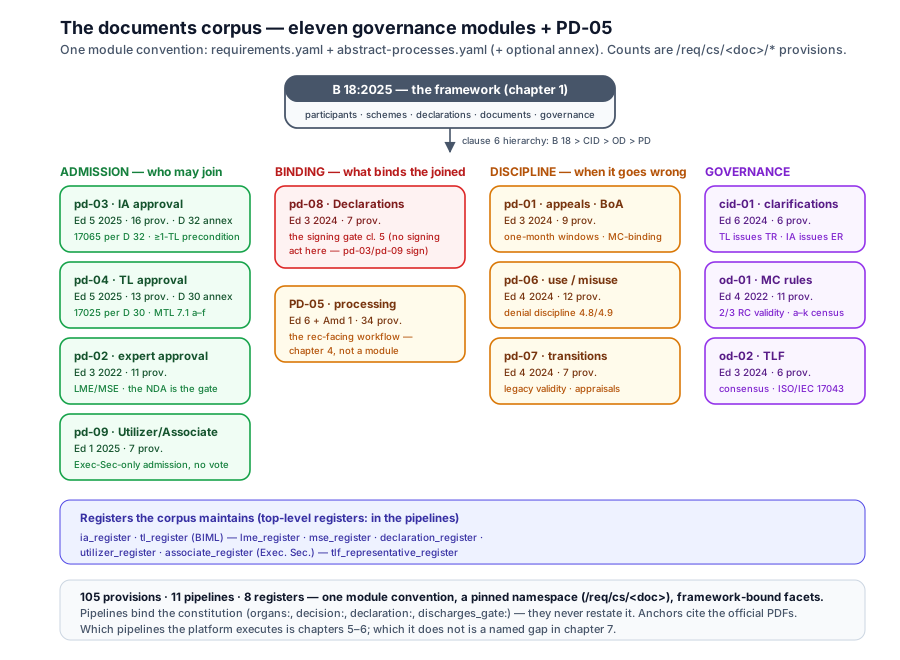
PD-05 is the document everyone knows, it is the one the certification workflow executes. But the system is governed by twelve: B 18’s clause 6 hierarchy names the tiers (B 18 > CID-01 > OD > PD > guidance), and the procedures split into families that answer different questions:
- Who may join? PD-03 (Issuing Authorities), PD-04 (Test Laboratories), PD-02 (experts), PD-09 (Utilizers and Associates) , the admission documents, each an approval pipeline ending in a Declaration or a register.
- What binds the joined? PD-08, the Declarations themselves: their obligation, content, and the signing gate of chapter 1.
- What happens when it goes wrong? PD-01 (appeals, complaints, disputes, the Board of Appeal), PD-06 (use and misuse of certificates), PD-07 (transitions from the legacy systems).
- How do the organs run? OD-01 (the Management Committee’s operational rules), OD-02 (the Test Laboratories Forum), CID-01 (the standing clarifications).
Modelling only PD-05 would leave the scheme without its admission,
discipline and governance content, precisely the content a PD-03/PD-04
assessment asks for. So the package carries a per-document module
for each: data/oiml-cs/documents/<doc>/.
3.2 The module convention
One fixed layout, eleven times:
data/oiml-cs/documents/<doc>/
  requirements.yaml        — provisions /req/cs/<doc>/* (rc.yaml shape)
  abstract-processes.yaml  — the document's pipeline as abstract processes
  annex-<guide>.yaml       — optional informative application guide
Three rules make the convention load-bearing:
- The namespace is pinned. The package owns
/req/cs; each module owns exactly/req/cs/<doc>. Composition enforces both directions (assertNoLayerOwnedRequirementScopes, a rec declaring at or under the scheme’s scopes throws;documentNamespaceViolations, a module straying into a sibling’s scope, or restating the layer root, throws). One ownership, one segregation, mechanical. - Pipelines bind the framework, never restate it. The
abstract-process schema carries the framework-facing facets:
organs:/participant_kinds:(who acts, chapter 1’s registry),decision: {rule, clause}(under which governance rule, the MC 80 % vote),declaration: {kind, action: sign|update}(which Declaration act the step performs),discharges_gate:(wiring the signing gate as the pipeline’s terminal invariant), and top-levelregisters:(the lists the document maintains). Linker rule R26 resolves every binding; the pipelines join the shared process checks (R18/R19/R23/R24) like any abstract process. - Annexes stay informative. D 30 (17025 application guidance) and
D 32 (17065 application guidance) ride as
annex-*.yamlwith their own schema,applies_toreferences the CASCO package, each guidance item naming its discharge. They guide assessments; they are never normative content.
What a module is for decides whether it exists: a document whose
content is scheme governance (who may issue/test/assess/join) gets
a module. PD-05’s rec-facing certification workflow does not, it stays
in the package’s own specification/requirements/cs.yaml +
evaluation/abstract-processes.yaml, and chapter 4 is its story.
3.3 The admission documents
PD-03, IA approval (Ed 5, 2025; 16 provisions; D 32 annex).
Competence is ISO/IEC 17065 applied per D 32, delegated, never
restated (competence-basis, 4.3). An IA application requires at
least one associated TL application (4.1, an invariant on the
pipeline’s first step). Two demonstration paths: accreditation (IAF
MLA + an MC-approved LME, 5.2.2) or peer assessment (MSE-led team, the
applicant arranges and bears the cost, 5.2.3). The pipeline runs
ia_application → ia_assessment → ia_rc_review → ia_mc_decision → ia_declaration_signing → ia_list_publication; the decision binds the
framework’s 80 % rule; the terminal ia_declaration_signing carries
declaration: {kind: issuing_authority_declaration, action: sign} +
discharges_gate: declaration-signed-before-issuance. Off-sequence:
Scheme-B self-declaration (6.1), periodic review (clause 10, annual
summary, 4-yearly reassessment, LME participation), suspension,
scope change, withdrawal. Register: ia_register (maintainer: the
BIML).
PD-04, TL approval (Ed 5, 2025; 13 provisions; D 30 annex).
Competence is ISO/IEC 17025 per D 30 (4.3). A TL applies endorsed by
an IA, in conjunction with the IA’s application (5.1); the three TL
kinds are referenced from the framework registry. The pipeline
mirrors PD-03’s but ends differently: ia_declaration_update ,
the TL is registered on the IA’s Declaration (TLs sign none), then
tl_list_publication. The MTL gets the controlled-supervision
model (7.1 a–f): documented instructions, the EUT-failure procedure,
start/finish notification, witness visits, spot-check re-tests, no
subcontracting, the safeguards chapter 6’s Scheme-A runtime enforces.
The TL’s periodic review rides on the IA’s cycle (PD-03 clause 10
covers “IAs and their associated Test Laboratories”, modelled once,
MECE).
PD-02, expert approval (Ed 3, 2022; 11 provisions). The scheme’s
assessors: Legal Metrology Experts and Management System Experts.
Competence criteria are delegated to OD-01 13.2.1/13.2.2 (pinned,
landed in the od-01 module). Nomination (7.1/7.2) → RC review → MC
decision (an “other proposal”, not the 80 % class) → the BIML
non-disclosure agreement (8.2) → publication on the ILAC-IAF-OIML
lists. The expert gate is the NDA, not a Declaration, the
pipeline carries no declaration: facet. Registers: lme_register,
mse_register (maintainer: the Executive Secretary).
PD-09, Utilizer/Associate admission (Ed 1, 2025; 7 provisions).
Two parallel tracks, no assessment and no RC/MC vote, the Executive
Secretary reviews, the participant signs its Declaration, the list is
updated. The Utilizer application captures what chapter 6 consumes:
additional national requirements, accepted IA/TL lists, the MTL
policy, all stated in the Declaration. Registers: utilizer_register,
associate_register.
PD-08, the Declarations register (Ed 3, 2024; 7 provisions). The
participation register itself: every IA/Utilizer/Associate signs
(cl. 4); the signing gate (cl. 5) plus its 5.2 proviso (evaluation and
testing before signature only after a positive, unconditional RC
recommendation, issuance always waits for the signature); MAA
acceptance conditions SHALL be
detailed, MTL acceptance is voluntary (cl. 6). The MECE split is
proven by test: the Declaration kinds live in
framework/declarations.yaml, the signing acts live in the
admitting pipelines (pd-03, pd-09), and pd-08 carries no
discharges_gate, it owns the register (declaration_register,
maintainer: the Executive Secretary) and the maintenance discipline.
3.4 The discipline documents
PD-01, appeals, complaints, disputes (Ed 3, 2024; 9 provisions).
The BoA: CIML-appointed Chair + 4, MC members barred, own-country bar
(4.1/4.2). Three complaint kinds (clause 6): incorrect technical
conclusions (substantiated ⇒ Executive Secretary investigates; upheld
⇒ the certificate is deregistered and the IA corrects the report),
non-acceptance (the MC may amend scopes), dissatisfaction. Disputes
escalate CIML-Member mediation → written explanation → BoA (clause 7).
Appeals (clauses 8–9): the applicant must first exhaust the IA’s own
procedure (8.1), then one month to lodge; the BoA circulates
information at least one month before considering; a written decision
within one month; the ruling binds the MC and cannot be appealed
further. The three one-month windows are structured windows:
facets on the pipeline, model content the operations runtime enforces
(chapter 6), never restated durations in TypeScript.
PD-06, use and misuse (Ed 4, 2024; 12 provisions). What a certificate is for (4.2: national type-approval support with type-identity evidence, initial-verification support, buyer information) and what it is not (4.1: no legal international approval; 4.4: not proof an individual instrument conforms, and no OIML logo on instruments, B 20 delegated). The denial discipline chapter 6 executes: non-acceptance requires consultation and a written justification addressed to the IA + the manufacturer + the Executive Secretary (4.8), except MTL-grounded denials, which are voluntary and justification-free (4.9). Misuse (clause 5): warning ⇒ corrective action ⇒ deregistration with the OIML Bulletin and website notice. Anchor note: the local corpus audit had 4.8/4.9 off by one; the module cites the official PDF and records the correction in its header.
PD-07, transitions (Ed 4, 2024; 7 provisions). Legacy Basic and MAA certificates remain valid (clause 4, B 18 §15.10/§15.11); since 2018 no new or revised legacy certificates, and “Annex” changes only for error correction or ownership transfer, never characteristics. Previous test data enters the OIML-CS through documented appraisals: Scheme B (5.2/5.3), MAA into Scheme A (6.1), Basic into Scheme A (6.2 with the 6.2.3 appraisal census), and the Scheme-B→A transition rules (7.1/7.2).
3.5 The governance documents
CID-01, clarifications (Ed 6, 2024; 6 provisions). The standing
interpretations as invariants: an OIML test report is issued by an
OIML Test Laboratory regardless of a Recommendation’s structure, and
the evaluation report by the Issuing Authority (3.1, B 18:2025
3.40 Note 3); an IA’s scope must be TL-supported “at all times” (3.3);
clarifications guide, never supersede (2.2, obligation: statement).
Cross-corpus consistency is proven by test: the PD-05 process model’s
testing step is roles: [test_laboratory], its evaluation/issue
steps roles: [issuing_authority].
OD-01, MC operational rules (Ed 4, 2022; 11 provisions). The
committee machinery: composition (≤ 4 representatives per Member
State, one voting), RC recommendation discipline incl. the
assessed-member bar (5.6, modelled as two segregation: entries
pairing the RC against the PD-03/PD-04 assessment processes), the
two-thirds RC recommendation validity (7.9), the annual report’s
a–k content census (8.2), scheme monitoring (12.1/12.2), the expert
competence criteria (13.2.1/13.2.2, the target of PD-02’s pinned
delegation) and the 3-yearly expert-list review (13.4).
OD-02, the TLF (Ed 3, 2024; 6 provisions). One representative per
TL per category (4.2); inter-laboratory comparisons encouraged per
ISO/IEC 17043 (5.1, the provenance of PD-04 5.1 i)); consensus, else
referral to the MC or the TC/SC (6.4). Register:
tlf_representative_register.
3.6 The corpus at a glance
| Module | Edition | Provisions | Pipeline (main chain) | Registers |
|---|---|---|---|---|
| pd-01 | Ed 3, 2024 | 9 | appeal_to_boa → boa_adjudication | , |
| pd-02 | Ed 3, 2022 | 11 | nomination → RC → MC → NDA → publication | lme, mse |
| pd-03 | Ed 5, 2025 | 16 | application → assessment → RC → MC → signing → publication | ia |
| pd-04 | Ed 5, 2025 | 13 | application → assessment → RC → MC → Declaration update → publication | tl |
| pd-06 | Ed 4, 2024 | 12 | post-issuance flows (no sequence) | , |
| pd-07 | Ed 4, 2024 | 7 | legacy maintenance, previous-data acceptance | , |
| pd-08 | Ed 3, 2024 | 7 | recording, maintenance | declaration |
| pd-09 | Ed 1, 2025 | 7 | application → Declaration signing (×2 tracks) | utilizer, associate |
| cid-01 | Ed 6, 2024 | 6 | cross-cutting identity pins | , |
| od-01 | Ed 4, 2022 | 11 | RC governance, annual reporting, expert lists | , |
| od-02 | Ed 3, 2024 | 6 | representation, comparisons, recommendations | tlf |
105 provisions, 11 module pipelines (pd-09’s carries two admission
tracks), 8 registers, all schema-valid, all composing into every
rec’s effective tree with provenance ['oiml-cs'], all link-checked
(R26). Which pipelines the platform executes is
chapters 5–6; which it does not is a named gap in chapter 7’s report ,
the model is complete even where the runtime is honest.
3.7 The clause-anchor discipline
A model of a corpus lives or dies by its references. The rule:
official published numbering only. Where the official PDF exists
locally (B 18:2025, PD-05 Ed 6 + Amd 1, PD-06 Ed 4, CID-01 Ed 6), every
anchor was verified against it with pdftotext. The local presentation
XMLs are numbered official−1 (their builds drop the front matter) and
are used for text only, never cited. Where no PDF exists locally,
anchors follow the corpus audit’s granularity, confirmed by the XMLs’
surviving internal cross-references, and the module headers say so ,
with the reconciliation queued as follow-up work (task 46). Two
source-level discrepancies are recorded rather than “fixed”, and since
task 54 they are first-class records, not header prose (● smart
8651182; the kernel construct is Volume I, chapter 9’s
discrepancy_record). Authored in
primmel-packages/oiml-cs/specification/discrepancies.prl (regenerated
to data/oiml-cs/specification/discrepancies.yaml), the corpus’s three
live records are the task-46 settlements:
pd-02-vs-od-01-expert-review-cycle, PD-02, 11.1’s four-year expert review vs OD-01, 13.4’s 3-yearly: a genuine source disagreement, both official texts verified verbatim against the published PDFs.resolution: annotated_only, neither governs; both modules keep their own clause’s cycle and both headers record both texts; a CID-01 clarification candidate for the real scheme.d-32-g711-4-numbering-gap, the official printed D 32:2018 itself skips G.7.1.1-4 (an editorial gap in the source, not a local conversion drop).resolution: follows_clause_x, governingurn:oiml:pub:d:32:2018, the corpus cites the official body numbering; no G.7.1.1-4 citation exists or may be added.od-01-toc-vs-body-numbering, OD-01’s own printed Contents skips 7.2, so every TOC entry from 7.2 on reads body−1.resolution: follows_clause_x, governing the body’surn:oiml:pub:cs:od-01:2022#clause-7.2, the body numbering that every internal cross-reference uses wins.
(PD-06’s 4.8/4.9 stays a module-header correction: the audit’s
reconstruction was off by one and the PDF wins, a citation fix, not a
source-vs-source conflict.) Two registry extensions ride the records:
linker rule R33 discrepancy-references (every cited URN resolves;
the resolved / follows-clause-x / annotated-only / open discipline of
Volume I, chapter 9), and the URN grammar itself, the cs doctype
with its series-letter cs-pub-number form (pd-02, od-01,
cid-01) and the bare #contents front-matter element are registered
in data/oiml-urn-specification.adoc (mirrored in
browser/src/data/urn.ts), so CS documents are cited by URN, never by
bare label. Honest anchors beat confident ones, and now the honesty is
machine-checked.
3.8 Grammar sketch (illustrative v3 syntax)
# ── one document module ─────────────────────────────────────
package oiml-cs {
  documents {
    document pd-03 {                       # IA approval, Ed 5 (2025)
      provision /req/cs/pd-03/competence-basis {
        reference "PD-03, 4.3"
        statement "Competence per ISO/IEC 17065:2012, applied per OIML D 32"
        # delegated — no 17065 text here
      }
      process ia_declaration_signing {
        activity_kind [declaration]
        organs [executive_secretary]
        declaration { kind issuing_authority_declaration, action sign }
        discharges_gate declaration_signed_before_issuance
      }
      register ia_register { maintainer biml }
      annex d032 {
        role informative
        applies_to iso-iec-17065            # reference, never restatement
      }
    }
  }
}
3.9 Validation rules
- every module file validates against its schema (requirements → rc; pipelines → the extended abstract-process schema; annexes → the document-annex schema);
- namespace ownership and segregation: a rec declaring at/under
/req/csthrows; a module declaring outside/req/cs/<doc>throws; - every pipeline binding resolves (R26): organs, participant kinds,
decision:rules againstframework/governance.yaml,declaration:kinds and the gate againstframework/declarations.yaml, register maintainers, sequence ids; - MECE: no module declares framework keys (
participants:/governance:/declarations:/schemes:) or ISO scopes (/req/iso-*); an annex’sapplies_toreferences a CASCO package and staysinformative; - clause anchors follow the official numbering where PDF-verified, the audit’s granularity otherwise, the header records which.
3.10 Summary
- The scheme is governed by twelve documents; PD-05 is one of them. The eleven governance documents get per-document modules, provisions, a pipeline, an optional annex, under a pinned namespace.
- Pipelines bind the framework through facets (
organs:,decision:,declaration:,discharges_gate:), they never restate it; the signing gate is the admission pipelines’ terminal invariant. - The corpus splits into admission (PD-03/04/02/09), the binding register (PD-08), discipline (PD-01/06/07), and governance (CID-01, OD-01/02).
- Anchors cite official numbering; unverifiable granularity is
disclosed in module headers, and source discrepancies are first-class
discrepancy_records checked by R33, recorded, never silently reconciled.
Next: Chapter 4, The certification workflow:
PD-05 as abstract processes plus 34 provisions, bound by realized_by
to the concrete Core processes.