

Measurement Vocabulary
Module A: QuantityKind, Unit, QuantityValue, uncertainty, Measurand, InfluenceQuantity, Conditions, MeasurementResult, TraceabilityChain.
In this chapter: Module A, the shared value layer of the metamodel. QuantityKind and Unit, the QuantityValue workhorse (INV-1), GUM uncertainty, measurands and influence quantities, the four condition roles, and what a complete measurement result is made of.
1.1 The shared value layer
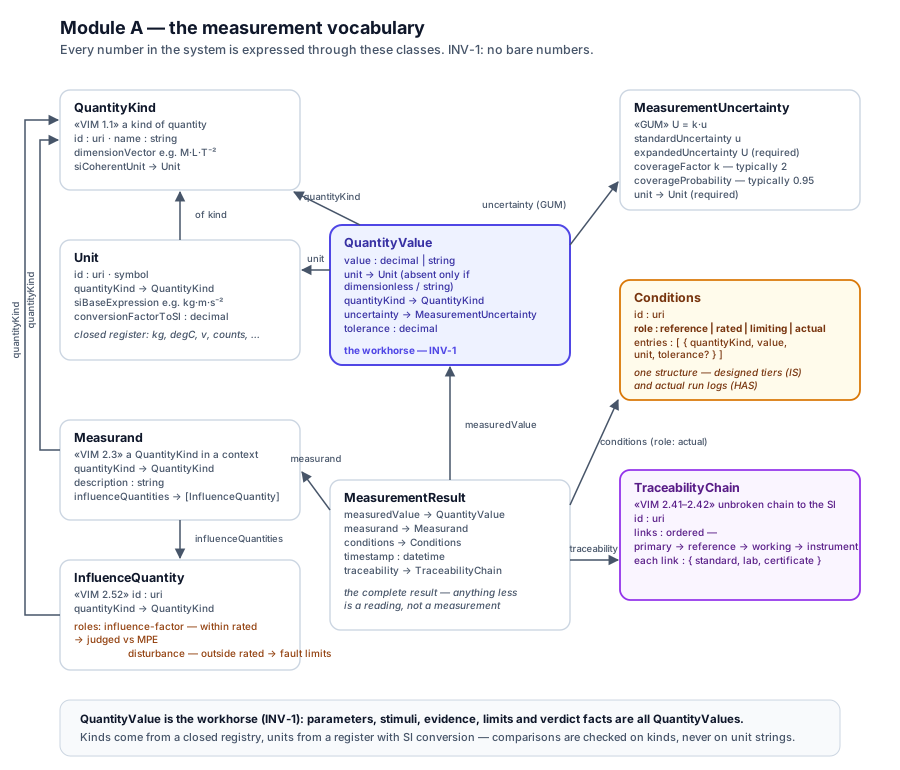
Every module of the metamodel deals in numbers: design parameters, test
stimuli, evidence values, limits, verdict facts. Module A exists so that
every number anywhere in the system is expressed through the same nine
classes (oiml-core-ontology.yaml, measurement-vocabulary: “Shared
value layer”). It is the only module that depends on nothing, the
value layer cannot afford imports, because everything imports it.
Module A is the OIML realization of the kernel’s data-and-value primitives (Volume I, Chapter 6), and it is deliberately conservative: every class is anchored to an international authority, the VIM for quantity concepts, the GUM for uncertainty, the SI for units. A metrology-specific model invented none of them; it typed them.
| Class | Authority | Status |
|---|---|---|
| QuantityKind, Unit | VIM 1.1; SI | ● |
| MeasurementUncertainty | GUM | ● schema · ◐ runtime adoption |
| QuantityValue | , | ● |
| Measurand, InfluenceQuantity | VIM 2.3, 2.52 | ● |
| Conditions (ConditionRole) | VIM reference/rated/limiting + actual |
● |
| MeasurementResult, TraceabilityChain | VIM 2.9, 2.42 | ● schema · ◐ runtime (per-equipment certificates) |
1.2 QuantityKind and Unit
A QuantityKind is “a kind of quantity that can be measured” (VIM
1.1): mass, force, temperature, humidity. It carries an optional
dimensionVector (e.g. M·L·T⁻² for force) and an optional reference to
its SI coherent unit. Kinds come from a closed registry
(data/schemas/quantity-kinds.yaml, mirrored into the engine), not from
free text, because the linker checks comparison coherence on kinds,
not on unit strings: an OCL expression comparing mass to temperature
is a static error, wherever it appears.
A Unit is a unit of measure with an explicit path to the SI:
- { id: kg,   label: "kilogram", symbol: kg, quantity: mass }
- { id: degC, label: "degree Celsius", symbol: "°C", quantity: temperature }
- { id: v, label: "verification interval", symbol: v, quantity: "load cell verification" }(data/r60/value-types.yaml, unit register.) The metamodel fields are
symbol, quantityKind (required reference), siBaseExpression (e.g.
kg·m·s⁻²) and a required conversionFactorToSI, so any two values of
the same kind are commensurable by arithmetic, not by convention. Two
rules from the R 60 build are worth internalizing:
- Units are registered before use. Authoring checklist item 11:
“Register new units in
value-types.yamlbefore using them”, the validator rejects unregistered unit ids. - Unit slots take unit ids only.
v_min(an attribute) was once misused as a unit on eight form fields; the fix established the rule that unit positions hold register ids (v,counts,degC), never attribute ids.
1.3 QuantityValue, the workhorse
QuantityValue:
  value:        decimal | string      # required
  unit:         ref Unit              # absent only for dimensionless/string values
  quantityKind: ref QuantityKind      # kind of the quantity
  uncertainty:  ref MeasurementUncertainty
  tolerance:    decimal
This is INV-1 made flesh: no bare numbers, every physical quantity
is a QuantityValue (value + unit, optionally + uncertainty + tolerance).
Attribute values live in map<attribute_id, QuantityValue> maps
(model.parameters.e_max, sample.test_context.d_max), never in
dedicated entity fields and never as raw scalars.
Three design notes:
unitis optional on purpose, but only for dimensionless and string values. A mass without a unit is a schema violation; a string designation with a unit is one too.quantityKindtravels with the value so that coherence checking does not depend on the unit string (§1.2):500 kgand0.5 tare the same kind and comparable;500 kgand500 degCare not.toleranceis a first-class field, not a footnote, condition entries (§1.6) are where it earns its keep:20 °C ± 2is one value, not two.
R 60 example, the model-scope design parameter E_max
(data/r60/model/attributes.yaml, e_max, quantity_kind: mass,
unit: kg): valued on a Model as model.parameters.e_max = { value: 500, unit: kg, quantityKind: mass }.
1.4 MeasurementUncertainty, the GUM fields
MeasurementUncertainty:
  standardUncertainty:  decimal   # u
  expandedUncertainty:  decimal   # U — required
  coverageFactor:       decimal   # k, typically 2 — required
  coverageProbability:  decimal   # typically 0.95
  unit:                 ref Unit  # required
The shape follows the GUM (OIML G 1-100): an expanded uncertainty U
is mandatory and is what a QuantityValue carries; the standard
uncertainty u, the coverage factor k (U = k·u, typically k = 2) and
the coverage probability (typically 0.95) complete the statement. The
unit is required on the uncertainty itself, an uncertainty is a
quantity, so INV-1 applies to it recursively.
Status honesty: the class is ● as schema; its systematic runtime adoption
(uncertainty carried on every evidence value, uncertainty-considered
flags on verdicts) is ◐, the uncertainty machinery that exists today is
the decision-rule side (guarded acceptance bands, uncertaintyConsidered
on Verdict), developed in Chapters 6–7.
1.5 Measurand and InfluenceQuantity
A Measurand is “the quantity intended to be measured” (VIM 2.3) ,
modelled not as a bare kind but as a QuantityKind in a specific
context: quantityKind + description + the list of influence
quantities that bear on it. For R 60 the measurand is force applied to
the cell, expressed in units of mass (measurand_kind: force on the
subject type, with output in mass units).
An InfluenceQuantity is a quantity that “does not affect the
measurand itself but affects the relation between indication and
measurement result” (VIM 2.52), temperature, barometric pressure,
supply voltage. Its decisive design point is the roles map: the role
depends on where the quantity’s value sits relative to the instrument’s
condition tiers (§1.6):
| Role | Where the value sits | How the response is judged |
|---|---|---|
influence-factor |
within rated conditions | against the MPE |
disturbance |
outside rated, within specified limits | against fault limits |
This is the metrological error model in two rows, and it is what the
conformance-test taxonomy (performance | influence | disturbance | durability | span-stability) maps onto, an influence test moves an
influence factor inside the rated envelope; a disturbance test applies
a disturbance outside it. Same quantity, different role, different limit.
(Chapter 3 returns to the tiers; Chapters 5–7 to the tests and verdicts.)
1.6 Conditions, named sets, four roles
Conditions:
  id:      uri
  role:    ConditionRole        # reference | rated | limiting | actual
  entries: [ { quantityKind, value, unit, tolerance? } ]
A Conditions instance is a named set of influence-quantity values
, nothing more. Its power is the role, and the fact that one value
structure serves all four roles (oiml-core-ontology.yaml ,
Conditions: “Reused for reference/rated/limiting tiers
(instrument-description), enforced conditions (D1), logged conditions
(D2)”):
| Role | Meaning | Where it lives |
|---|---|---|
reference |
where specification values are valid, calibration/evaluation conditions | Module C design tiers; enforced by tests |
rated |
the envelope where the instrument performs as designed | Module C design tiers |
limiting |
what it survives without permanent shift | Module C design tiers |
actual |
what the unit actually experienced during a run | Module D2 conditions logs |
The first three are designed envelopes, IS aspects (Chapter 3,
OperatingConditionSet). The fourth is observed, a HAS aspect, the
environmental context of a specific run. That one structure in two aspect
roles is the metamodel’s concrete encoding of the kernel’s IS/HAS
duality: designed vs exhibited, same value shape, never the same slot.
A test then says the one sentence verification needs: hold the actual
conditions (HAS) within the designed envelope (IS), R 60’s reference
conditions, for instance, pin temperature at 20 °C ± 2, with stability
during the test defined as extreme temperatures differing by at most one
fifth of the cell’s temperature range, and never more than 2 °C
(data/r60/model/conditions.yaml, load-cell-reference-conditions, per
R 60-2, 2.10.1 + 2.7.3.1).
1.7 MeasurementResult and TraceabilityChain
A MeasurementResult is the complete statement of one measurement:
measuredValue (a QuantityValue) + measurand + the conditions under
which it was obtained + timestamp + traceability. Nothing less is a
result; a value without its conditions and traceability is a reading, not
a measurement. Module D2’s evidence composes exactly these parts (the
EvidenceRecord carries value, conditions log and timestamp), and the
measured dr of R 60 is annotated as “a D2 MeasurementResult”
(data/r60/model/attributes.yaml, dr, note).
A TraceabilityChain is the “unbroken chain of comparisons to SI”
(VIM 2.42): an ordered list of links, primary standard → reference →
working standard → instrument, where each link carries { standard, lab, certificate }. The chain is only as strong as its weakest link, so
the model makes the links explicit and ordered rather than implied. In
the running system, per-run equipment carries calibration-certificate
references (data/r60/entities/test-execution.yaml, TestRunEquipment);
the fully composed chain object per result is the ◐ part of §1.1’s
table.
A note from the twin direction (Volume I, Chapter 14 ○): when values are
served live rather than recorded at the bench, timestamp becomes
semantics, every served value carries a declared freshness window, and
staleness degrades judgments to indeterminate rather than passing or
failing silently. The window lives on the serve binding, not on the
QuantityValue; the nine classes above are unchanged. Served actual
conditions (§1.6) are the same story: a streamed conditions log is still
a Conditions instance, fresher provenance, same class.
1.8 Grammar sketch (illustrative v3 syntax)
quantity_kind mass { dimension "M"  si_unit kg }
unit  kg   of mass { symbol "kg"  si "kg"            factor 1 }
unit  degC of temperature { symbol "°C" si "K"       factor 1 }   # offset handled by the register
unit  v    of load_cell_verification { symbol "v" }               # rec-defined kind, no SI path

uncertainty u_cal {
  expanded 0.05 kg   standard 0.025 kg
  coverage_factor 2  coverage_probability 0.95
}

conditions load_cell_reference_conditions role reference {
  temperature 20 degC ± 2        # value + tolerance, one entry
}

measurand applied_load {
  kind mass
  influence temperature      role influence-factor   # within rated
  influence barometric       role influence-factor
  influence supply_voltage   role disturbance        # outside rated → fault limits
}

measurement_result {
  value        499.97 kg ± u_cal
  measurand    applied_load
  conditions   load_cell_reference_conditions   # actual log at run time
  timestamp    2026-05-11T14:32:00Z
  traceability chain { primary -> reference -> working -> this_instrument }
}
1.9 Validation rules
- INV-1. No bare numbers: every physical value is a QuantityValue; unit-less values must be dimensionless or strings.
- Closed kinds and registered units.
quantityKindresolves to the quantity-kinds registry;unitresolves to the unit register; the unit’squantityKindmust equal the value’s. - Comparison coherence. OCL operands of different kinds are a static error (checked on kinds, not unit strings).
- Uncertainty completeness.
expandedUncertainty,coverageFactorandunitare required; k ≈ 2 / p ≈ 0.95 is convention, not default , the values are stated, not assumed. - Condition roles.
roleis one of the four ConditionRole values; entries are QuantityValues (tolerance optional); designed tiers and actual logs are different instances, never the same record. - Traceability order. Chain links are ordered primary → … → instrument; every link names standard, lab and certificate.
1.10 Summary
- Module A depends on nothing and is used by everything: nine classes, all anchored to VIM/GUM/SI.
- INV-1: every physical quantity is a QuantityValue, value + unit (+ uncertainty + tolerance); kinds come from a closed registry, units from a register with SI conversion.
- Influence quantities have roles, not fixed natures: influence-factor within rated conditions (judged vs MPE), disturbance outside them (judged vs fault limits).
Conditionsis one structure in four roles, reference/rated/limiting designed (IS), actual observed (HAS): the IS/HAS duality encoded in data.- A MeasurementResult = value + measurand + conditions + time + traceability chain to the SI; anything less is a reading.
Next: Chapter 2, The Subject Chain: Family → Group → Model → Sample, and the delegation law that resolves their attributes.