

Evaluation
Module D3: SampleEvaluation, Verdict, TypeEvaluation, EvaluationReport, TypeApprovalDecision.
In this chapter: Module D3 of the metamodel, judgment as a re-runnable function. Sample evaluations, verdicts, type evaluations, evaluation reports, and the approval decision: how permanent facts become legal conclusions, and why the computation can always be run again.
7.1 Module D3: judgments are functions, not records
Module D3 (evaluation in
ontology-remix/OIML Core Models/Ontology/oiml-core-ontology.yaml) consumes
D1 definitions and D2 reports, and nothing else. Its dependency rule
is the sharpest in the metamodel: evaluation depends on D1 and D2 only; it
touches nothing physical. A verdict cannot change a sample, a run, or an
evidence record. It is a pure function:
verdict = f( requirement definition , bound facts , limit snapshot )The payoff is INV-5: re-evaluation requires no re-testing. New class limits, a corrected derivation, a surveillance re-assessment, each is a re-run of the function over the same permanent facts. A judgment in this architecture is never an event that happened once in someone’s head; it is a computation whose inputs are all on record, so it can be recomputed, audited, and, when an evaluator lawfully intervenes, overridden with the override itself on record.
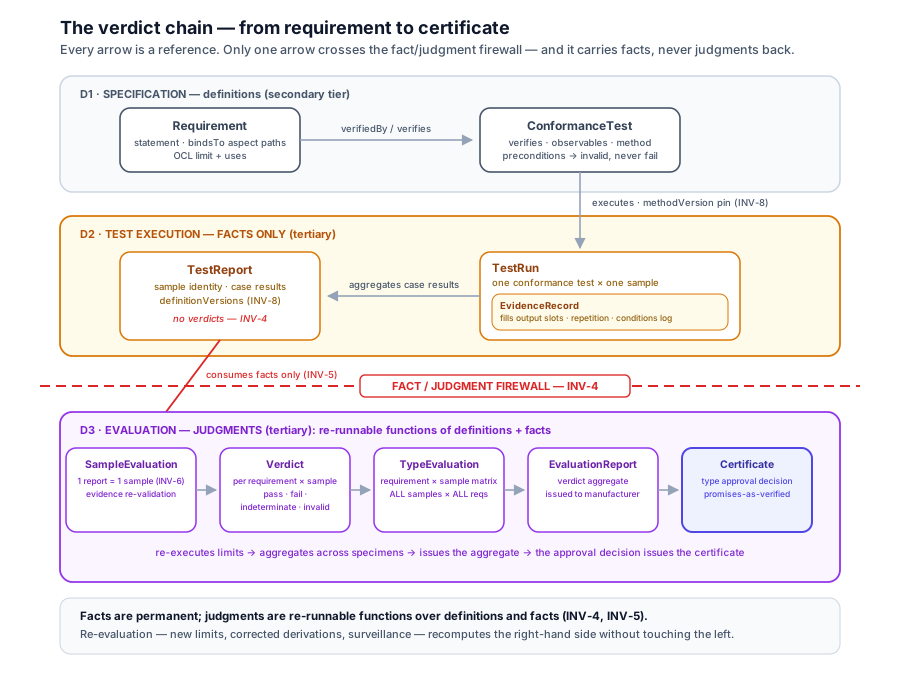
The full chain, requirement → test → run → report → evaluation → verdict → type evaluation → certificate, with the fact/judgment firewall between D2 and D3. Everything left of the firewall is fact; everything right of it is re-computable judgment.
7.2 SampleEvaluation, one report, one sample
A SampleEvaluation is the judgment pass over exactly one TestReport
(= one Sample), INV-6’s correspondence made executable. Its first act is
not to judge but to validate evidence (evidenceValidation):
formulaRechecks, re-run every Formula derivation over the recorded inputs; each{ formula, consistent }confirms the report’s derived values are what the definition computes (a lab that hand-edited a derived value is caught here, not by a reviewer squinting);constraintRechecks, re-run the ConstraintChecks against the recorded values; a constraint now violated re-flags the run;allRunsAdmissible, confirm every contributing run passed the admissibility gate of Chapter 6.
Only then does evaluation judge comparisons. Evidence validation is itself re-execution, the same OCL statements, evaluated again over the same facts (INV-9: the statement executes identically in D2 and D3). ◐ in the running system: run-time constraint checks and admissibility are ● (test-run service); the evaluation-time re-validation pass is wired where verdicts re-execute (below) and is being consolidated into a single declared gate.
7.3 Verdict, one requirement, one sample
The Verdict is the atomic judgment: one requirement × one Sample. Its fields make the function’s inputs explicit:
factUnderJudgment,{ name, value: QuantityValue }: the observed fact the limit ran against, resolved from the requirement’s primarybinds_topath on the entity graph (e.g.sample.test_context.d_max) or from the computed value realizing an observable symbol (e.g.e_l);limit, the limit snapshot: the OCL expression and every input value it was evaluated with. The verdict carries its own reproducibility;uncertaintyConsidered, whether measurement uncertainty entered the comparison (the acceptance decision rule of §5.4);outcome, one of four:
| Outcome | Meaning |
|---|---|
pass |
the fact satisfies the limit |
fail |
the fact violates the limit |
indeterminate |
no judgment possible, a real metrological outcome, not an error |
invalid |
a violated run-validity precondition voids the evidence |
The four outcomes are a deliberate epistemology:
indeterminateis real. Metrologically, an uncertainty interval overlapping the limit is a genuine third answer, not a malfunction , and, operationally, missing evidence or an unevaluable expression lands here too, with the reason recorded innotes. A system with only pass/fail forces these cases into a lie in one direction or the other.invalidcomes only from violated preconditions (§5.6), it voids the run, never the instrument. An invalid verdict is not a failure; it is the absence of a usable test, routing the sample back to the bench.preconditionViolationslists the violated precondition ids.
Two more fields discipline the judgment’s legal force:
modality,shall(default) orshould, inherited from the requirement limit. A failed should-verdict is an observation in the evaluation report, never a pass/fail blocker; the decision rule reads only shall-verdicts. (The ISO/IEC Directives modality catalog, enforced at computation time.)criterion, the R 91-2 §6.1 taxonomy stamped on the verdict:I/MPE(limit during the influence factor),D/NSFa(no significant fault after the disturbance, recorded manual intervention allowed),D/NSFd(no significant fault during),n/a(observational).
And the human override: an evaluator may replace a computed outcome, the
override is recorded, never silent: overridden, override_note
(mandatory justification), override_by, override_at, and an
AuditEvent on every verdict write path (override_verdict /
recompute_verdicts) carrying actor, before/after outcome diff and a
first-class basis (● smart ce10a43, the audit-trail completion).
The function re-runs; the
override is data over its result, so the record always shows both what the
machine computed and what the human decided. ●
(browser/src/services/verdict.service.ts, VerdictMatrix.vue;
data/r60/entities/workflow.yaml, Verdict.)
7.4 Verdicts re-execute the canonical chain
Where does the limit come from? From the one home declared in D1: the
requirement’s limit.expression, or, for shared acceptance quantities ,
the VerdictQuantity registry (data/r60/specification/verdicts.yaml),
referenced via limit.accepts: { verdict, op, limit }. The registry
parses each derivation once per standard load; the requirement-level
verdict service and the form-level calculation engine evaluate the same
cached AST, so the lab’s on-form indication and the authority’s verdict
cannot diverge by construction. The historical defect this kills is the
restatement: one acceptance quantity computed three slightly different
ways at three layers (the MDLO case, requirement, form, and report once
disagreed on normalization and on the v→v_min conversion; the single
registry derivation mdlo_normalized replaced all three).
This is the executable meaning of “derived once, referenced everywhere” from Chapter 5, and the reason evaluation is a re-execution rather than a first execution of anything.
7.5 TypeEvaluation, conformity is established across samples
A TypeEvaluation is conformity assessment on one or more specimens of an identified type (OIML V 1:2022, 2.04). It exists because type conformity is a property of the type, and a type is only ever observed through its specimens, INV-6: type conformity is established only by TypeEvaluation across Samples.
sampleEvaluations, the per-sample judgment passes;crossSampleChecks, checks that only make sense across specimens: declared parameters identical across samples, family criteria holding, no sample silently re-specified between labs;perRequirementMatrix, the requirement × sample → outcome matrix (the VerdictMatrix view: every applicable requirement, every specimen, one cell each);typeVerdict, the synthesis rule: ALL samples, ALL requirements. One specimen passing is a fact about that specimen; the type passes when every cell of the matrix is pass (should-observations and invalids handled by their rules above).
◐ in the running system: the cross-lab/cross-sample synthesis runs as
ModelEvaluation on the EvaluationReport (required vs covered forms,
contributing reports and labs, decision PASS | FAIL | CONDITIONAL | INCOMPLETE), with the per-requirement matrix re-executed by the verdict
service; the metamodel’s single TypeEvaluation class with its declared
matrix and rule is the v3 consolidation. ● for the matrix itself.
7.6 EvaluationReport and TypeApprovalDecision
The EvaluationReport is the verdict aggregate the TypeEvaluation
issues: subject (the Model), typeVerdict, the basis Recommendation, the
recipient (issuedTo the Manufacturer), issue date. It is a judgment
artifact, it restates no evidence, only references it.
The TypeApprovalDecision is the act of legal relevance based on
review of the evaluation report (OIML V 1:2022, 2.05): an authority
reviews the computed aggregate and decides approved | rejected. On
approval it issues the Certificate, the conformity artifact of Module
B, whose characteristic list is the subject’s promises-as-verified
(Volume I, Chapter 2). The chain closes: manufacturer promises (IS) →
requirements constrain → tests observe → runs record → verdicts judge →
the certificate prints the promises, now verified.
7.7 The three-level synthesis
Evaluation in the running system is not a single checkbox aggregation but
a layered synthesis (docs/oiml-smart-modelling-methodology.md §7):
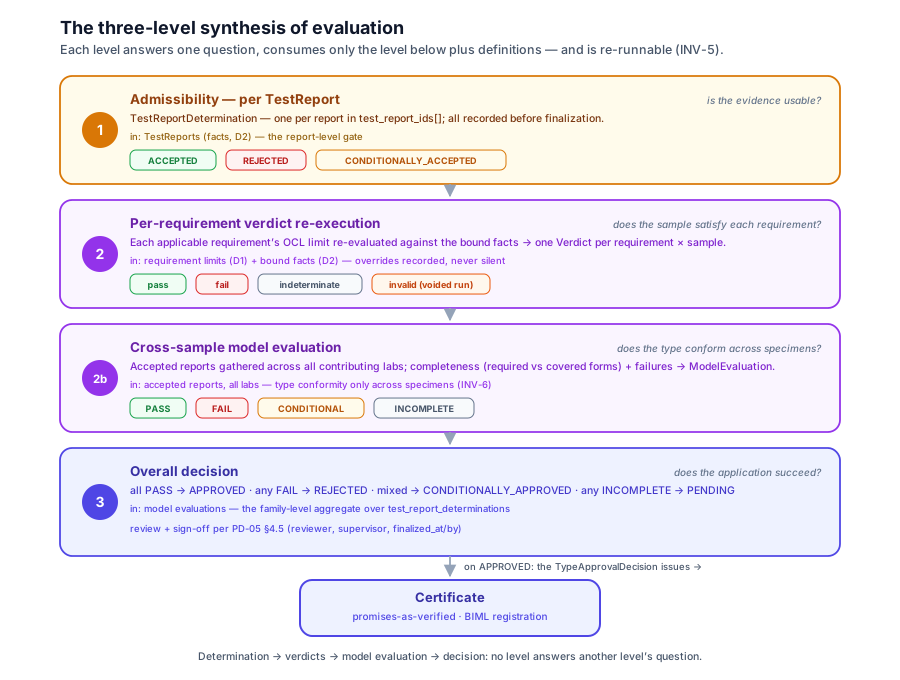
- Level 1, admissibility, per TestReport. Each report receives a
TestReportDetermination:ACCEPTED | REJECTED | CONDITIONALLY_ACCEPTED. One per entry intest_report_ids[]; finalization requires all of them. This is the report-level gate: is this evidence package usable at all? - Level 2, per-requirement verdict re-execution. Each applicable requirement’s OCL limit is re-evaluated against the bound evidence → one Verdict per requirement × sample (§7.3).
- Level 2b, cross-sample model evaluation. Per model, evidence is
gathered across the accepted reports of all contributing labs;
completeness (required vs covered forms) plus failures derive the
ModelEvaluation.decision:PASS(all required forms covered, no failures),FAIL(any FormInstance result FAIL),CONDITIONAL(covered with non-passing evidence),INCOMPLETE(forms missing). - Level 3, the overall decision.
overall_decision: all PASS →APPROVED; any FAIL →REJECTED; mixed/indeterminate →CONDITIONALLY_APPROVED; any INCOMPLETE →PENDING(cannot finalize). On APPROVED the authority issues the Certificate (Chapter 8).
Each level consumes only the level below plus definitions; each is re-runnable. The levels answer different questions, is the evidence usable? does the sample satisfy each requirement? does the type conform across specimens? does the application succeed?, and the architecture refuses to let one level answer another’s question.
7.8 Continuous verdicts, the same judgment, on a new rhythm ●
Nothing in this chapter changes when the evidence arrives continuously. A verdict was never an event; it is a function (§7.1), and the twin direction (Volume I, Chapter 14 ●, monitor and gateway shipped, tasks 33/34) only calls that function on a new rhythm: monitors evaluate the same requirement OCL over served live evidence, and each outcome is a Verdict in exactly this chapter’s sense , one requirement × one subject, fact under judgment, limit snapshot, four outcomes.
Two of this chapter’s disciplines carry the live case without modification:
indeterminateabsorbs staleness. A stale served value is not a metrological event, and silence is not evidence: the verdict degrades toindeterminatewith the reason recorded (§7.3). No fifth outcome is needed.- INV-5 is the audit story. Continuous verdicts remain re-runnable functions over the accumulated evidence stream: a later engine re-judges any time window against new limits without asking the instrument anything.
And one boundary holds: continuous verdicts feed surveillance and the certificate’s post-issue life (Chapter 8); they do not replace TypeEvaluation. Type conformity is still established across Samples (INV-6), a fleet of passing monitors is evidence about units, not a type verdict.
7.9 Grammar sketch (illustrative v3 syntax)
sample_evaluation SE-0091 {
  report  TR-2026-0091                        # exactly one (INV-6: = one sample)
  sample  sample:ACME-LC-500-SN0047
  evidence_validation {
    formula_rechecks    [{ formula: loadCellError, consistent: true }]
    constraint_rechecks [{ constraint: constr:r60:fig3-2b, result: satisfied }]
    all_runs_admissible true
  }

  verdict /req/metrological/mpe × sample:ACME-LC-500-SN0047 {
    fact_under_judgment { name: observable:e_l, value: 0.12 v }
    limit_snapshot { accepts: mdlo_normalized, op: lte,
                     inputs: { mpe: 0.5 v, accuracy_class: C } }
    uncertainty_considered true
    modality shall
    outcome pass                               # computed; re-runnable
  }

  verdict /req/metrological/creep × sample:ACME-LC-500-SN0047 {
    fact_under_judgment { name: observable:c_c, value: 0.41 v }
    outcome indeterminate                      # real outcome; reason recorded:
    notes "uncertainty interval overlaps 0.7·MPE limit"
  }
}

type_evaluation TE-0007 {
  model             model:ACME-LC-500
  sample_evaluations [SE-0091, SE-0092]        # one or more specimens
  cross_sample_checks [declared-parameters-identical, family-criteria-hold]
  per_requirement_matrix { mpe: [pass, pass], creep: [indeterminate, pass], … }
  type_verdict = ALL(samples, ALL(requirements))
}

evaluation_report ER-2026-003 {
  type_evaluation TE-0007
  subject model:ACME-LC-500
  basis   R60:2021
  issued_to manufacturer:ACME
}

type_approval_decision {
  based_on_report ER-2026-003                  # review of the report (VIML 2.05)
  authority "NMI Issuing Authority"
  decision  approved
  issues_certificate cert:R60-2026-…
}
7.10 Validation rules
- a SampleEvaluation references exactly one TestReport and its Sample
(INV-6);
evidenceValidationmust precede verdict computation; - every Verdict names one requirement and one sample, and carries the limit snapshot it was computed with;
outcome = invalidrequires non-emptypreconditionViolations;outcome = indeterminaterequires a recorded reason;modality: shouldverdicts never enter the pass/fail decision rule;- an override requires
override_noteandoverride_by; the computed outcome remains on record alongside it; - a TypeEvaluation covers one or more SampleEvaluations of one Model;
typeVerdictis derived by the ALL/ALL rule, never hand-set; - a TypeApprovalDecision references an issued EvaluationReport; the Certificate it issues references the decision (Module B), closing the chain;
- D3 references D1 and D2 only, a verdict touching a physical entity (sample, equipment) is a dependency-rule violation.
7.11 Summary
- Evaluation is a pure function over D1 definitions and D2 facts: re-runnable by construction, re-evaluation without re-testing (INV-5).
- A SampleEvaluation validates evidence (formula/constraint re-checks, admissibility) over exactly one TestReport, then judges.
- A Verdict is one requirement × one sample: fact under judgment, limit
snapshot, and four honest outcomes,
pass,fail,indeterminate(real metrological answer),invalid(voided run, never a failed instrument). Modality shades limits (a failed should is an observation); overrides are recorded, never silent. - Verdicts re-execute the canonical verdict chain: one derivation, one cached AST, referenced by forms and requirements alike.
- TypeEvaluation establishes type conformity only across specimens (INV-6): cross-sample checks, the requirement × sample matrix, the ALL/ALL rule.
- The three-level synthesis, report admissibility → per-requirement verdicts → cross-sample model evaluation → overall decision, ends in the TypeApprovalDecision that issues the Certificate.
Next: Chapter 8, Parties and Workflow: who acts, and the process machinery that moves the artifacts.