

The Certification Workflow
PD-05 as abstract processes + 34 provisions, realized_by binding, the .prm coverage discipline.
In this chapter: PD-05 as a model, the 8-step scheme process plus the off-sequence flows as abstract processes, the 34 provisions with the full clause-coverage table, the 18-element test-report checklist, and
realized_bybinding the abstract to the concrete Core processes under the.prmcoverage discipline.
4.1 Why abstract + concrete
Volume I’s author’s ladder (chapter 4) applies to the scheme itself.
PD-05 requires a process, application, review, testing, evaluation,
decision, issuance, registration, but a requirement for a process is
not an execution of one. The scheme package therefore holds the process
abstract: signature, roles, evidence requirements, invariants,
clause anchor, activity_kind, “a process is required to fulfil these
provisions”. The platform holds the matching concrete processes in
the Core layer (data/core/evaluation/processes.yaml), the ones the
app actually walks. The join between them is one declared facet:
# data/oiml-cs/evaluation/abstract-processes.yaml
- id: testing
  reference: "PD-05 §4.3"
  activity_kind: [testing]
  realized_by: [conduct_tests, compile_test_report]
realized_by is the scheme’s answer to “who runs you?”: a list of
concrete Core process ids. An empty list is not an omission, it is a
named gap, and the coverage gate of chapter 7 holds it open until a
realization lands. The abstract process is always valid; the gap is
always honest.
4.2 The 8-step sequence
PD-05 §4 (Scheme B; clause 5 applies the same provisions under Scheme A) defines the chain every OIML certificate travels. The model carries it as eight abstract processes with per-step classification and realization:
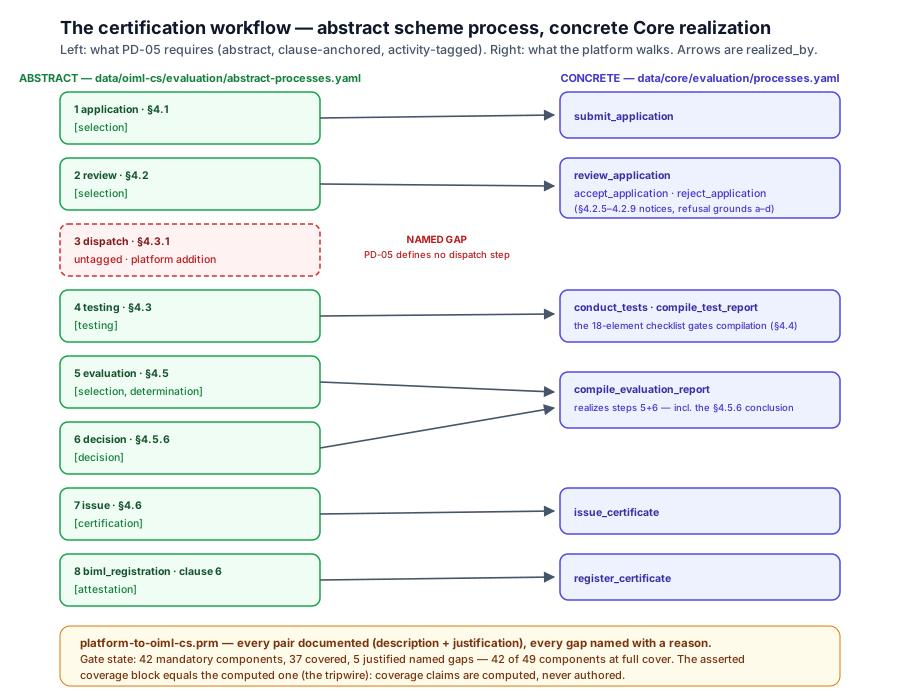
| # | Abstract step | PD-05 | activity_kind |
realized_by (Core) |
|---|---|---|---|---|
| 1 | application |
§4.1 | [selection] |
submit_application |
| 2 | review |
§4.2 | [selection] |
review_application, accept_application, reject_application |
| 3 | dispatch |
§4.3.1 | , (deliberate non-tag) | named gap |
| 4 | testing |
§4.3 | [testing] |
conduct_tests, compile_test_report |
| 5 | evaluation |
§4.5 | [selection, determination] |
compile_evaluation_report |
| 6 | decision |
§4.5.6 | [decision] |
compile_evaluation_report |
| 7 | issue |
§4.6 | [certification] |
issue_certificate |
| 8 | biml_registration |
clause 6 | [attestation] |
register_certificate |
Two steps deserve their footnotes:
dispatchis a documented platform addition. PD-05 defines no dispatch step, the audit’s flow analysis confirms it, yet every real operation splits work across laboratories. The model keeps the step (the platform’s workflow needs it), leaves it untagged and unrealized, and carries the named gap with the reason: the clause binds the performing laboratory (§4.3.1), the platform binds at the test request created at dispatch, and no concrete Core process owns that binding point. Honesty over symmetry.decisionis not a separate app act. The §4.5.6 failure/approval conclusion is reached inside evaluation compilation, so both steps 5 and 6 realize tocompile_evaluation_report. One concrete process may realize two abstract steps; the pair documentation says what each half contributes.
The concrete processes live in Core because every rec shares them:
recs overlay only gate criteria, requirement URNs and testing gateways,
and the concrete processes validate_provision-reference the scheme
package’s /req/cs/* provisions, which is why core declares
requires: [oiml-cs].
4.3 The off-sequence flows
The linear chain is not the whole document. PD-05’s other flows are modelled as off-sequence abstract processes, initiable any time their precondition holds, never part of the 8-step order:
| Flow | PD-05 | activity_kind |
Realization |
|---|---|---|---|
revision |
§8.1 | [decision, certification] |
handle_revision ● |
re_application |
§4.5.7 | [selection] |
named gap, no platform linkage of a new application to the failed evaluation |
registration_fee |
§6.2–6.3 | [withdrawal] |
named gap, the 3-month listing-withdrawal timer is off-platform |
incorrect_conclusions |
§7.1 | [complaint] |
handle_complaint, deregister_certificate ● (task 45, chapter 6) |
parallel_certificates |
§8.2 | [certification] |
issue_certificate ● (the §8.2.1 possession gate inside it) |
recommendation_update |
§8.3 | [decision, certification] |
handle_edition_change ● |
scheme_a_certification |
clause 5 | [selection, determination, certification] |
the five Core processes of the chain, under the Scheme-A gates ● (task 45) |
registration_fee’s tag is the taxonomy used honestly: invoicing has
no ISO/IEC 17000 counterpart, but the fee’s consequence, listing
withdrawn if unpaid within 3 months (§6.2), is a withdrawal act
(8.3). One tag, justified in the file.
4.4 The 34 provisions, full clause coverage
specification/requirements/cs.yaml holds the scheme’s provisions,
/req/cs/*, PD-05 Ed 6 + Amd 1 clause-referenced, 34 provisions
covering every clause of the document. The file header carries the
complete clause → provision/exclusion table: clauses 1–9 and Annexes
A–C, each row naming its provision or its documented exclusion reason.
The exclusions are adjudications, not oversights:
- enabling clauses (who may apply, 4.1.1/4.1.3/4.2.3/5.1.1) state no verifiable obligation;
- transitional arrangements (4.3.4/4.4.7/5.3.4/5.4.4) are PD-07 content, modelled in the pd-07 module;
- permissive clauses (4.3.5/5.3.5, results from outside the TL’s permanent control MAY be used) are conditioned on the TL’s ISO/IEC 17025 scope, laboratory-competence content, delegated to the iso-iec-17025 package;
- §4.6.7 (issuance start date = the category’s inclusion date) is scheme governance, re-pointed to the chapter-1 framework model (auto-inclusion, scheme placement, the Declaration scope and signing gate);
- Scheme-A sourcing (5.1.3/5.2.2) conditions which previous reports Scheme A accepts, folded into the Scheme-A provisions.
Two stale cross-references in the published text itself (§4.5.7’s “the procedure in 7.1”; Annex B Note 4) are documented in the table, the model records the document’s own errata rather than silently repairing them.
The provisions are process requirements, actors, documents, sign-offs
, so they carry no binds_to/limit against the instrument; they bind
to workflow outputs (applications, test requests, test reports,
evaluation reports, certificates) declared in the Core entity layer.
4.5 The 18-element test-report checklist
PD-05 §4.4.3 fixes the minimum content of every OIML test report as
elements (a)–(r). The package models them as data ,
execution/test-report-checklist.yaml, one entry per element with
obligation and a source path into the entity graph, so report
completeness is validated at compilation time, not reviewed by eye.
The checklist is scheme-level content living in the scheme package;
recs overlay the rec-bound form strings of the four entries that
name Recommendation-specific forms (h, samples tested; m, test
facilities; n, instrument/simulation setup; o, adjustments).
Element (p), results with uncertainty and traceability, is the single
may in the list; the rest are shall. The checklist’s own coverage
is enforced in the evaluation process model: compile_test_report
validates the /req/cs/test-report-18-elements provision (§4.4), and
compile_evaluation_report refuses synthesis while checklist coverage
is below 1.0 (§4.5). The gate is mechanical: a report missing element
(d) does not reach evaluation.
4.6 realized_by and the .prm discipline
The abstract↔concrete join has a second, auditable serialization: the
map data/core/evaluation/platform-to-oiml-cs.prm, a standalone
Primmel mapping profile (Volume I, chapter 5) from the platform’s
concrete processes to the scheme’s abstract processes and provisions.
Every pair carries a description and a justification written
against real platform records, e.g. the application pair cites
IAReviewResult.sample_count_required and
Application.previous_test_reports; the language pairs cite the
English-by-construction renderings; the Scheme-A pairs cite
TestReport.includes_mtl_results and the §5.5.4 statement.
The .prm also carries what realized_by cannot: named gaps with
reasons (dispatch, test-laboratory eligibility, re-application, the
registration-fee pair) and the asserted coverage block, the
tripwire the gate recomputes. A pair dropped from the map fails the
gate even when inheritance would keep the cover full: the pair is the
fulfilment documentation, and coverage without documentation is an
assertion without evidence. Chapter 7 develops the calculus; the
current state of this map is the pd-05 section of the unified report ,
42 mandatory components, 37 covered, 5 justified named gaps, 42 of 49
components at full cover.
4.7 Grammar sketch (illustrative v3 syntax)
package oiml-cs {
  process type_evaluation {              # abstract: required, not executed
    does {
      step application        { source "pd-05#clause-4.1" activity_kind [selection] }
      step review             { source "pd-05#clause-4.2" activity_kind [selection] }
      step testing            { source "pd-05#clause-4.3" activity_kind [testing]
                                executor actor TestLaboratory }
      step evaluation         { source "pd-05#clause-4.5" activity_kind [selection, determination] }
      step decision           { source "pd-05#clause-4.5.6" activity_kind [decision] }
      step issue              { source "pd-05#clause-4.6" activity_kind [certification] }
      step biml_registration  { source "pd-05#clause-6"   activity_kind [attestation] }
    }
  }
  provision test_report_18_elements {
    modality shall
    source "pd-05#clause-4.4.3"
    checklist elements a..r               # the 18-element model of §4.5
  }
}
And the implementation side, as a standalone .prm pair:
{
  "@type": "Primmel_MAP",
  "id": "platform-to-oiml-cs",
  "mapSet": { "oiml-cs": { "mappings": {
    "core.compile_test_report": { "oiml-cs#testing": {
      "description": "Report composer with the 18-element checklist gate.",
      "justification": "Compilation validates /req/cs/test-report-18-elements; coverage < 1.0 blocks synthesis (PD-05 §4.5)."
    } }
  } } }
}
4.8 Validation rules
- every abstract step and provision carries clause-level provenance
into PD-05 (
source: { doc, clause }), citing the Ed 6 + Amd 1 numbering; realized_byids resolve to declared concrete Core processes; an unrealized mandatory component exists only as a.prmnamed gap with a reason;- process-type provisions bind only
/req/cs/*ids (the R19 discipline); the scheme package owns no instrument facts and a rec owns no scheme facts; - the 18-element checklist is enforced at compilation, evaluation synthesis refuses while coverage < 1.0;
- every
.prmpair carries description + justification; the asserted coverage block equals the computed one (the tripwire), coverage claims are computed, never authored; - the header’s clause-coverage table accounts for every PD-05 clause: provision, exclusion with reason, or re-point to the framework model.
4.9 Summary
- PD-05 is modelled twice by design: abstract (the scheme requires it)
in the oiml-cs package, concrete (the platform walks it) in Core ,
joined by
realized_by, audited by the.prm. - The 8-step sequence plus seven off-sequence flows cover the whole document; the 34 provisions carry a complete clause-coverage table with adjudicated exclusions.
dispatchstays a documented platform addition and a named gap , the model’s honesty is part of the model.- The 18-element checklist is data, enforced at report compilation.
- Pairs are the fulfilment documentation: description + justification against real records, or it is not coverage.
Next: Chapter 5, The participant runtime: the registry, the approval pipeline with the MC 80 % vote, and the issuance gate that fails closed.