
The SST interaction contract
The normative spec for how anything talks to a Primmel Simulated SMART Twin states the thesis the whole platform is built on: the digital twin's GraphQL API is fully determined by the Recommendation's Primmel instrument model.
What it is. The normative spec for how anything talks to a Primmel SST (Simulated SMART Twin), and, more than that, the statement of the thesis the whole platform is built on:
The digital twin’s GraphQL API is fully determined by the Recommendation’s Primmel instrument model.
The instrument model is the digital twin’s definition. Its hierarchy (IS), its properties and registers (HAS), and its behavior (DOES) mirror exactly into the API. Nothing about the served surface is designed at the API layer, and nothing is hand-written anywhere along the chain.
This page documents how the model becomes the API, and then how a consumer interacts (four verbs). It deliberately does not enumerate the served fields, a field list is a lie the day the model changes. The fields are whatever the Primmel model says; read the model, or ask the endpoint (introspection, below).
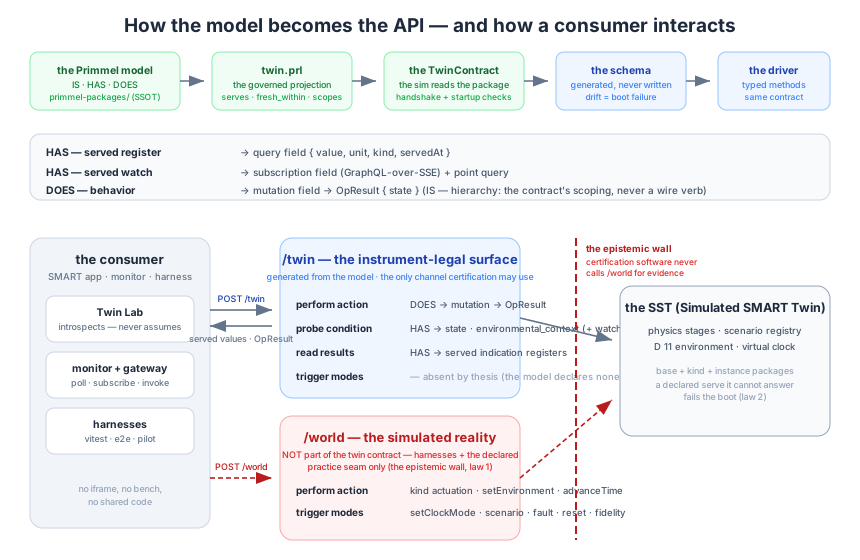
How the model becomes the API
The chain, every arrow generated and drift-checked:
- The Recommendation’s Primmel instrument model (the SSOT ,
primmel-packages/oiml-r60and siblings): the subject’s IS (hierarchy, identity), HAS (attributes, registers, state, environmental context), and DOES (behaviors, processes with inputs, steps, outputs). - The governed projection declaration (
model/twin.prlin the rec package): which of the model’s registers the twin serves (withfresh_within), which watches it offers, and which of the model’s behaviors are instrument-legal commands, with access scopes. This is the rec saying: a compliant twin of this instrument serves exactly this, no more and no less. - The product package’s twin declaration (
primmel-packages/acme-*): the manufacturer’s instrument restates its twin surface consistently with the rec’s governed set (the layering rules: the rec governs). - The SST reads the package directly. The sim repo consumes
primmel-packages/off disk (env-overridable paths), parses it with its adapter, asserts fixture equality in handshake tests, and produces the TwinContract, the normalized serve contract. - The GraphQL schema is generated from the contract and startup-conformance-checked: a served surface that drifts from the package fails the boot, loudly.
- The client driver is generated from the same contract (the sim
repo’s
specs/10-twin-driver.md: TwinDriver/WorldDriver, typed methods, never raw GraphQL strings). The SMART app’s own graphql connector is this driver’s semantic counterpart on the consumer side.
The mapping, facet by facet:
| model facet (IS/HAS/DOES) | API face |
|---|---|
HAS, a served register (serve … via … fresh_within) |
a query field returning a served quantity { value, unit, kind, servedAt } |
HAS, a served watch (watch-kind operation) |
a subscription field (GraphQL-over-SSE), and a point query, because a real twin also answers polls |
DOES, an instrument-legal behavior (operation … (command), does: the model behavior) |
a mutation field returning OpResult { state } |
| IS, hierarchy & identity | the contract’s scoping (what this twin is), never a wire verb |
Generation is total in both directions: a declared serve the instrument cannot answer fails generation; a field the model never declared cannot exist. Drift is a build/boot failure, never a silent possibility.
The two channels, and why only one is the contract
Every SST serves two GraphQL endpoints (GraphQL Yoga; introspection enabled, consumers discover, never assume):
| channel | what it is | who may call it |
|---|---|---|
/twin |
The instrument-legal surface, generated from the model as above. What a real, deployed SMART twin of this instrument would serve. | Any consumer. This is the only channel certification software may use (the epistemic wall, law 1). |
/world |
The simulated physical reality, the physics, the environment, the clock, the scenarios. Not part of the twin contract, a real instrument offers none of it, which is exactly why it can never appear on /twin. |
Harnesses (vitest, e2e, the pilot) and the app’s declared practice seam (G18: segregated, marked, never certification evidence). Never certification logic. |
The wire protocol is identical on both: POST <url> with
{"query": "…"}; subscriptions ride GraphQL-over-SSE (the same POST with
accept: text/event-stream, one GraphQL response per data: event).
CORS is the Yoga default (origin echo), so a browser app calls an SST on
another port directly. /world is guarded by an opt-in bearer token
(SIM_WORLD_TOKEN); /twin is open in simulation (real deployments
attach per-scope credentials, the gateway’s { env: VAR } doctrine in
06-the-twin-runtime).
The streaming sibling (GET {url}/stream). The SST also serves a
plain-SSE stream of the twin channel: GET /twin/stream?targets=…
answers text/event-stream, an immediate snapshot frame on connect,
then one event: twin frame per clock advance carrying
{ timestamp, targets: [{ target, value }] } (atomic, clock-aligned),
id: = the instrument-clock timestamp (resumable via Last-Event-ID),
and heartbeats every 5 s. The gateway’s twin_stream connector profile
binds it as the watch transport (operation → target by the serves[0]
convention, receipt-stamped like every connector; a stream that ends is
the feed going away, unavailable, never thrown). It is the same
channel’s streaming face, so the validator admits it against graphql and
rest_json endpoints alike; a twin that does not stream (a real
instrument twin, or a legacy sim) keeps the GraphQL subscription as the
watch transport, the probe discovers which, never assumed.
The four verbs, sourced from the model
Everything a consumer can do to an SST is one of four verbs, each one sourced from the model facet it mirrors:
| verb | on /twin (instrument-legal, model-sourced) |
on /world (simulated reality) |
|---|---|---|
| perform action | DOES → mutation: invoke a declared instrument-legal command (the model behavior runs; the answer is OpResult). |
kind actuation (place a load, feed an object) + core (setEnvironment, playProfile, advanceTime). |
| trigger modes | , (absent by thesis: the model declares no mode knobs, so the twin has none) | setClockMode, scenario(name) (swap the instrument definition), injectFault / clearFault, reset, the fidelity/physics knobs, the lying-twin levers. |
| probe condition | HAS → query/subscription: the state register and the environmental-context register, as point queries and as the SSE watch. | worldState, groundTruth (the harness’s reference channel), clock, scenarios, profiles. |
| read results | HAS → query: the served indication registers, the evidence channel. | groundTruth, what the physical value actually is. Harness-only: a reference, never evidence. |
Notice what the asymmetry teaches: trigger modes exists only on
/world, a real instrument offers no way to swap its own physics, so
the twin channel doesn’t either. The contract’s shape is the lesson.
Reading the served surface (never from this page)
The served fields are whatever the model declares, so the only honest way to know them is to read the model or to ask the endpoint:
- The model:
primmel-packages/oiml-r60/model/twin.prl(the rec’s governed declaration) andprimmel-packages/acme-*/model/*.prl(the product’s). These are the contract; everything else is commentary. - The endpoint: GraphQL introspection. The Twin Lab’s connect flow does exactly this, it introspects the endpoint, intersects the discovery with the rec’s declared interface, and shows the binding it derived. Because the schema is generated, discovery is always true.
One illustrative example, generated from the R 60 model at time of
writing, read the model, not this page: a query of
{ indication { value unit kind servedAt } }, a watch of
subscription { state }, and the command mutation { runSelfTest { state } }
, the R 60 model’s indication register, state register, and self_test
behavior, mirrored.
Served values, timestamps, freshness
- A served quantity is
{ value, unit, kind, servedAt }.servedAtis the instrument clock: boot-seconds inmanualclock mode, epoch seconds inwallmode. - The SMART graphql connector stamps the serve at receipt with the
deployment clock by default (the serve event is the round trip); a
wall-clocked twin can be consumed with the
timestamp_fieldsextension so freshness judges the served epoch instead. Both are declared deployment behavior, never invented evidence times. - Freshness windows (
fresh_within) come from the model’s serve declarations and are carried verbatim into every binding; a stale twin degrades verdicts toindeterminate, never tofail. - Any transport failure is
unavailable: the value stays absent, the reason goes to the health log, and no connector call ever throws into evidence.
A worked sequence (the Twin Lab’s guided run, one leg)
- perform action (harness, /world), place the reference load, advance the clock (settle).
- probe condition (harness, /world),
worldStateconfirms the pan and the clock. (In a human run this is the tester looking at the bench; the app never does this step for evidence.) - read results (app, /twin), the served indication, auto-recorded with the pair skew against the capture time.
- attest (human, into the app), the physical display reading, typed into the run’s box. The attestation is the evidence of record; the twin’s serve is the recorded cross-check.
Steps 1–2 are the simulated reality; steps 3–4 are the legal interaction. The wall runs between them, and the evidence only ever comes from the legal side plus the human.
The operator flows (testing a real instrument, or an SST in practice)
The guided run serves both postures, the connect flow discovers which:
- A real Primmel SMART Instrument Twin (any host, any port): the operator has physical access to the instrument. The app drives the test procedure as instruction cards (the test’s declared steps, verbatim, with resolved setpoints), the operator performs each action physically, records the conditions (setpoint chips/attestations) and the physical display’s readings (the attestation boxes), and the app auto-records the twin’s served values and any instrument commands (the invoke face). The compiled evidence lands in the rec’s own report forms, judged by the verdict chain.
- An SST standing in for the instrument (practice, G18): the same
cards, but the endpoint carries a
/worldsibling (discovered by introspection, never assumed). The cards gain “perform on the SST” buttons (set the chamber, place the load) that drive the world mutations through the declared practice seam. The run and its evidence are practice-segregated (practice-ids), never certification evidence; the twin channel and the attestations remain the only evidence sources. A real twin has no/worldsibling, the probe reports honestly and the instructions stay manual.
How the SMART app consumes the contract
| consumer | channels used | how |
|---|---|---|
Twin Lab (/app/twin-lab) |
/twin only |
introspect → proposed binding → compliance cycles → guided-run capture + command issuance (twin-lab/* modules) |
| monitor + gateway | /twin only |
the graphql connector (poll + GraphQL-over-SSE subscribe + invoke), per the derived GatewayIntegrations |
practice flows (/app/sim) |
/world + /twin |
the declared practice seam (G18): practice entities are marked and segregated; the seam is declared in code, never an accident |
| vitest / e2e / pilot | both | the harness is the physics: it drives /world (loads, environments, scenarios) and asserts on /twin + the app’s verdicts |
| the SST bench / console | , | the SST’s own human faces. The SMART app does not embed them to interact, this contract replaces any need to. |
Composite twins (the thesis holds at every level of the graph)
A composite instrument (a gas analytical system, analyzer + sampling + conditioning) is modelled as a hierarchy of twins: the composite’s Primmel instrument model declares its components, and the composite’s twin API is generated from that model exactly as a single instrument’s is, the composite’s serves decompose to component registers, its commands to component behaviors. The rec governs at every level. (TODO.v3/03 lands the exemplar; the composition calculus, which component certificate statuses compose into the composite’s, is the program’s concern, never the wire’s.)
Stability across the SST migration
The sibling repo is renaming (@sim/* → @primmel/sst-*), factoring
packages into base / kind / instance tiers, and gaining the generic
primmel-sst run <instance> boot and the sst-shell host (its
TODO.complete/ workstreams; the normative server-side API spec is its
specs/12-external-graphql-api.md). This contract is the stable
surface through that migration: the model-driven chain, the two
endpoints, the four verbs, the served shapes, and the epistemic wall do
not change. Legacy family bins delegate to the new runtime during the
window, so every consumer written against this page keeps working.
Back to the index.