
Shared
BIML-operated
One hosted platform serves every issuing authority and test laboratory. The register is built in; participation is an account, not an installation.
The OIML-CS global deployment of the SMART runtime. SMART tier: Type-approval workflow, application to BIML registration. SMART+ tier: the same runtime extended to every certified instrument in service.
The OIML-CS workflow, modelled end to end on B 18:2025. Every participant role, every document, every verdict is an entity in the system, so the whole chain is traceable, and every state change carries its evidence.
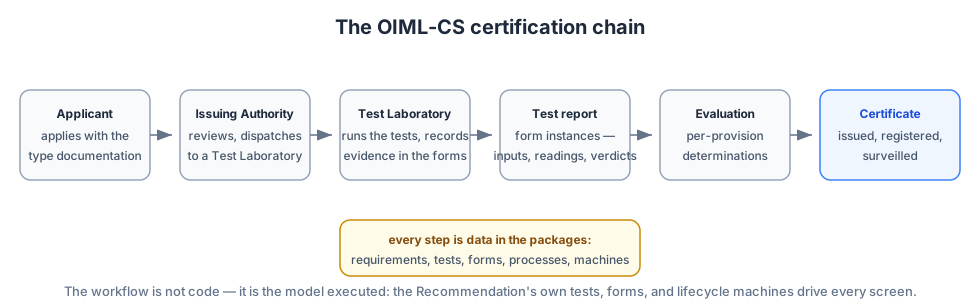
The scheme itself, the roles, the documents, the governance, is on the OIML-CS page; the certificate format is OIML CNML.
Every participant in the OIML-CS gets a console shaped to their role in the workflow, the same underlying model in four different seats.
File the application, declare the model family, ship samples, watch the verdicts arrive, status is a query, not a phone call.
Review applications, request samples, dispatch test requests, judge the evaluation, sign and issue the certificate.
The lab inbox, the structured test run, evidence capture at the bench, the test report generated from the run itself.
Registration of issued certificates, the participant registry, the public record, the system of the OIML-CS, operated by the Bureau.
The OIML Certificate System for Measuring Instruments began in 1991 as a paper workflow: applications by mail, test reports as documents, certificates as signed paper. OIML B 18, the Framework for the OIML Certification System, defines the current scheme, and the 2025 edition (B 18:2025) names digital operation as the direction. The platform is that direction built: the scheme's roles, documents, and decisions modelled as entities and processes, so the workflow the Basic Publication describes is the workflow the system runs.
The platform runs where the authority needs it: as the shared system the BIML operates for everyone, or as an authority's own instance whose signed submissions the shared register accepts. The member-state deployment is the OIML SMART Platform.
One hosted platform serves every issuing authority and test laboratory. The register is built in; participation is an account, not an installation.
An issuing authority runs its own instance under its own custody; signed submissions flow into the shared register, which verifies the signature chain on import.
The SMART+ tier extends the same runtime to the individual certified instrument. Every type-instance in service carries a twin; every measurement is signed and traceable; every conformance verdict runs against the SMART Recommendation continuously. The Type-approval baseline (the SMART-tier output) is the contract; the SMART+ lifecycle is the instrument fulfilling it, in the field, over time.
The instrument twin is SMART Measuring Instruments; the simulated twin for bench work is SST; the instance certificate is OIML CNML at the Type-instance level.
The SMART+ tier adds the operator seat and reshapes the laboratory and authority consoles around the live twin, not the paper record.
The instrument in service, its current conformance state, its measurement stream, alerts the moment a parameter drifts.
Type-instance certificates under the IA’s custody, the population of instruments in the field, the re-verification schedule.
Re-verification runs, calibration updates, evidence captured at the bench against the live twin, not a paper record.
The cross-border registry of Type-instance certificates, the verifier for instruments in service across member states.
The OIML-CS SMART+ Platform is the global registry of Type-instance certificates and the cross-border verifier for instruments in service. Member states, NMIs, and laboratories may run their own OIML SMART+ Platform under national custody, federating instance data upstream.
BIML-operated registry of Type-instance certificates. The cross-border verifier for instruments in service across member states.
Member-state deployment of the SMART+ runtime. Instance data under national custody, federated with the global register.
The demo instance runs the whole chain, seed a sample application, dispatch it, run the tests against the simulated instrument, evaluate, and issue the certificate. Sign-in runs through the identity service, the fictional cast assumed as personas.