

The OIML Core Metamodel
The metamodel of legal metrology, the 4-layer architecture, the six modules, the dependency law.
The Primmel kernel (Volume I) is domain-free: it knows what a Subject is,
what IS/HAS/DOES mean, what a requirement, a process and a verdict are ,
and nothing about measuring instruments. This volume is the specialization:
OIML Core, the metamodel of legal metrology, centred on
MeasuringInstrument (OIML V 1:2022, 0.10) and built entirely from kernel
primitives.
The metamodel is one file: oiml-core-ontology.yaml
(ontology-remix/OIML Core Models/Ontology/, id urn:ontology:mi:upper,
v0.6.1). Its header states the contract: schema only, classes,
enumerations, invariants, dependency rules, containing no
instrument-kind-specific terms (no load cells, no R 60 symbols). Every
Recommendation instantiates it through a domain profile that is data,
not schema: “A new Recommendation = a new profile file; zero schema
changes” (oiml-r60-loadcell-profile.yaml, profile note).
The runtime endgame is the served instance: the instrument as a live twin, its model and state queryable over a declared endpoint and judged continuously by the same OCL (Volume I, Chapter 14, on the Primmel SMART docs site, ●, the twin console, the monitor runtime and the live pilot all shipped).
The 4-layer architecture
OIML Core sits at layer 1 of a four-layer stack. Each layer depends only on the layers above it; the running system’s R 60 realization is cited per layer.
Layer 0  Vocabularies    glossarist registers viml-2022 (OIML V 1:2022) and
                         vim-2012 (OIML V 2-200, the VIM) — terms are anchored,
                         never invented (vocab_ref → register + clause)
Layer 1  Metamodel       oiml-core-ontology.yaml (this volume) + one domain
                         profile per Recommendation (ontology-remix/OIML
                         Recommendation Models/Ontology/R 60/)
Layer 2  Domain data     data/r60/ — model/, entities/, specification/,
                         execution/, evaluation/ : the Recommendation as data
Layer 3  App instances   runtime entities in IndexedDB, seeded from
data/r60/sample-data.yaml- Vocabulary anchoring. Subject classes carry VIML clause references
(family 4.02, model 4.06, sample 4.09); data terms link into the
registers (
data/r60/terminology.yaml). The metamodel’s ownreferences:block names its four authorities: VIM, VIML, the GUM, and the IEC CDD. - The schema/instance split is the load-bearing wall. An attribute is defined once in the profile (INV-2) and valued in domain data; a Recommendation’s normative content lives entirely at layer 2. Adding a requirement, attribute or form is a data edit, never a schema edit.
- OCL is the only rule language at every layer (INV-9): constraints
are OCL
inv, derivations OCLderive, and the same statement executes identically in test execution and in evaluation.
The six modules
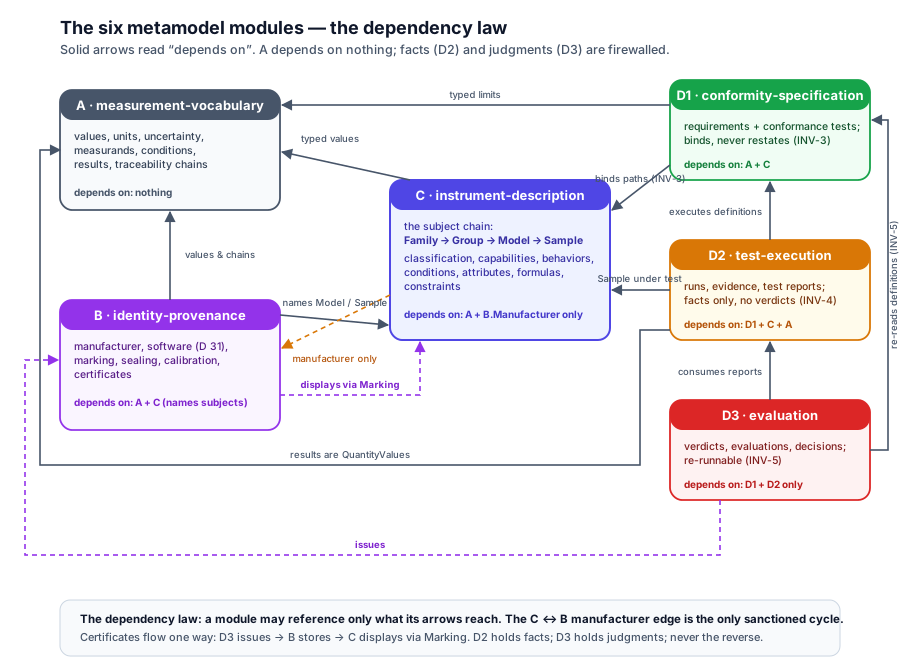
The metamodel is organized in six modules with a strict dependency law
(oiml-core-ontology.yaml, dependencyRules). Three describe the subject
and its values (A, B, C); three describe conformity (D1, D2, D3).
| Module | Name | Contents | Depends on |
|---|---|---|---|
| A | measurement-vocabulary | QuantityKind, Unit, QuantityValue, uncertainty, Measurand, InfluenceQuantity, Conditions, MeasurementResult, TraceabilityChain | nothing |
| B | identity-provenance | Manufacturer, SoftwareComponent, Marking, Sealing, CalibrationRecord, Certificate, VerificationMark (v0.6.1) | A, C |
| C | instrument-description | the subject chain Family → Model → Sample; Classification (incl. set-valued dimensions), Capability, Behavior, OperatingConditionSet, AttributeDefinition, Parameter, Formula, Constraint; Structure, Characteristic, Promise, ArtifactDefinition, OperationalStateMachine, Dual (v0.6) | A, B.Manufacturer only |
| D1 | conformity-specification | Recommendation, Requirement, ReferenceMaterial, ConformanceTest, TestMethod, TestStep, VerificationProcess (v0.6.1) | A, C, binds, never restates |
| D2 | test-execution | TestRun, EvidenceRecord, TestRunResult, ConstraintCheck, TestCaseResult, TestReport | D1, C, A, facts only |
| D3 | evaluation | SampleEvaluation, Verdict, TypeEvaluation, EvaluationReport, TypeApprovalDecision, Verification (v0.6.1) | D1, D2, touches nothing physical |
The version line is additive-only, a profile authored against any
earlier version validates unchanged against every later one. v0.6
(task 12) adopted the v3 kernel primitives as first-class metamodel
classes (the C-module additions above) and completed the invariant set
to INV-1..14; v0.6.1 (task 21) modelled metrological control beyond
type evaluation: the VerificationProcess definition (OIML V 1:2022,
2.09, initial, subsequent, periodic and in-service kinds per 2.12–2.14,
with validity windows and re-verification triggers), the Verification
event on one Sample, and the VerificationMark it applies (3.04).
Three rules do the work:
- B names subjects; C names its manufacturer, one sanctioned cycle.
Module B’s artifacts reference the subject chain defined in C (a
Certificate certifies a Model; a CalibrationRecord belongs to a Sample),
while C’s
Model.manufacturer/Family.manufacturerpoint back into B. That C→B back-edge is the only cycle the metamodel permits. - The fact/judgment firewall. D2 contains facts only (INV-4: a TestReport that says “pass” is a broken schema); D3 consumes only definitions and reports (INV-5: re-evaluation requires no re-testing).
- Certificates flow one way: D3 issues → B stores → C displays via Marking.
Chapters 1–4 of this volume cover A, C and B, the subject half. Chapters 5–7 cover the conformity half (D1, D2, D3).
The chapter map
- This README, volume overview; the 4-layer architecture; the six modules.
- Measurement vocabulary, Module A: QuantityKind, Unit, QuantityValue, uncertainty, Measurand, InfluenceQuantity, Conditions, MeasurementResult, TraceabilityChain.
- The subject chain, Module C core: Family → Group → Model → Sample; VIML anchoring; classification; scope and origin; delegation.
- Instrument aspects, Module C aspects: attributes/parameters, capabilities, behaviors, condition sets, formulas, constraints, the IS/HAS/DOES instrument catalog.
- Identity and provenance, Module B: Manufacturer, SoftwareComponent, Marking, Sealing, CalibrationRecord, Certificate.
- Specification, Module D1: Recommendation, Requirement, ConformanceTest, TestMethod, TestStep.
- Test execution, Module D2: TestRun, EvidenceRecord, admissibility, ConstraintCheck, TestReport.
- Evaluation, Module D3: SampleEvaluation, Verdict, TypeEvaluation, EvaluationReport, TypeApprovalDecision.
- Parties and workflow, parties, roles, the certification workflow entities, lifecycle state machines.
- Invariants, INV-1..14: the metamodel’s laws, each with rationale, checks, and the shipped registry’s crosswalk.
- Shared modules, emc-disturbances, env-iec60068, software-d31, reference-materials, specimen-governance, report-headers, examination-docs.
The one-sentence summary
OIML Core models a measuring instrument as a subject chain (Family → Group → Model → Sample) whose values are all quantities (Module A), whose aspects are defined once and valued per level (Module C, INV-2/INV-10), whose identity artifacts name it (Module B), so that requirements bind to it (D1), tests record facts about it (D2), and verdicts judge it (D3) without any layer ever reaching into another’s business.
Next: Chapter 1, Measurement Vocabulary: the shared value layer every number in the system passes through.