
The twin stream (the model-API for continuous twin interaction)
The twin stream is the real-time face of the twin channel, a plain-SSE stream that serves the twin's governed registers as they change, an immediate snapshot on connect, then one atomic frame per clock advance.
What it is. The real-time face of the twin channel: a plain-SSE
stream, GET /twin/stream?targets=…, that serves the twin’s governed
registers as they change, an immediate snapshot on connect, then
one atomic frame per clock advance. It is how the platform stops
polling a twin and starts following it: continuous conformance
monitoring, live state watches, instant fault annunciation.
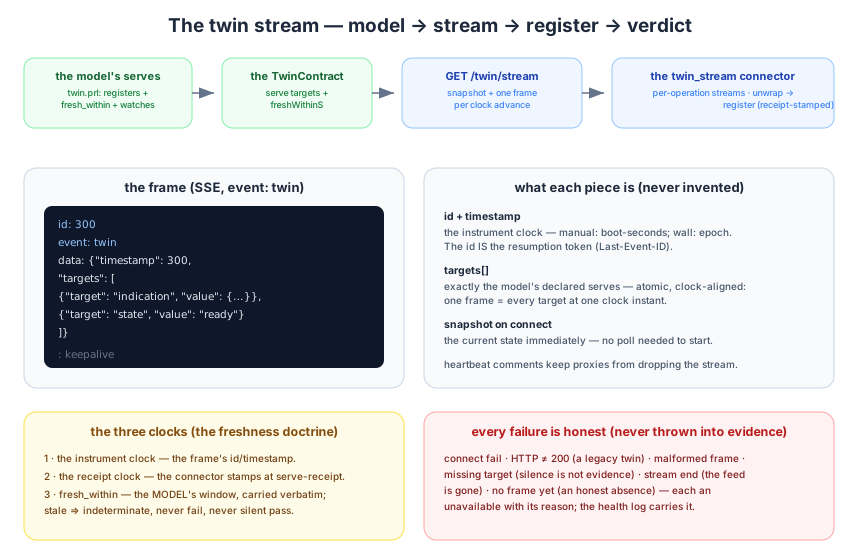
Like everything on the twin channel, the stream is determined by the Primmel model, this page documents how the model becomes the stream, the wire contract, the time doctrine, and the failure semantics. It deliberately does not enumerate targets: the targets are whatever the Recommendation’s model declares (read the model, or introspect the endpoint).
How the model becomes the stream
The same chain as the query/subscription faces (12, the SST interaction contract), with the stream as a third face of the same governed projection:
- The Recommendation’s twin declaration (
model/twin.prl): which registers the twin serves (serve … via … fresh_within …) and which operations are watches. Thefresh_withinis the model’s own freshness contract, it travels with the data, everywhere. - The TwinContract (the normalized serve contract the SST parses from the package): each serve becomes a target reader, a register the instrument can answer. A declared serve the instrument cannot answer fails generation loudly (law 2).
- The stream endpoint (generated, never hand-written): one target per declared serve, answerable together in one frame.
- The consumer’s connector (the SMART app’s
twin_streamprofile): maps each operation to its stream target by the sameserves[0]convention the GraphQL documents use, unwraps frames into served values, and lands them in the register layer.
Nothing in the stream exists that the model did not declare; nothing the model declared is silently dropped. The stream’s target list IS the model’s serve list, probing it is introspection, reading it is the contract.
The wire contract
Request. GET {twin-url}/stream?targets=<csv> with
accept: text/event-stream. The targets filter is optional and
honest: the endpoint serves what was asked, from its declared set ,
an unknown target is an error, not a silent omission. One HTTP
connection, held open. CORS is the Yoga default (origin echo), so a
browser app on another port connects directly.
Frames. Server-Sent Events, three kinds of line:
id: <instrument-clock>, the frame’s identity AND the resumption token: reconnect withLast-Event-ID: <id>to resume after the last frame seen. The id is the instrument’s own clock value.event: twin+data: {…}, the payload:{ "timestamp": <instrument-clock>, "targets": [{ "target": <id>, "value": <served> }] }. Every requested target, at one clock instant, the atomic, clock-aligned sample a poll can never give you.: keepalive(a comment, every 5 s), keeps proxies and load balancers from dropping the idle connection. Carries no data; consumers skip it.
Lifecycle. On connect, the endpoint emits the current state immediately (the snapshot, a consumer never needs a bootstrap poll). After that, it emits one frame per clock advance, the stream ticks when the instrument’s clock ticks. A state change alone does not emit; it rides the next advance. When the stream ends or breaks, that IS the feed going away.
The three clocks (the freshness doctrine)
Three times, never conflated:
- The instrument clock, the frame’s
idandtimestamp.manualmode: seconds since boot.wallmode: epoch seconds. Never assumed to be epoch by the consumer. - The receipt clock, the SMART connector stamps each served
value at serve-receipt with the deployment clock (the serve
event is the arrival). This is the documented default for every
connector; a wall-clocked twin’s frame timestamp can instead be
consumed via the
timestamp_fieldsextension (a declared opt-in , evidence times are never invented). fresh_within, the MODEL’s freshness window, declared on the serve and carried verbatim into every binding. The verdict service’s freshness gate judges the landed value’s age against it: a stale value degrades verdicts toindeterminate, never a fail, never a silent pass.
The pairing discipline for attestation rides on top: when a human
attests a physical reading and the twin’s streamed value is recorded
alongside, the pair skew (|capture − served|) is recorded, and the
window it is judged against is the serve’s fresh_within.
The consumer connector (twin_stream)
The SMART gateway binds the stream as one of its connector profiles ,
a builtin, like graphql or rest_json:
| aspect | the contract |
|---|---|
| subscription | one SSE stream per bound operation (per-operation, mirrors the GraphQL subscribe face; the single-stream fan-out is a named optimization) |
| target mapping | stream_targets on the source: operation → stream target (the serves[0] convention, watch_state → state) |
| snapshot | the first frame lands immediately (the current state, the monitor’s watch starts warm) |
| advances | each frame unwraps to a served value, receipt-stamped, and lands in the twin’s register via the entity register writer, the same production sink as every connector |
| fetch face | the latest frame’s value per target (a point read); an honest absence when no frame has arrived |
| validator | twin_stream sources are admitted against graphql and rest_json endpoints, the stream is the same channel’s streaming face (like file_drop’s out-of-band rule) |
| fallback | a twin that does not stream (a real instrument twin, a legacy sim) keeps the GraphQL subscription as the watch transport, the connect flow probes the stream and binds honestly (probeTwinStream, headers only) |
The monitor consumes the pushed values unchanged: a streamed state
change lands in the register and fires the on_change trigger; the
next cycle judges it. Continuous conformance is a wiring fact, not a
new verdict engine.
The failure taxonomy (every failure honest, never thrown into evidence)
| failure | the connector’s answer |
|---|---|
| connect refused / DNS / TLS | unavailable (transport, the value stays absent, the health log carries the reason) |
| HTTP ≠ 200 | unavailable, “the endpoint does not stream (a legacy twin?)” |
| malformed frame | unavailable with the offending bytes (truncated) |
| frame missing the target | unavailable, “silence is not evidence” |
| stream ends / breaks | unavailable, “the feed is gone”; the last-served value stands in the register and the freshness gate owns its aging |
| no frame yet (fetch face) | an honest absence, never an invented zero |
| reconnect | resume with Last-Event-ID, the stream’s own resumability; the register never sees a gap as a value |
What the stream is NOT
- Not evidence by itself. A streamed value is evidence only once landed in the register with its time, the same doctrine as every served channel. The wall holds: certification reads the register, never the wire.
- Not on legacy bins. The legacy family sims do not stream yet
(their migration to the SST runtime is in flight); the sst-runtime
session (
primmel-sst run <instance>) serves it. The probe says which, per endpoint. - Not a physics guarantee. The stream transports what the instrument serves; the sst-runtime’s indication rewire is in flight (it serves 0 under load today). The transport contract is pinned by our tests; the physics is the sim repo’s work.
- Not multi-target atomic per operation, yet. The connector opens one stream per bound operation today. The single-stream fan-out (one connection, targets distributed per frame) is the named follow-up, the wire already carries atomic multi-target frames.
How it proves it works
- Unit (
gateway-connectors.test.ts): snapshot + advance frames, heartbeat skipped, missing target, stream end, legacy 404, honest absence, each pinned. - Binding (
twin-lab.test.ts): the probed stream binds the watch arm astwin_stream(the GraphQL subscription fallback), validated clean by the real gateway validator. - Live (
twin-lab-monitor.test.ts): against the sst-runtime session, the snapshot landsreadyin the register by push; a worldinjectFaultplus a clock advance streamsfaultin, no poll. (The leg documents the tick rule: the stream emits per clock advance, so a state change rides the next advance.)
Peel deeper. AGENTS.d/12-twin-integration.md (the runtime
doctrine), 06, the twin runtime (gateway +
monitor), 12, the SST interaction contract
(the two channels and the four verbs).
Back to the index.
The stream × the twin-cert program (TODO.v3/12)
The SMART Twin certification program consumes the stream in three legs , with four doctrines explicitly unchanged: the reference channel (ground truth / observer attestation with the declared “twin ≡ display, not twin ≡ mass” limitation), the pairing window and the U:MPE ≤ 1:3 reference-quality rule, the epistemic wall (the stream is delivery, not evidence), and the certificate chain (verdicts → certificate → suspension).
- The streamed probe channel (
twin-cert/streamed-probe.ts): state-fidelity’s acceptance becomes construction-complete ,collectStateLogrecords EVERY transition (snapshot + every advance, frame ids attached) instead of sampled probes;transitionsInOrderchecks the sequence exactly; the pairing machinery consumes streamed values unchanged. - Event-driven surveillance, as a deployment posture: a pushed
register value that DIFFERS fires a chained monitor cycle within
the advance (
fireChange+changeChain, bursts stay sequential). The MonitorDecl’son_changetrigger DECLARES the intent; the deployment BINDS the firing (fireOnChange, default inert) , because an instant cycle can outrun the reference channel’s cadence, producing a transient false fail (served fault truthful, reference pre-fault). Only a deployment that understands its reference cadence opts in. - Admission + continuity + parked:
admitStreamSurfacechecks the first frame’s target set against the pinned contract (the admission’s consumer-side check); the continuity span (from/to frame ids + resumptions) is the watch-continuity attestation; a silent-but-alive stream reportsparked(a heartbeat is not an advance), distinct from a dead feed.
Proof: twin-cert-streaming.test.ts (S2’s cycle semantics with the
verdict + escalation chain, S1’s live transition log against the
sst-runtime, S3’s admission and parked legs).
Back to the index.