

The twin runtime (gateway + monitor)
The twin runtime is the pair of modules, the API gateway and the compliance-engine monitor, that connect the platform to live twins.
What it is. The two modules that connect the platform to live
twins: browser/src/gateway/ (the API gateway) and
browser/src/monitor/ (the compliance engine).
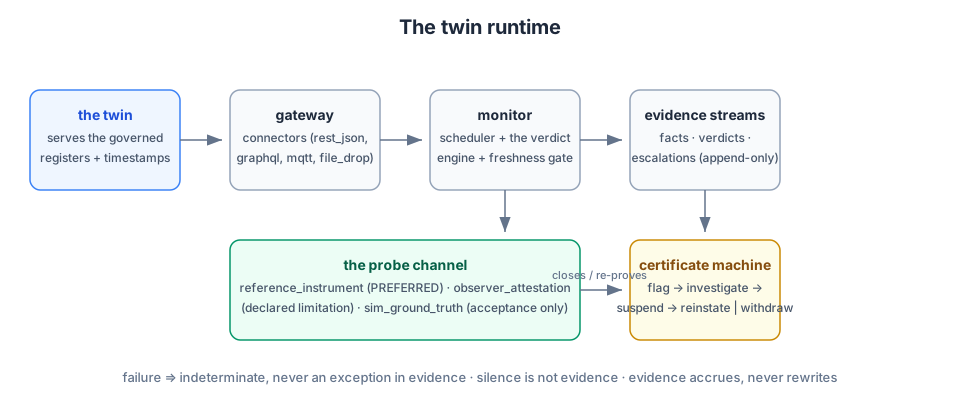
What the gateway does. Fetches served values from twins and lands them in the entity registers:
- Connectors are a registry (
registerConnector(profile, factory)):rest_json(poll GET + webhook),graphql(the sim’s/twinis the reference server, with GraphQL-over-SSE for subscriptions),mqtt,file_drop(batch ingestion), andopc_uaas a declared stub. - Freshness is judged against the twin’s own served timestamp
(
timestamp_fields), a stale twin degrades toindeterminate, never fails and never silently passes. A declared-but-absent timestamp isunavailable, never invented. - Failures are
unavailable, never exceptions. A dead connector leaves the register untouched and writes the health log; the freshness gate owns the degradation. - No secrets in models. Credentials are
{ env: VAR_NAME }references resolved at runtime; literals under secret-looking keys are rejected by validation.
What the monitor does. Watches the certified fleet continuously:
- A scheduler + the existing verdict engine (never a second dialect): timer / signal / change triggers → gateway fetch → freshness gate → verdicts per requirement per twin.
- Evidence streams, facts, verdicts, escalations: append-only,
window-queryable, version-pinned (every record carries
definition: { monitor, version, standard_id }). A transport failure never lands as evidence. - Re-judgment (INV-5): re-run a stored window against new limits with zero twin queries, the stored snapshots are the judgment basis; re-judged verdicts append marked, never rewrite.
- Escalation closure: a certificate clear | reinstate closes the flags it judged (the record accrues closure metadata), so a fresh fail cycle opens a fresh record and a stale flag never re-investigates.
What it owns. The runtime semantics: connectors, cycles, the
streams, the deployment bindings (model/gateway.yaml and
model/monitors.yaml are app config, not normative content).
How it proves it works. The acceptance suites:
sim-twin-acceptance (the real wire against a live sim: pass ⇒ drift
fail + escalation ⇒ outage indeterminate ⇒ restart recover),
monitor-acceptance (24 cycles + zero-call re-judgment),
gateway-verdict-e2e, and the twin-cert surveillance walks.
Where it plugs in. The packages declare the twin interfaces
(model/twin.prl); deployments bind them live. The twin-cert program
adds its fleet monitor (five continuously-judgeable requirements ,
campaign-shaped requirements like creep-envelope are judged by probe
campaigns, never per cycle). The twin lab (browser/src/twin-lab/,
page /app/twin-lab) is the generic operator face of exactly this
runtime: it derives a deployment binding from the rec’s declared
interface ∩ a live endpoint’s introspected surface, runs monitor
cycles over it, and compiles guided conformance-test runs into the
rec’s own evidence forms, the deployment is the lab session. The
streaming leg of the same runtime, following a twin instead of
polling it, has its own page:
14, the twin stream.
Peel deeper. AGENTS.d/12-twin-integration.md (the complete runtime
doctrine), AGENTS.d/14-twin-certification-program.md.
Back to the index.