

The Authority Duality: the committee publishes both forms
The committee in charge of a Recommendation publishes its decisions in two co-authoritative forms, the text and the SMART model, and the platform audits the duality in both directions at build time.
Version 1.0 · 2026-08-18 · Doctrine (TODO.standards/14). This statement is normative for the program: a feature that treats the model as subordinate to the text, or the text as subordinate to the model, is a defect, not a direction.
The concern this retires
The program’s August 2026 external review carried an unnamed premise: that the published text is the sole authority of a Recommendation, and that a machine-readable model of it is a derivative risk to be managed. That premise is wrong, and the program does not concede it. The authority of a Recommendation is the COMMITTEE’s decision. The committee in charge, a 62-member-body governance, publishes its decisions in two co-authoritative forms: the text and the SMART model. Neither form outranks the other, because both are the same decisions published by the same body. No single member body, no administration, and no external ecosystem holds a special seat in that authority, and authority never flows from them.
The two forms, made auditable: the congruence matrix
A claim of co-authority is only as good as its audit surface. The platform generates, at build time and per Recommendation, the congruence matrix: the duality checked in both directions.
- Forward, the committee’s reading order. Every clause of the
published text, in the document’s own numbering, maps to the model
nodes that carry it. Where the committee has not yet resolved a
clause into the model, the row records the committee-pending decision
with its reason and date (the named gaps of
config/sources-prd/<rec>/congruence.yaml), never a silent absence. - Reverse, the engineer’s reading order. Every model node maps to its clause anchors in the published text, so any behavior of the model can be traced to the exact clause that authorizes it.
The matrix is published per Recommendation on the platform’s reference
surface (for R 60: /app/standards/r60/congruence, likewise for R 91,
R 129 and R 144), rendered from the build artifact
(browser/src/data/generated/congruence-matrix.ts, produced by
browser/build/congruence-matrix-plugin.ts). The committee-facing view
reads the text’s own clause order; the engineering view reads the
model’s nodes.
The gate is npm run test:congruence-matrix
(browser/scripts/congruence-matrix-gate.ts, wired into bin/check).
It fails the build when a clause loses its mapping, and it fails the
build when a model node cites a clause the text does not have. Duality
drift is a build error, never a review surprise. Both failure
directions are mutation-proven in
browser/src/__tests__/congruence-matrix.test.ts.
The matrix rides the existing provenance machinery: every model node
already carries clause-level provenance
(source: { doc: urn:oiml:pub:r:60-1:2021, clause: "…" }), and the
extraction pipeline (sources/ + scripts/extract-prd.py) already
decomposes the compiled text into addressed, normativity-marked
fragments (the .prd extracts, TODO.roadmap/24). The matrix adds no
new authoring burden; it makes the existing provenance auditable in the
two directions the doctrine requires. Its scope is the extracted source
parts of each Recommendation. Citations of documents outside the
extracted set (the VIM, the VIML, other Recommendations) are
references, not duality anchors; the
docs/standards/alignment-register.md
owns their disposition.
Interpretation decisions land in both forms
Where the text underdetermines a value or a behavior, the committee’s
resolution is recorded once, in the Recommendation’s modelling-decisions
register, and lands in both forms with the same decision id. The model
does not defer to the text, and the text does not defer to the model:
both forms carry the committee’s decision. The running instance of this
practice is the
docs/standards/r60-modelling-decisions.md,
which records the interpretation decisions, the source-text
contradictions the model forced into the open, and the named gaps that
remain; the edition-drift comparison it draws on is
analysis/clause-drift-r60-2017-2021.txt, and the R 60 congruence
matrix links the register from the page’s provenance line.
The model-normative publication mode, supported today
The forward direction of the doctrine, stated plainly: a committee may publish the SMART model as the sole normative form of a Recommendation, with the text as guidance. That is a legitimate and supported evolution of this platform, not a risk to be guarded against. The platform already runs Recommendation models as executable truth; dual-form publication is the current publication practice, not an architectural ceiling.
Concretely, a committee publishes a model-normative Recommendation
today by declaring it in the Recommendation’s manifest
(config/standards/<tree>/standard.yaml):
publication:
  mode: model-normative
Under this declaration the model package carries the normative core;
the loader and the evaluator consume the model exactly as they do for
every Recommendation (there is no code path that evaluates the text),
and the text attaches as guidance: the declaration lands in the
standard’s generated meta, and the reference surface marks the mode
(the congruence page carries the publication-mode badge and, under
model-normative, the banner stating that the model is the normative
form and the text is guidance). The
congruence matrix still audits both directions under this mode, because
even a guidance text must not drift from the normative model. The mode
is exercised by a fixture Recommendation in the unit suite
(browser/src/__tests__/congruence-matrix.test.ts, the model-first
describe block). The undeclared default is dual, the co-authoritative
publication practice described above.
The figure
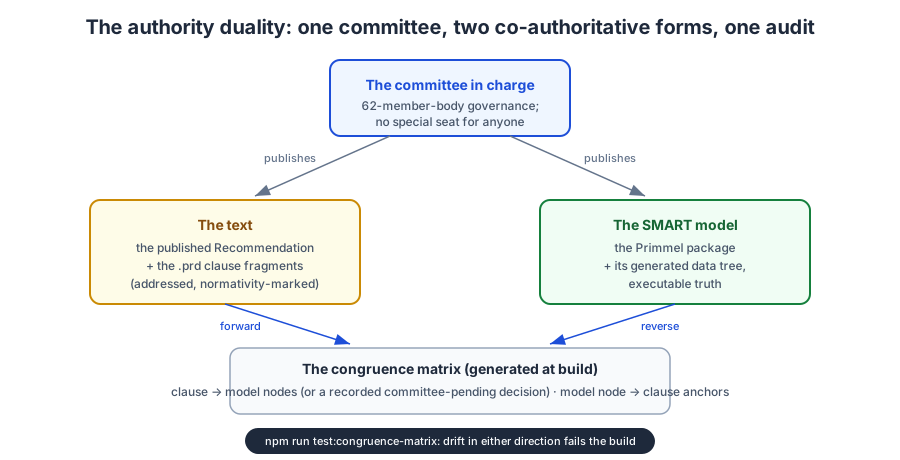
The figure reads from the top. The committee in charge of the
Recommendation sits at the top as the sole source of authority. Two
arrows descend from it to the two co-authoritative forms it publishes:
the text (the published PDF, and its addressed clause fragments in the
.prd extracts) on the left, and the SMART model (the Primmel package
and its generated data tree) on the right. Neither arrow is primary;
both carry the committee’s decisions. Beneath the two forms, the
congruence matrix spans them with two arrows in opposite directions:
the forward mapping (every clause to its model nodes, or to a recorded
committee-pending decision) and the reverse mapping (every model node
to its clause anchors). At the base, the build gate
(npm run test:congruence-matrix) watches both arrows: drift in either
direction fails the build.
What this doctrine is not
- It does not renumber, reword, or restructure any published text. The
extraction is verbatim, and the text-identity axis of the
reconstruction congruence gate (
npm run validate, section 1g) proves it. - It offers committees no governance advice beyond documenting the two publication modes. The choice of mode belongs to the committee.
- It does not make the model supreme. The
dualmode is the default and the current practice;model-normativeis a supported publication mode a committee may choose, and the duality gate guards both equally.