

Shared Modules
emc-disturbances, env-iec60068, software-d31, reference-materials, specimen-governance, report-headers, examination-docs.
In this chapter: the seven shared modules, parameterized test and form families between the OIML core and the Recommendation packages, what each provides, what each requires, who consumes it, and the per-rec delta mechanism that replaced copying.
10.1 The problem: between “copy” and “restate from scratch”
The cross-standard census (analysis/cross-standard-layering.md) measured the
three re-architected Recommendation trees, R 60 (111 YAML files), R 91 (34), R
144 (76), and found two kinds of sharing:
- Verbatim sharing. 12 R 91 files are byte-identical to R 60. Some are genuinely shareable (parties, workflow entities, state machines, obligation); some are wrong for R 91 (certificate template, gateways, notes, checklist , the audit’s R2 residue). The census’ verdict: the copy mechanism and the bug mechanism are the same mechanism.
- Pattern sharing. Every rec re-implements the same EMC immunity family, the same IEC 60068 climatic family, the same D 31 software examination, the same report headers, with different observables, severities, acceptance quantities, and clause URNs. Byte-level sharing cannot express this; restating from scratch loses the skeleton.
The first kind is core content (chapters 1–8 of this volume). The second kind is neither core (the content is not identical) nor rec content (the pattern is not the rec’s law). The seven shared modules are the missing mechanism: layer 2b in the language stack, parameterized packages that freeze a skeleton and let each Recommendation bind its own content.
Status honesty: the patterns run inline in the rec packages (●), and the
packaged modules with the uses: composition are shipped (● smart
e80b349, tasks 14/17), all seven carry kind module as
oiml-smart-module-* packages, with R 60, R 144 and R 129 as the proving
consumers. Each module entry below marks both the inline pattern and the
packaged consumption.
10.2 The module contract
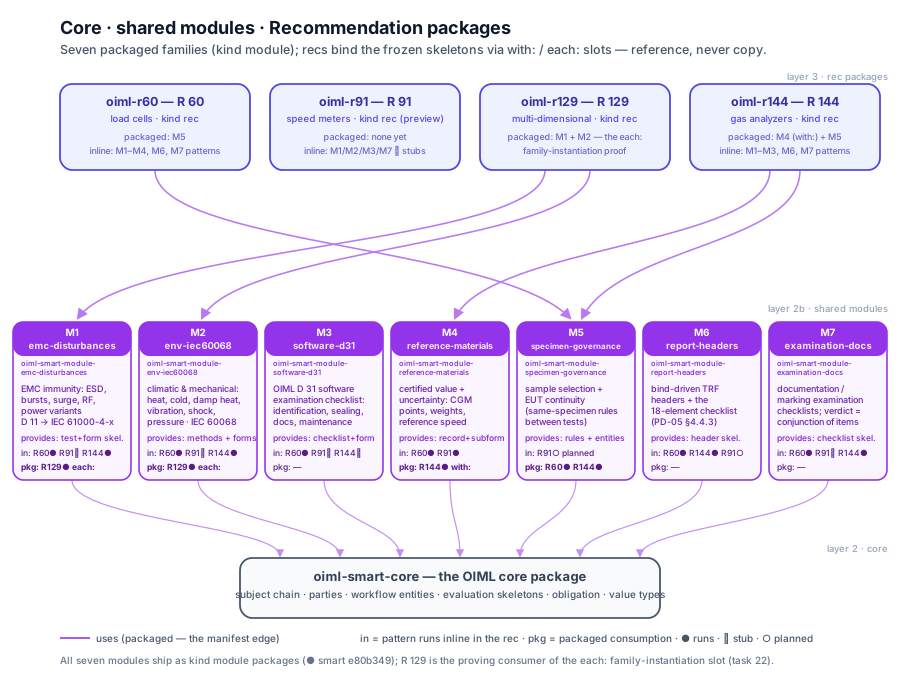
A module is a package (Volume I, chapter 8) with a three-part contract:
- provides, the frozen skeletons: test patterns, form skeletons, verdict variants, checklist structures;
- requires, what a consumer must supply: core entities, attribute ids, dimensions, capabilities;
- consumers, the Recommendations known to bind it.
The per-rec delta mechanism has exactly four binding slots:
- attribute ids, the rec’s own observable and parameter names
(
indicationin counts vse_xin ppm); - severities, the test levels (discharge voltages, temperatures, durations, drop heights);
- acceptance expressions, the OCL limit, targeting the rec’s own requirement ids and verdict quantities;
- clause URNs, provenance into the rec’s own edition.
The parameterization machinery is shipped (●): a module’s skeletons/
templates carry ${{ slot }} placeholders; a slot in the manifest’s
with_slots materializes at its target path when the rec binds it
(uses: [{ module: module-<name>, with: { <slot>: <value> } }]), and a
slot declared each: true binds a list of binding maps so a whole
test family instantiates from one with-map. The skeleton owns the pattern
interface (field names, types, measurement methods, derivations, verdict
rules); the rec’s overlay at the target path binds units, calculation
ids, clause URNs, enum values and flavored labels, it references
module ids, never redefines them, and a multilingual-array key is owned
by exactly one side per field (composition unions such arrays; restating
one duplicates entries and fails the uses-no-redefine check).
10.3 M1, emc-disturbances
Scope. The EMC immunity test family. The normative anchor chain is identical in every rec: rec → OIML D 11 → IEC 61000-4-x (R 144 names the parts: -4-2 ESD, -4-4 bursts, -4-5 surge, -4-3/-4-6 RF, -4-11 dips).
The shared skeleton (evidenced by the cross-rec ESD comparison):
kind: disturbance
steps: record baseline observable
     → apply disturbance at severity S
     → record observable under disturbance
verdict pattern (two rec variants):
  R 60:  ocl{not significant_fault}   — significant_fault := abs(difference) > v_min
  R 144: abs(e_x) <= abs(mpe_v) or fault_detected        (R 144-1, 4.5.4)
form skeleton: header ref → disturbance parameters (severity, network,
  polarity) → measurement rows (subform) → fault flag → verdict → remarks
provides: test patterns esd, bursts, surge, rf-emf, conducted-rf,
power-voltage-variation, short-time-power-reduction, low-battery;
parameterized form skeletons; the verdict variants. requires: core
entities; the rec’s observable attributes; the electronic capability flags.
package ● oiml-smart-module-emc-disturbances (provides
disturbance-test-skeletons, disturbance-form-skeletons,
disturbance-verdict-variants).
consumers: R 60 ● (specification/conformance/electronic.yaml, esd at R
60-2 §2.10.7.8: record reference indication → apply contact discharge → record
→ apply air discharge → record → check significant fault → determine
pass/fail), R 144 ● (per-part tests, verdict within_limits_or_detected), R 91
◐ (stubs, its audit condenses 33 normative rows to 11 stubs), all inline;
R 129 ● packaged (task 22, the each: proving consumer: the
8-disturbance-form family instantiates from one with-map, thin overlays at
execution/forms/emc/<form_id>.yaml binding severities, clause URNs, labels
and enum values). deltas: observable names and
units, severities, acceptance quantity, clause URNs, form ids.
10.4 M2, env-iec60068
Scope. Climatic and mechanical influence tests, anchored to IEC 60068: -2-1 cold, -2-2 dry heat, -2-78 damp heat steady, -2-30 damp heat cyclic, -2-47/-2-64 vibration, -2-31 shock (R 144 adds -2-17 leak).
Shared skeleton: kind: influence; stabilize at severity → measure against
reference → verdict abs(error) <= mpe_operating (or the rec’s own influence
limit).
provides: dry-heat, cold, damp-heat (cyclic | steady), vibration, shock,
ambient-pressure method skeletons + form skeletons. requires: core;
reference-materials (the test-point subform). package ●
oiml-smart-module-env-iec60068 (provides env-method-skeletons,
env-form-skeletons).
consumers: R 144 ● (dry heat
at 40 °C, cold at 5 °C, damp heat 30 °C / 85 % RH for 2 days, vibration, shock
as a 25 mm edge drop), R 60 ●, consumes the method skeleton and keeps its
own acceptance quantities (the temperature effect on MDLO; the humidity limits,
themselves carrying a source discrepancy the census records), R 91 ◐ (stubs) ,
all inline; R 129 ● packaged (the environmental forms instantiate through
the same each: with-map mechanism at execution/forms/env/<form_id>.yaml;
its execution/subforms/dimension-measurement.yaml is the bound
measurement-row shape). deltas: severities, stabilization rates, the
acceptance limit (MPE vs a rec-specific influence limit), condition-tier
bindings.
10.5 M3, software-d31
Scope. The OIML D 31 software examination checklist pattern: identification, sealing/protection, documentation, maintenance interfaces.
provides: the examination checklist skeleton + form. requires: core;
the rec’s software identity attributes (legally relevant software, Module B).
package ● oiml-smart-module-software-d31 (provides
software-examination-skeleton); no packaged consumer yet, the recs run the
pattern inline.
consumers: R 60 ● (test software, R 60-2 §2.6, with the 10-field
software-examination form), R 91 ◐ (stub today; R 91-2 §8 requires the real
evaluation), R 144 ◐ (lightweight variant, software appears as
documentation-examination items). deltas: the
checklist items, bound to the rec’s documentation requirements and software
attributes.
10.6 M4, reference-materials
Scope. The traceable reference pattern: a certified reference entity , certified value + uncertainty + traceability, bound into test runs, with machine-checked normative constraints on its use.
provides: the reference-material record pattern; the test-point subform
skeleton (the CGM-point shape); the uncertainty-budget validity hook (the
census’ language gap L7). requires: core, Module D1 ReferenceMaterial ●
already carries the shape: identity fields plus OCL constraints bound to
evidence fields via evidence: maps, with on_violation: invalidate voiding
the run. package ● oiml-smart-module-reference-materials (provides
reference-material-pattern, test-point-subform, umpe-validity-hook).
consumers: R 144 ●, the most complete instantiation,
packaged (the proving with: consumer: with: { subform: cgm-point } ,
its execution/subforms/cgm-point.yaml a thin overlay):
specification/reference-materials.yaml declares the certified gas mixture
with identity fields (composition, certified value, expanded uncertainty k=2,
certification authority, certificate id, expiry, traceability) and constraints
(blend tolerance ≤ 10 %, Annex A.2.2; the U:MPE ≤ 1:3 rule with the
issuing-authority 1:2 override, R 144-1 §7.2.2.2), evaluated against run
evidence before the verdict; execution/subforms/cgm-point.yaml, one row
per CGM point: certified value, indications, mean, error, MPE-at-point ,
consumed by fourteen forms. R 60 ● (weights / the force-generating system;
test-equipment declarations with calibration references). R 91 ●
(reference-speed variables). deltas: the material kind, identity fields,
the constraint set, the evidence binding.
10.7 M5, specimen-governance
Scope. Sample selection plus EUT continuity: which specimens are tested, and the rule that a test series keeps the same equipment under test.
provides: the sample-selection-rules schema (id / step / rule / rationale /
applicability / selector / test_kind, the IA auto-select walks these) and the
EUT-continuity contract (the design.specimens block: count,
max_additional, continuity, rules). requires: core, the TestRun →
sample linkage is the run-level face; the test-report checklist’s
sample-selection row is the checklist face. package ●
oiml-smart-module-specimen-governance (provides sample-selection-rules,
eut-continuity-contract, test-execution-entities).
consumers: R 60 ● packaged (R 60-2 §2.4 + Annex D:
smallest e_max per group; the merit walk class → n_lc → v_min in
5–10× steps; same-capacity de-duplication; partial-evaluation flags), R 144 ●
packaged (R 144-1 §7.1.2, definitive-type-per-model), R 91 ○ (when its
evaluation layer lands). deltas: the normative rules themselves, selection
law is rec content; the schema and consumption path are shared.
10.8 M6, report-headers
Scope. Test-report header and identification blocks: the bind-driven skeleton every report page carries, plus the OIML-CS 18-element report checklist.
provides: header skeletons, an identification block bound to the subject
chain (family.*, model.*, sample.*) plus a test-conditions block, and
the 18-element checklist binding rules (PD-05 §4.4.3, elements a–r, each with a
source binding and a validation). requires: core (subject-chain and
workflow entities). package ● oiml-smart-module-report-headers (provides
report-header-skeletons, checklist-binding-rules); no packaged consumer
yet, the recs bind their headers inline.
consumers: R 60 ● (five headers: header-a,
header-b, header-c, conditions, sh-humidity-header), R 144 ● (three:
header-a, header-b, conditions), R 91 ○ (when its forms land).
deltas: exactly the bound attributes and dimensions ,
model.parameters.e_max in R 60’s header-a vs
model.classification.measurand_components in R 144’s. The two files are 57 %
structurally similar, and the difference is the binding set. R 60’s
header-c and SH humidity header are rec-specific extensions that stay in the
rec.
10.9 M7, examination-docs
Scope. Documentation, marking, and visual examination: checklist-style examination of documents and inscriptions against technical-requirement targets.
provides: the examination checklist skeleton; the verdict is the
conjunction of item booleans (ocl{a and b and …}, visible in both R 60 and R
144 forms). requires: core; the rec’s documentation and marking
requirements. package ● oiml-smart-module-examination-docs (provides
examination-docs-skeleton); no packaged consumer yet, the recs run the
checklists inline.
consumers: R 60 ● (documentation, inscriptions,
suitability, software), R 144 ● (documentation, visual-examination), R
91 ◐ (documentation-inspection, vehicle-identification stubs). deltas:
the item lists and their requirement targets; marking content is rec law and
stays in the rec.
10.10 What stays out of the modules
The census is equally clear in the other direction: requirements, MPE tables, acceptance quantities, terminology, and the whole model layer are normative ownership, the rec’s own law, never shared by reference. R 91’s conditions file (R 60’s 20 ± 2 °C reference tier where R 91 requires 23 ± 5 °C) is the standing proof: anything allowed to drift via copies eventually does. Modules take the skeletons; the rec keeps the law.
10.11 Grammar sketch (shipped v3 forms)
# ── the module package manifest (verbatim shape) ───────────
package {
  id oiml-smart-module-emc-disturbances
  kind module
  uses { oiml-smart-core }
  requires { oiml-smart-core }
  provides { disturbance-test-skeletons disturbance-form-skeletons
             disturbance-verdict-variants }
}
# ── the rec binds the slots — reference, never redefine ────
# (layer-manifest form; an each: slot instantiates per entry)
uses:
- module: module-emc-disturbances
with:
forms: # each: true — one with-map,
- test_id: /conf/disturbance-tests/esd # eight R 129 forms
form_id: esd
form_identifier: r129-3/sec-2.10
requirement_clause: urn:oiml:pub:r:129-1:2020#clause-4.3.1
verdict_variant: "ocl{measurements->forAll(m | m.pass_fail)}"10.12 Validation rules
Composition-time checks (the model linker and the registry extended across
uses: boundaries, all live, ●):
- every module
requiresis satisfied by core, by previously composed modules, or by the rec itself, an unmet capability token fails the composition; - no id is defined twice across layers, an overlay references module and core ids, never redefines them (uses-no-redefine, incl. the multilingual-array single-owner law);
- every module
providesis consumed by the rec or explicitly waived, partial consumers are legal, silent omission is not; - overlay bindings type-check against the frozen skeleton: bound attribute ids
exist in the rec’s register, severities are QuantityValues (INV-1),
acceptance OCL resolves (INV-3, INV-9), clause URNs match the rec’s declared
edition;
with:slot bindings are validated (an unknown slot or a missing required binding fails); - module packages carry
kind module(and corekind core), so registries, navigation, and search never list them as publishable Recommendations.
10.13 Summary
- The seven modules are layer 2b: parameterized test/form families between the OIML core and the rec packages, the mechanism between “copy” and “restate from scratch”.
- Each module freezes skeletons and declares provides / requires / consumers; each rec binds exactly four slots: attribute ids, severities, acceptance expressions, clause URNs.
- The patterns run inline in the recs (●), and the packaged modules ship (●) ,
all seven
oiml-smart-module-*packages withkind module; R 60 and R 144 consume specimen-governance (R 144 adds reference-materials viawith:), R 129 consumes emc-disturbances and env-iec60068 via theeach:family-instantiation slot. - Normative content, requirements, tables, acceptance quantities, terminology , never enters a module; R 91’s copied conditions are the standing proof of why.
Next: Volume III, Authoring OIML Recommendations: the methodology that turns a Recommendation text into a validated package.