

The baked trees (`.cache/primmel/`)
The baked trees are the composed model trees the build actually reads, composed fresh on every bake and never committed.
What it is. The composed model trees the build actually reads. One
tree per standard (r60, r91, r129, r144), plus the layers they
compose from (core, the iso-iec-* packages, oiml-cs,
oiml-cs-dataspace, the oiml-smart-module-* packages), the program
tree (oiml-twin-cert), the lab packages (config/labs/lab-*), and
the sample data (config/standards/<tree>/sample-data.yaml). The
trees live in the build cache (browser/.cache/primmel/<tree>/),
composed fresh on every bake, never committed.
What it does. It is the middle stage of the SSOT flow: packages →
these trees → generated TypeScript → the app. The bake
(browser/build/bake.ts) projects each package’s PRL content into the
tree shape and overlays the authored app config
(config/standards/<tree>/), writing a per-tree source-map.json
that answers “where did you come from” for every file.
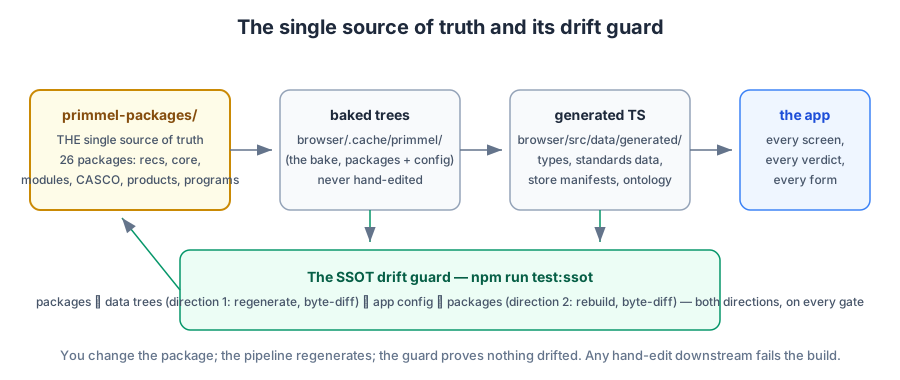
What it owns. Nothing. That is the point: these trees are downstream baked artifacts of the packages. Every convention about them exists to keep that true:
- Never hand-edit a baked file. The drift guard
(
npm run test:ssot) rebakes and byte-diffs; a hand edit fails the build. - Author in Primmel in the content repo
(oimlsmart/primmel-packages);
a content change lands here only by a deliberate bump of the pinned
@oimlsmart/primmel-packages. - Two classes of content stay authored app config by doctrine:
document prose modules (
documents/<doc>/document.yaml, prose has no PRL construct, the package ships them verbatim) and consumer-side runtime bindings (model/gateway.yaml,model/monitors.yamldeployments are runtime configuration, not normative content). App-config residuals live underconfig/standards/<tree>/; the bake carries them byte-clean.
How it proves it works. npm run test:ssot, byte-clean, on every
gate run.
Where it plugs in. The build (browser/build/standards-registry.ts)
reads each standard’s baked tree (the REC-WINS layer overlays were
composed and asserted at bake time), codegen projects it to
src/data/generated/, and the app consumes that.
Peel deeper. AGENTS.d/05-data-conventions.md,
AGENTS.d/07-linker-layering-and-pins.md (the layer composition).
Back to the index.