

Parties and Workflow
Parties, roles, the certification workflow entities, lifecycle state machines.
In this chapter: who acts, and the machinery that moves the artifacts. The party model, the eleven roles, the certification workflow entities, the lifecycle state machines, gateways, and approvals, the OIML-CS certification process as an implementation model of the scheme.
8.1 The workflow is an implementation model
Everything in Chapters 5–7 is reference content: what the Recommendation says. This chapter is different in kind: the certification workflow , application, dispatch, report, evaluation, certificate, is the operation of organizations, an implementation model whose reference model is the OIML Certification System (OIML-CS, PD-05) itself.
The compliance relation between the two is mapping (A ⇒ B: fulfilling
the implementation fulfils the scheme clause). In the running system the
mappings are still embryonic: each approval step carries its PD-05 clause
reference (data/r60/evaluation/approvals.yaml, reference: "PD-05 §4.5"), a hand-written pointer where v3 will carry a typed .prm mapping
with coverage calculus ◐. Every entity below is an implementation component
that maps to a PD-05 provision, not a restatement of it.
A workflow is itself a subject, and the universal anatomy organizes the
chapter: a workflow IS its phase model (parties, roles, phases),
HAS lifecycle state per object (the state machines), DOES its
dispatch/evaluate/issue processes (gateways, approvals, cascades). Note
throughout: lifecycle state is the state of a process artifact (an
application, a report, a certificate), never the subject’s operational
state (off → warming → … → fault), a HAS aspect of the instrument.
8.2 Workflow IS: the party model
Parties are Foundations-tier content, referenced by everything, anchored
to nothing in the subject. Four party classes cover the certification
world (data/r60/entities/parties.yaml) ●; the BIML in the table is a
role (data/r60/evaluation/roles.yaml), not a party class:
| Party | What it is | Key fields |
|---|---|---|
| Manufacturer | the organization responsible for the instrument (Module B) | legal identity, address, contact |
| IssuingAuthority (IA) | OIML Issuing Authority: conducts type evaluation, issues certificates | oiml_code, country, utilized_laboratory_ids, declarations |
| TestLaboratory (TL) | performs the tests on an IA’s behalf | oiml_id, lab_kind, declared capabilities |
| Expert | registered individual expert | kind: lm-expert | ms-expert, registration status |
| BIML | the Bureau, registers certificates (a role; the registration record lives on the Certificate) | registration machinery (§8.7) |
Two modelling decisions deserve note:
- IA and TL share one store. Both extend a common
Organizationbase (identity, address, OIML scope, accreditation), discriminated bykind: issuing-authority | test-laboratory, oneorganizationsstore, two concrete parties;kindis single-valued, so the same legal entity may register once per kind. - Labs declare capabilities, not equipment. A TestLaboratory carries an
abstract capability list (
humidity-testing,emax-up-to-50000kg, …) that dispatch matching consumes (evaluation/lab-selection-criteria.yamlmaps parameter values to required capabilities,humidity_class = CHrequireshumidity-testing). Amanufacturer_test_lab(the MTL of PD-05 §5.3.1 b, Scheme A) must reference its parent manufacturer (§8.6).
8.3 Workflow IS: the role model
Parties are organizations; roles are functions in the process. The
role model (data/r60/evaluation/roles.yaml) declares exactly eleven ●:
applicant            manufacturer          issuing_authority
test_laboratory      manufacturer_test_laboratory
evaluator            supervisor            test_operator
responsible_person_ia  responsible_person_tl
biml
The granularity is deliberate: who may act is answered per transition,
per approval, per console, and the answers differ. The applicant drafts
and resubmits; the evaluator performs tests and evaluations; the
supervisor reviews them; the responsible_person_* signs at each
organization. The platform’s access layer resolves the same model: role
homes and section rules in browser/src/auth/roles.ts, consoles per role
, the applicant portal, the IA console (review → dispatch → evaluate →
issue), the TL workbench, all reading the one role declaration.
Two roles wait in the twin direction (Volume I, Chapter 14 §14.8 ○), and they are deliberately not among the eleven. The twin provider , the manufacturer, or the owner-operator of a deployed unit, serves the live instance and speaks for the product. The engine operator, an IA, regulator or market-surveillance body running continuous evaluation , runs the monitors and speaks for the standard. They belong to the continuous-compliance loop that runs after issuance, not to the certification loop this chapter models; when v3 admits them, they enter the role declaration the same way the eleven did, resolved per transition, per console.
8.4 Workflow IS: the phase model and entity chain
The workflow runs five phases with actor handoffs
(data/r60/evaluation/workflow.yaml): intake (applicant),
dispatch (IA), testing (TL), evaluation (IA), issuance
(IA → BIML). Each step declares actor, inputs, outputs, and gates ,
preconditions that must hold before the next step begins. The entity chain:
Application ──< TestRequest (one per lab) ──< TestAssignment (form × sample × lab)
                                    TestReport (per lab × group) ──< FormInstance / TestRun
EvaluationReport ──< TestReportDetermination ──< ModelEvaluation
Certificate ──► BIML registration
The entities, in order of life:
- Application, the type evaluation request: references the model
family matrix (
model_family_id,model_ids[]) and samples on the subject chain (the instrument definition is not duplicated onto the application, it lives on the chain), plus scheme (A/B), ANR countries, documentation, and the IA review result (PD-05 §4.2). - TestRequest, the IA’s dispatch to one laboratory
(
assigned_laboratory_id), one per lab: the explicit work tuples (assignments), test conditions, scheme/MTL flags, andparent_request_idsfor re-tests and amended requests. - TestAssignment, the atomic unit of work: one form × one sample × one model × one lab. The IA chooses precisely which (form, sample) pairs each lab performs, a high-capacity lab and a humidity lab split one family between them.
- TestReport, the lab’s submission, one per lab × model group,
bundling its FormInstances (cascade) and declaring justified
form_omissions; signed by evaluator and authorizing person (PD-05 §4.4.3 r). Inside it, the FormInstance (one per form × sample: recorded values + OCL-computed values) and the TestRun of Chapter 6. - EvaluationReport, the IA’s aggregate over
test_report_ids[]: per-form determinations, one TestReportDetermination per report (the admissibility gate with its re-executed verdicts), one ModelEvaluation per model (the cross-lab synthesis), and theoverall_decision(Chapter 7’s three levels). - Certificate, issued on APPROVED; scope mirrors the application’s
matrix (or the amended outcome); its
biml_registrationrecord closes the chain at the BIML ● (registration service + public register at/app/register; true web publication ○).
8.5 Workflow HAS: lifecycle state machines
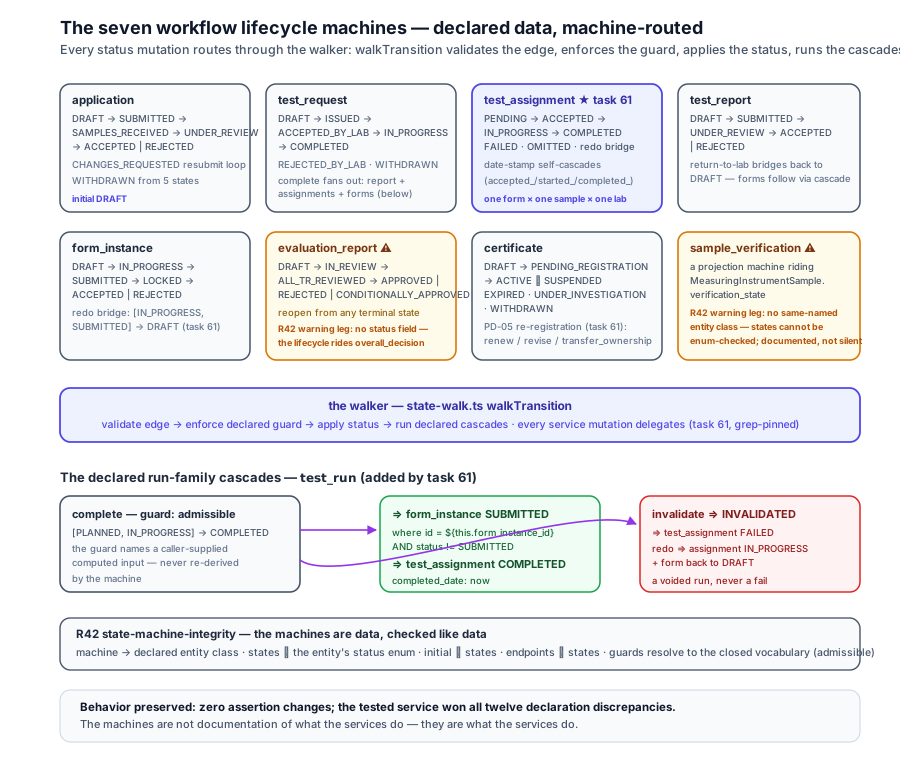
Every process artifact carries its lifecycle as data
(data/r60/evaluation/state-machines.yaml), seven machines ●. Three
representative shapes:
- application:
DRAFT → SUBMITTED → SAMPLES_REQUESTED → SAMPLES_RECEIVED → UNDER_REVIEW → ACCEPTED | REJECTED, with the edit-and-resubmit loopCHANGES_REQUESTED → UNDER_REVIEWandWITHDRAWNreachable from five states. - test_request:
DRAFT → ISSUED → ACCEPTED_BY_LAB → IN_PROGRESS → COMPLETED(plusREJECTED_BY_LAB,WITHDRAWN). - certificate:
DRAFT → PENDING_REGISTRATION → ACTIVE, then the post-issue life:EXPIRED,SUSPENDED ⇄ ACTIVE,UNDER_INVESTIGATION,WITHDRAWNfrom three sources, plus the PD-05 re-registration edges (renew/revise/transfer_ownershipfrom[ACTIVE, EXPIRED]).
Three mechanics make the machines executable rather than decorative:
-
Guarded transitions. Each transition is a triple
{ from, to, action }; only the declared action fires it, and only the role the action names may fire it. A transition may also name a guard from the closed vocabulary, today exactly one:admissible, the test-run service’s computed admissibility, required by the test_run machine’scompletetransition. A guard names a caller-supplied computed input the walker requires at walk time; the machine never re-derives it (the R 144state: readygate precedent). -
Cascades. A transition may declare side effects on other entities:
set(field writes,'now'timestamps),where(a filter selecting the affected rows),create(new records, e.g. the audit event on issue), and the semantic actions (submit/lock). A status write on a machinated target is never a raw write: the step declaresvia <transition-action>and the walker routes the hop through the TARGET record’s own machine (gap E12), walked when the record sits in the named edge’s from-set (the payload rides along, and the edge’s own cascades fire under an activation stack that throws on a cycle), skipped untouched when the record is already at the target (no date re-stamping, that would falsify the audit trail), refused loudly otherwise. Completing a TestRequest timestamps it, submits its TestReport, and completes its assignments, one atomic act:- from: IN_PROGRESS to: COMPLETED action: lab_issues_test_report cascade: - entity: test_request set: { status: 'COMPLETED', completed_date: 'now' } - action: submit target: test_report where: 'test_request_id = ${this.id}' via: lab_submits - entity: test_assignment where: 'test_request_id = ${this.id} AND status != OMITTED' via: complete set: { status: 'COMPLETED', completed_date: 'now' }The report’s FormInstances lock as the NESTED cascade of the report’s own
lab_submitshop, the composition is declared once, on the edge that owns it. Self-targeting steps (test_requestabove) stay raw writes: the walker already set the status, and thesetblock carries the payload dates. The routing contract is checked twice: kernel rule C95 cascade-transition-resolve over the packages, mirrored by linker rule R44 cascade-routing over the composed trees (via resolves, lands on the written status, unguarded, and forbidden everywhere else). -
Multi-source transitions.
frommay be a list: the applicant withdraws from any of five pre-decision states; the IA reopens a finalized evaluation report from any of its three terminal states ([APPROVED, REJECTED, CONDITIONALLY_APPROVED] → IN_REVIEW). The machine states the real policy, “withdrawable until decision”, as one transition, not five.
8.5.1 All mutation is machine-routed (task 61) ●
The machines above are not documentation of what the services do, they
are what the services do. Phase 9 (task 61, ● smart 6a9484b) completed
the machine-routing: the state walker (browser/src/data/state-walk.ts)
exports walkTransition, validate the edge, enforce the declared
guard, apply the status, run the declared cascades, and every
mutation site delegates to it: all ten test-run.service status
writes, useTestAssignment.setStatus, useApplication.updateStatus,
useTestReport.submit, and all eleven useCertificate lifecycle
methods. The delegation is behavior-preserving by construction: zero
assertion changes in the test suite, and a pinned grep leg
(lifecycle-machines.test.ts) proves no .status = write survives in
the seven-entity surface outside the walker.
The task also closed the declaration gaps it found. Six of the seven
machines were already declared; the task added TestAssignment (with
date-stamp self-cascades) and TestRun, the run-family cascades now
declared, not coded: COMPLETED ⇒ the form goes SUBMITTED and the
assignment COMPLETED; INVALIDATED ⇒ the assignment FAILED; redo ⇒
the assignment back to IN_PROGRESS and the form to DRAFT. FormInstance
gained the service-tested DRAFT → SUBMITTED hop and the redo bridge;
Certificate gained the re-registration edges named above. One premise
the task corrected honestly: twelve viewer-table/service discrepancies
surfaced in the merge, and the tested service won every one, the
machines were authored from observed behavior, and where the two
disagreed the disagreement is recorded. (One such record has since been
resolved: EvaluationReport carried no status field at task-61 time,
its machine declared data riding overall_decision; gap D8 separated
the axes, the entity now carries a walker-owned status, the workflow
position, DISTINCT from overall_decision, the JUDGMENT axis the
terminal transitions set by declared cascade.)
8.5.2 R42, the machines’ own integrity ●
The machines are data, so they are checked like data. Linker rule R42
state-machine-integrity resolves every machine to its declared entity
class, requires its states to be values of the entity’s status enum
(initial ∈ states, every transition endpoint ∈ states), and resolves
every declared guard against the closed vocabulary. One documented
warning leg stays visible rather than silent: sample_verification
(a projection machine riding
MeasuringInstrumentSample.verification_state, its states cannot be
enum-checked, and R42 says so). The second historical leg closed with
gap D8, evaluation_report’s entity now declares a status enum, so
its machine is checked like every other. The discipline is §9’s
crosswalk applied to workflow: a machine that cannot be checked against
its carrier is a finding, never an assumption.
8.6 Workflow DOES: gateways
Branching is declared as gateways, exclusive splits with condition
edges (data/r60/evaluation/gateways.yaml) ●, in two families:
- Static gateways route on classification dimensions, the subject’s
exhibited classification decides the path before any test runs:
test_runs_gateway([accuracy_class] in ['A','B']→ 5 load applications;['C','D']→ 3),humidity_test_gateway(CH→ cyclic,SH→ steady-state),electronic_tests_gateway(technology). - Runtime gateways route on recorded results:
test_result_gateway(every([within_mpe]) = true→ compile passing report),mtl_gateway([lab_kind] = 'manufacturer_test_lab' and [scheme] = 'A'→ accept MTL results; default → independent TL required).
Every edge has a condition, every gateway a default edge, no
computation hides in a connector. (In the kernel: the gateway step kind,
conditions on edges, in OCL.)
8.7 Workflow DOES: approvals
The legally significant acts are declared as approval steps
(data/r60/evaluation/approvals.yaml) ●: actor, signatory
(approve_by), the record approved, and the PD-05 clause it implements:
| Approval | Signatory | Record | PD-05 |
|---|---|---|---|
| IA accepts application | responsible_person_ia | applications | §4.2 |
| TL authorizes test report | responsible_person_tl | testReports | §4.4.3 r |
| IA approves evaluation report | responsible_person_ia | evaluationReports | §4.5 |
| IA signs OIML certificate | responsible_person_ia | certificates | §4.6 |
| BIML registers certificate | biml | certificates | §4.7 |
| IA approves certificate revision | responsible_person_ia | certificateAnnexes | §8.1 |
The reference column is the embryonic mapping of §8.1: each approval is
an implementation component claiming “performing this act fulfils that
clause.” In v3 each row becomes a .prm entry, from the approval step,
to the PD-05 provision, carrying description and justification, counted
in the coverage calculus over the OIML-CS reference package ◐.
8.8 Grammar sketch (illustrative v3 syntax)
party TestLaboratory extends Organization {
  kind       test-laboratory
  oiml_id    42
  lab_kind   manufacturer_test_lab        # PD-05 §5.3.1 b (Scheme A)
  parent     manufacturer:ACME            # required when lab_kind = mtl
  capabilities [humidity-testing, emax-up-to-50000kg]
}

role responsible_person_tl "Authorized signatory at the Test Laboratory"

workflow oiml_type_evaluation {           # implementation model of OIML-CS PD-05
  phases [intake, dispatch, testing, evaluation, issuance]

  entity TestRequest {
    states  [DRAFT, ISSUED, ACCEPTED_BY_LAB, IN_PROGRESS, COMPLETED, WITHDRAWN, REJECTED_BY_LAB]
    initial DRAFT
    transition lab_issues_test_report {
      from IN_PROGRESS to COMPLETED
      cascade [
        set  test_report  where 'test_request_id = ${this.id}' { status: SUBMITTED, submitted_date: now }
        set  form_instance where 'test_report_id = ${testReport.id} AND status != LOCKED' { status: LOCKED, locked_at: now }
        create audit_event { entity_type: testRequests, action: completed }
      ]
    }
    transition ia_cancels { from [DRAFT, ISSUED] to WITHDRAWN }   # multi-source
  }

  gateway test_runs_gateway {             # static: classification-driven
    edge "5 load applications" when ocl{self.classification.accuracy_class->includes('A') or …} -> conduct_mdlo_5runs
    edge "3 load applications" default -> conduct_mdlo_tests
  }

  approval ia_sign_certificate {
    actor issuing_authority
    approve_by responsible_person_ia
    record certificates
    maps_to "PD-05 §4.6"                  # embryonic mapping — .prm in v3
  }
}
8.9 Validation rules
- every
reference(X)target resolves;on_deletesemantics (cascade / restrict / nullify) declared per FK; - every state machine has exactly one
initialstate; every transition’sfrom/tostates are declared and everyactionunique; every cascadeentity/where/createreferences declared entities and fields; - every state machine resolves to its declared entity class, its states
are values of the entity’s
statusenum, and every declared guard is in the closed vocabulary (R42 state-machine-integrity); every status mutation at runtime routes through the walker, a.status =write outsidewalkTransitionin the seven-entity surface is a pinned test failure; - every role referenced by a transition, approval, or console is one of the eleven declared roles;
- every gateway has a
defaultedge; every edge condition’s identifiers resolve (dimension ids, lab fields); - every approval names a declared record store and a signatory role;
- a manufacturer test lab (
lab_kind) must reference its parent manufacturer;includes_mtlrequests must match the lab’s kind; - every TestAssignment’s form id is a declared R 60-3 form and its sample belongs to the dispatched model set.
8.10 Summary
- The certification workflow is an implementation model of the OIML-CS
reference scheme; today’s PD-05 clause refs are embryonic mappings,
v3’s
.prmfiles make them a coverage-checked calculus. - Parties (manufacturer, IA, TL, expert, plus the BIML as a role, not a party class) are Foundations-tier organizations; the eleven roles are process functions resolved per transition, approval, and console. Labs declare capabilities, not equipment.
- The entity chain, Application → TestRequest (one per lab) → TestAssignment (form × sample × lab) → TestReport → FormInstance/TestRun → EvaluationReport → determinations → model evaluations → decision → Certificate → BIML registration, is the gated five-phase workflow.
- Lifecycle state machines carry guarded transitions,
set/where/createcascades, and multi-sourcefromlists; lifecycle state is the state of process artifacts, never the subject’s operational state. Since task 61 the machines are not descriptive but operative: every service mutation routes through the walker (walkTransition, validate edge, enforce guard, apply status, run cascades), behavior-preserving and grep-pinned; R42 keeps the declarations honest against their entity classes. - Gateways branch on classification (static) or on results (runtime); approvals are recorded acts by declared signatories, each mapped to its PD-05 clause.
Next: Chapter 9, Invariants: INV-1..10 and beyond , the metamodel’s laws, each with rationale and checks.