

The identity service (one account, every instance)
One Worker with its own database at id.oimlsmart.org serves the OIDC Provider contract for the federation, and every other instance signs in through it as a relying party.
TODO.identity · The federation’s own OpenID Connect Provider, and every
instance a relying party trusting it. Since TODO.identity-extract/04
(2026-08-24) the provider builds and deploys from
oimlsmart/identity — it was
extracted from this repository, where it ran as a deployment profile of
the same build. This chapter is the merged whole; the operator’s
reference is
docs/deployment/identity.md (a pointer to
the identity repository’s canonical copy).
What it is. One Worker with its own database,
id.oimlsmart.org, serving the OIDC Provider contract that the
instances already consume: discovery, JWKS, authorize with consent,
token, userinfo. It holds the federation’s account list (invite-only
password accounts), the client registry (one row per instance), the
upstream sign-in providers (GitHub and friends, linked to accounts,
never the list itself), the per-client role claims, and the delegated
organization administration. Every other instance (the platform hub,
an NMI’s or a laboratory’s own instance, the demo) signs in through it
with the generic OIDC relying-party configuration; sign-in becomes
single sign-on across the federation.
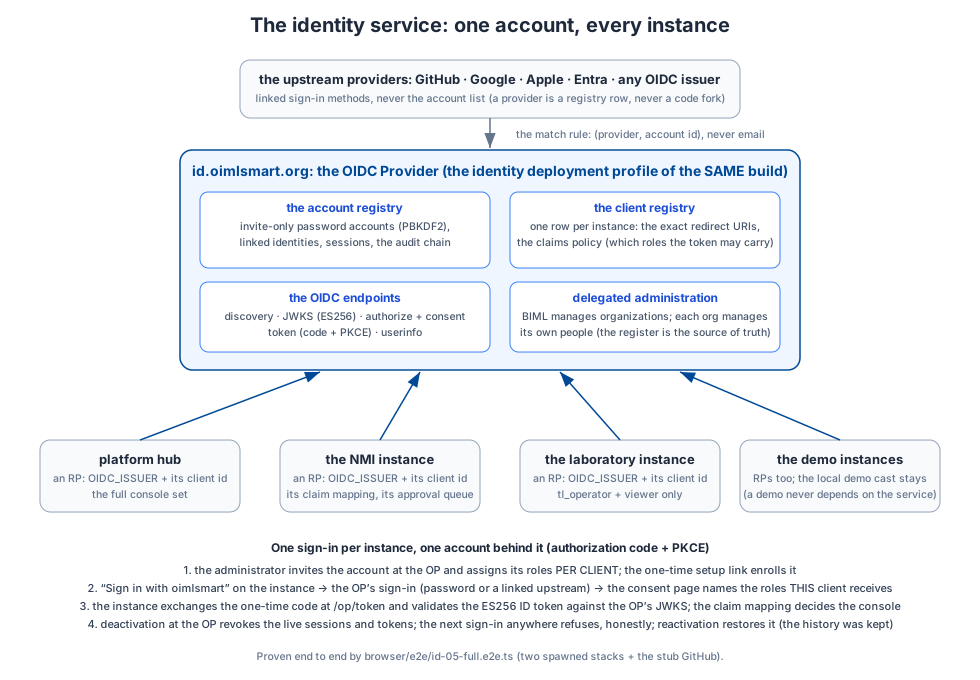
The diagram, in prose: the upstream providers sit above the provider and feed it linked sign-in methods, matched by provider and account id, never by email. The provider itself carries four registries: the account registry, the client registry, the OIDC endpoints, and the delegated administration ladder (BIML manages organizations, each organization manages its own people). Below it, every instance is a relying party with its own client id, its own claim mapping, and its own approval queue. The flow is one invite and per-client assignment at the provider, then a sign-in at any instance that ends in the console the claims mapping decides; deactivation at the provider ends sign-in everywhere, and reactivation restores it with the history intact.
Why this shape
- The account list is central by design: per-instance lists drift, and the scheme’s people move across instances. One registry, maintained once.
- The relying-party side predates the provider (TODO.federation/10): discovery, PKCE, ID-token validation, claim mapping, and the approval queue were already built and tested against external IdPs. The provider is the bounded new half.
- No external identity stack: the platform already carries users, sessions, RBAC, the login page, and the crypto, so the provider adds exactly the OIDC surface and nothing else.
- The upstream providers are login methods, never the source of truth: revoking a GitHub app never touches an account.
The account model
Accounts are real password accounts, invited by an administrator,
never self-registered. The credential lives apart from the account row
(PBKDF2-HMAC-SHA256 at 600 000 iterations over WebCrypto, the same
code on node and the Worker). Enrollment is a one-time 24 h setup
link, emailed when the mailer is configured and handed over out of
band when it is not; one-time means one-time, and an expired link is
burned on presentation. The first administrator on a fresh deployment
arrives by declaration (OP_ACCOUNT_SEED), with the setup link logged
at boot until the password is set.
The account holder’s self-service console (/app/account) covers the
profile, the sign-in methods (password and linked upstreams as equal
citizens, with the at-least-one-method guard), the password (a change
evicts the other sessions), the sessions (per-device revocation), and
the account’s own activity feed read back from the audit chain. The
user-facing walkthrough is
docs/guides/your-oimlsmart-account.md.
The linking rules
One rule governs every upstream sign-in, and the program calls it THE
MATCH RULE: an upstream identity resolves by (provider, provider_account_id) against the link table, never by email alone,
even when the upstream vouches for the address. An unlinked identity
is refused honestly, with the provider named and the way out explained.
One upstream account links to exactly one OIML SMART account; one
account holds at most one link per provider. Unlinking never touches
the account, and the guard keeps at least one way in.
The providers themselves are rows in a registry (GitHub’s OAuth web flow, or generic OIDC with discovery and PKCE; Google, Apple, and Microsoft Entra are the same rows with their quirks documented). Adding a provider is a row, never a code fork.
The per-client role claims
Access to an instance is the meeting of three declarations, none of which can widen another:
- The client’s claims policy (the provider’s registry row): which claim families the ID token may carry for that instance, and the closed allowlist of roles it may ever name.
- The account’s per-client assignment: the roles the registry assigns that account for that instance. No row means the account’s default carries; an explicitly empty row means no role claims at all, which is the honest “no access here yet”.
- The instance’s claim mapping (its own configuration): the emitted values mapped one-to-one onto the roles that instance serves. Nothing unmapped is granted; with no default role configured, the unmapped sign-in waits in the instance’s approval queue, where the administrator sees the claims the provider sent and decides.
The consent page names the effective set before anything is released (“On ⟨client⟩ you hold: …”), so the account holder sees exactly what each instance receives. A linked or provisioned account keeps its locally decided role; the claims never re-apply over it.
Delegated administration
The scheme operator (BIML) never manages hundreds of member-state people by hand. The ladder: BIML manages the organizations (the participants register is the source of truth; an account is created only for a registered participant), each registered organization gets one organization administrator created by BIML after verification, and the organization administrator manages its own people’s slice: approving join requests, inviting colleagues, never reaching another organization’s accounts. The self-service “Request an account” page feeds the ladder; a request naming an unlisted organization lands with BIML and is answered with the participation pointer.
The migration story
The instances signed in directly with GitHub before the provider
existed. The cutover is per user and lossless: the account of record
is the provider’s account, GitHub becomes a linked sign-in method at
the provider, and each user’s existing local account on an instance is
adopted at their first single-sign-on (the provider vouches for the
verified email; the locally assigned role and organization stand,
untouched by the claims). A direct-GitHub retry afterwards gets the
plain-language “this account now signs in with oimlsmart” page, never
a duplicate account. When no direct-GitHub accounts remain, the
instance’s GitHub pair retires and the button disappears. The full
runbook is the operator’s reference,
docs/deployment/identity.md#migrating-the-direct-github-accounts.
How to prove it works
TODO.identity-extract/04 (2026-08-24): the identity service builds and
deploys from oimlsmart/identity
now. Its e2e legs (the id-01…id-10 series, the op-surface contract, the
key rotation) and the OP-side unit suites run there against its own
spawned stacks; the deployment reference linked below names them.
What still proves itself HERE (the relying-party half, which every instance of this platform runs):
- The SSO round trip against the stub IdP (no external provider):
browser/e2e/fed-10-oidc.e2e.ts— the login posture, the claim mapping, the approval queue, the RP-initiated logout. - The instance wiring + the GitHub cutover:
browser/e2e/id-04-wiring.e2e.ts(rewritten in the split to drive a fixture instance over the stub IdP + the stub GitHub) and the committed-wiring drift guardbrowser/src/__tests__/id-04-wiring.test.ts. - The real cross-repo round trip: oimlsmart/identity’s deploy gate probes the preview deployment before production (the declared-env doctrine; no stub dresses as the OP here).
Where it plugs in
- The relying-party side (discovery, PKCE, claim mapping, the approval
queue):
@oimlsmart/platform-server/oidc+browser/server/routes/auth.ts, documented indocs/deployment/identity.md. - The provider: moved to oimlsmart/identity with TODO.identity-extract/04
(its
browser/server/routes/op.ts+browser/server/auth/op/; this repository’s copies are retired, and its build answers the provider paths with a plain 404 on every instance). - The deployment and the secrets: oimlsmart/identity’s
wrangler.toml(the same worker names and database ids) and the operator’s reference there.