

The CIML tour
The Digital OIML, live
OIML SMART as a guided tour: every claim one click from a running proof, every demo moment playable live or read from a dated capture.
- Nineteen slides, two cuts: the 5-minute committee slot and the 20-minute working visit. The presenter notes carry both, with the recorded rehearsal timings.
- Navigate with the arrow keys, the on-screen buttons, or a clicker. Every slide has a stable address: /tour#s07 goes straight to the seventh slide.
- The honesty rules: everything on the demo instance is simulated (a fictional cast, a nightly reset), and every future is labeled SMART+.
- The presenter notesthe two cuts, the per-slide talk track, the rehearsal record
- The leave-behindseven per-audience one-pagers, printable
- The live demo ↗the cast assumed as personas through the identity service
The problem, said kindly
Certification runs on documents, and it works
Today's chain is careful people re-keying careful documents at every hand-off. The medium is lossy; the people are not the problem.
- The Recommendation is a PDF. Every tool that touches it, the application form, the test bench, the report template, re-encodes it by hand, and every re-encoding drifts a little from the text.
- The application is a scanned form and an email; the test report is a PDF re-typed at the authority; the certificate is a signed PDF, verified by a phone call to the issuer.
- None of this is broken. It is the best the portable document could do. The cost is paid quietly: in transcription, in drift, in waiting, and in evidence nobody can query.
- The end-to-end storythe same arc, told as one continuous use case
The services, one picture
The service map
One model at the center, everything else derived: the page you read, the form you fill, the verdict computed, the certificate signed, the register that answers.
- The component mapthe repositories, the SSOT flow, the live gate numbers
- The services directoryeach service with its live proof
Flow 01 · the applicationSMART
The form is the Recommendation
The manufacturer applies in a wizard whose instrument form the R 60 model itself authors. Change the Recommendation and the form changes.
- The first pick is the Recommendation, explicitly, with its edition; everything downstream derives from it.
- The instrument step renders the declaration R 60-3 §4.5 asks for, with the model's own guidance on every field.
- The authority is picked from scoped cards; only authorities that can take R 60 are shown.
Open the live step ↗sign in as Applicant · /app/portal/applications/new
Sign in as the Applicant, open the new-application wizard, pick R 60, and watch the instrument step render from the model.
The whole flow, narrated: Walkthrough 01 · the application, six steps narrated.
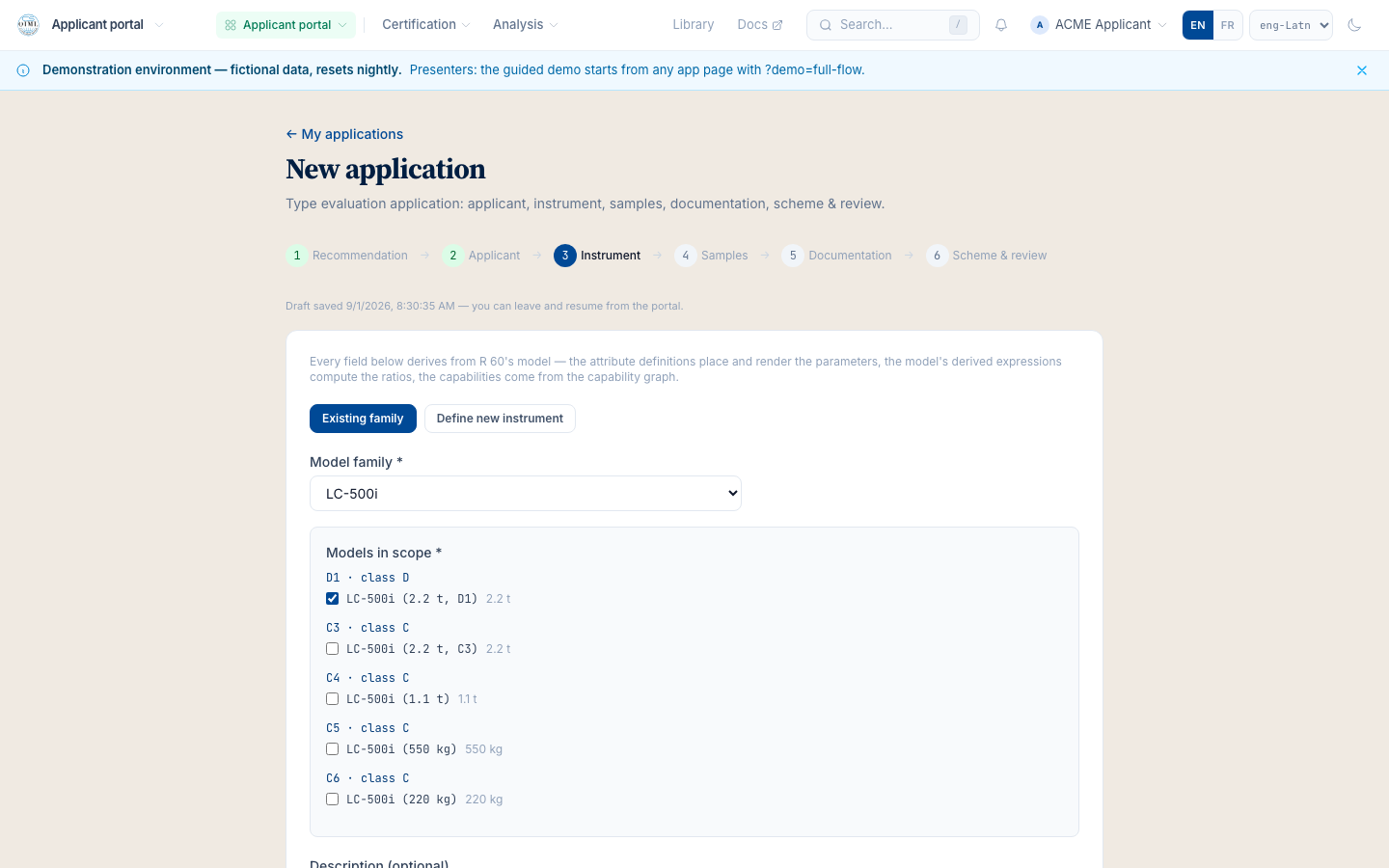
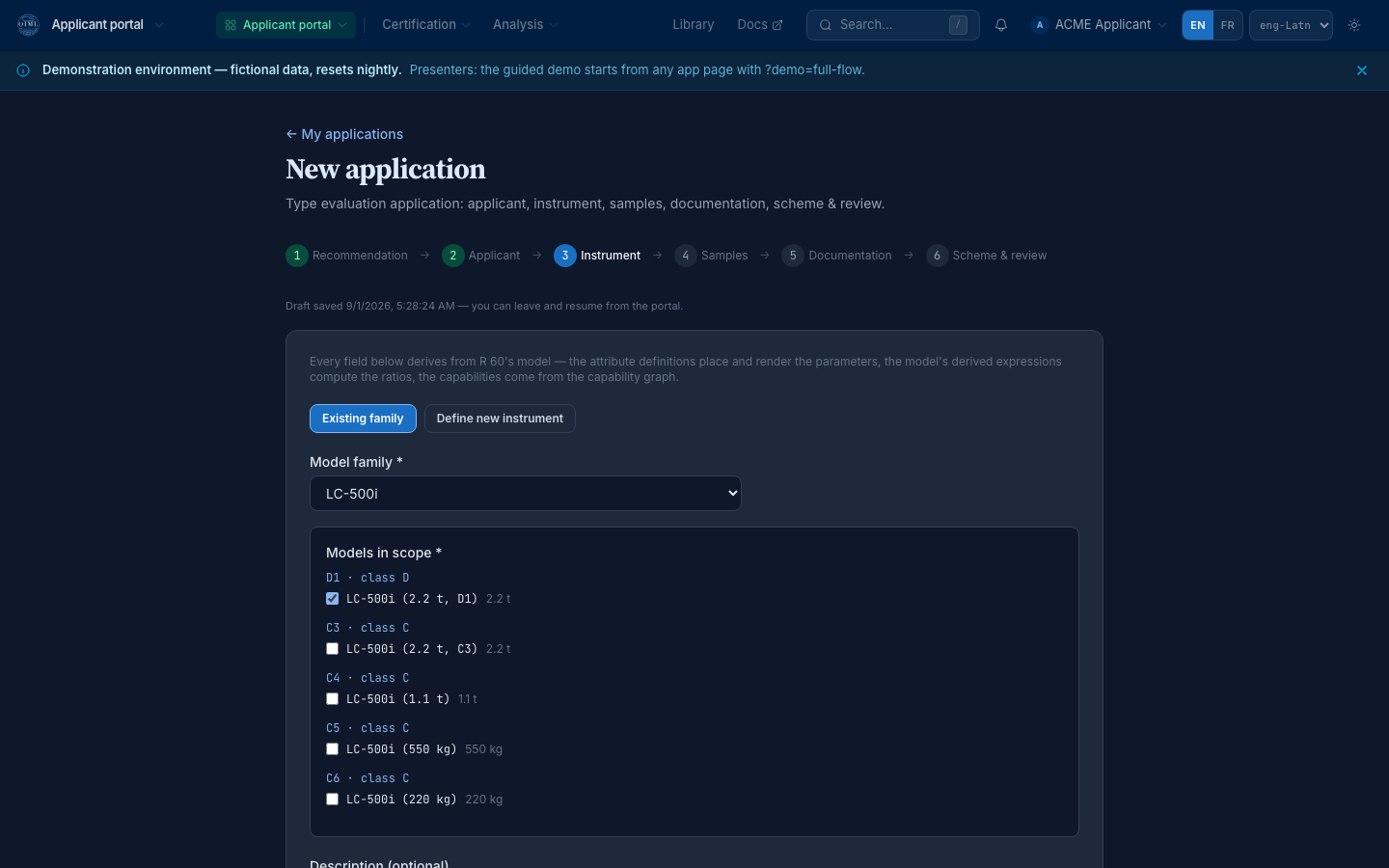
The no-network room: this dated capture carries the moment.
Flow 02 · the authority's intakeSMART
The honest reject-or-accept
The application lands in the authority's review queue, oldest first. The accept opens the evaluation project: the shared dataspace the three parties work in.
- The review queue shows every waiting application with its age on the row; nothing waits silently.
- The reject is honest: a reason, recorded, returned to the applicant. The accept opens the evaluation project.
- Samples, custody, and the dispatch to the laboratory ride the same project; the laboratory sees exactly what the authority sent.
Open the live step ↗sign in as Issuing Authority · /app/ia
Sign in as the Issuing Authority and open the review queue; the waiting application is flow 01's submit, seen from the other side.
The whole flow, narrated: Walkthrough 02 · the intake, eight steps narrated.
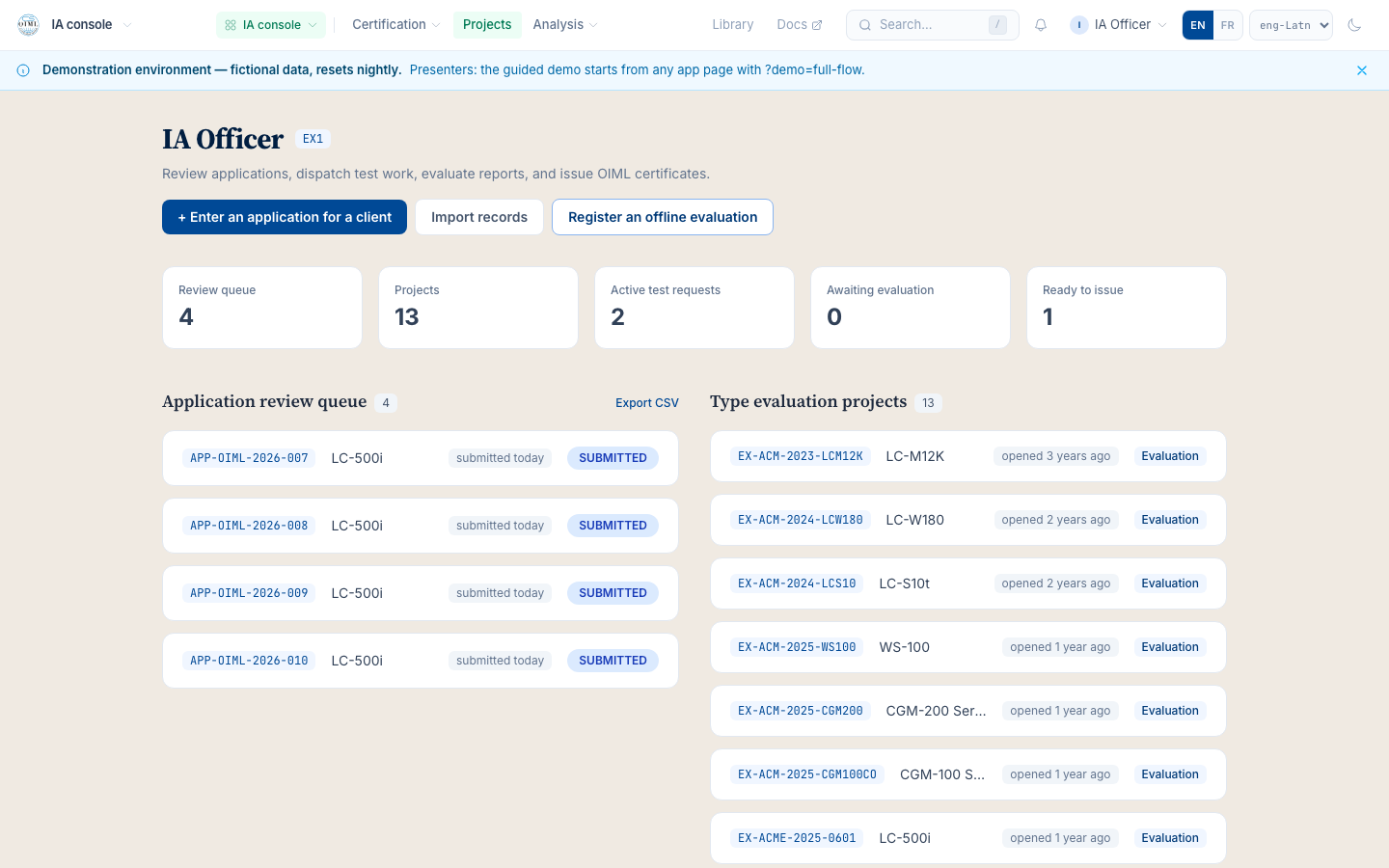
The no-network room: this dated capture carries the moment.
Flow 03 · the laboratory's workSMART
Evidence captured at the bench
The laboratory accepts the assignment, joins the project dataspace, and runs the tests the model declares: the procedure walked step by step, the report generated, never transcribed.
- The dispatched request lands in the laboratory's inbox; accepting it joins the evaluation project.
- The test-run wizard walks the declared procedure; every step's purpose and clause read from the model.
- The report composer knows completeness: what is missing is named, never silently absent.
Open the live step ↗sign in as Test Laboratory · /app/lab
Sign in as the Test Laboratory, open the accepted request, and step the model-driven test run at the bench.
The whole flow, narrated: Walkthrough 03 · the laboratory's work, six steps narrated.
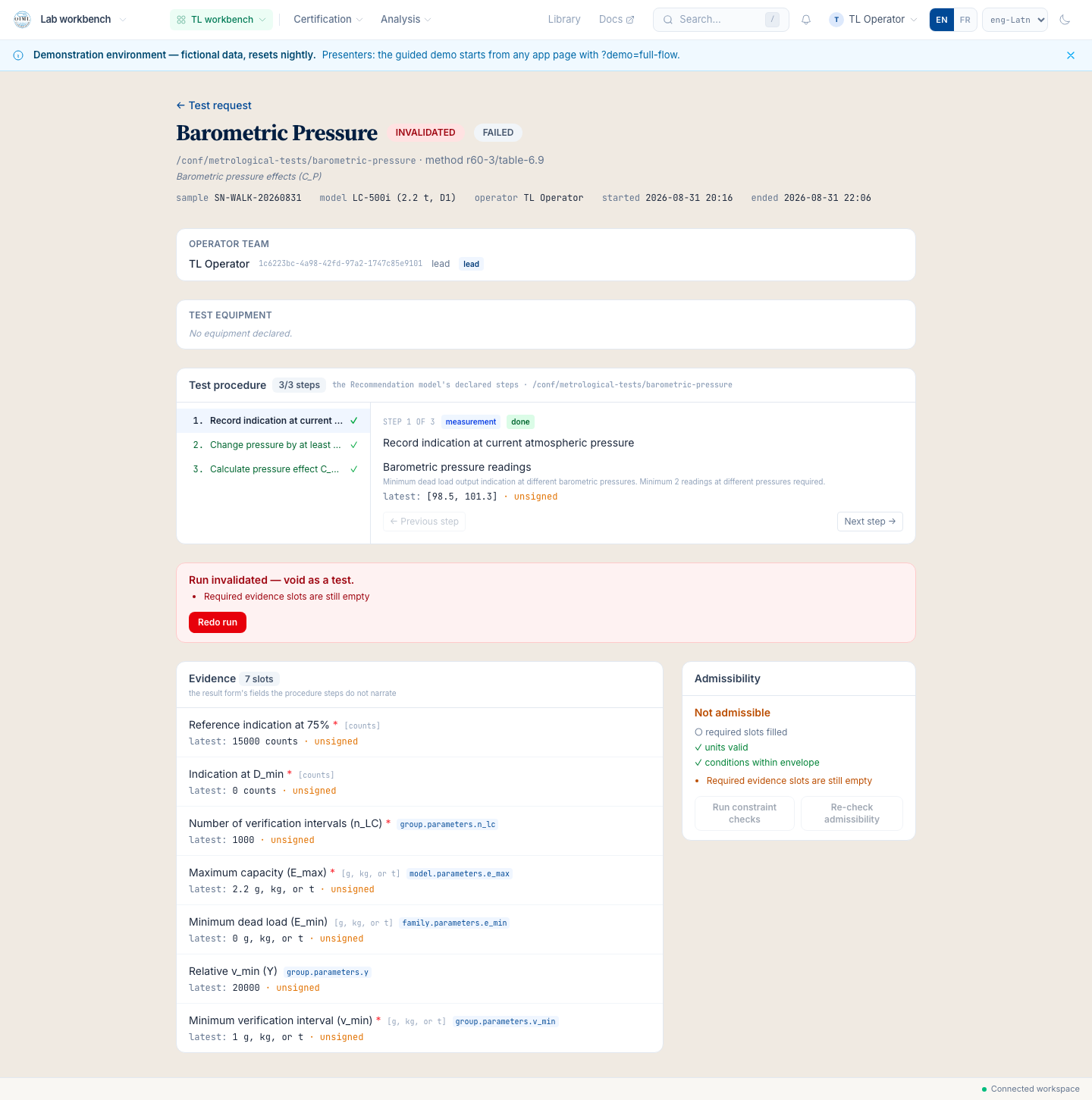
The no-network room: this dated capture carries the moment.
Flow 04 · the evaluation and the certificateSMART
The verdict computed, the certificate signed
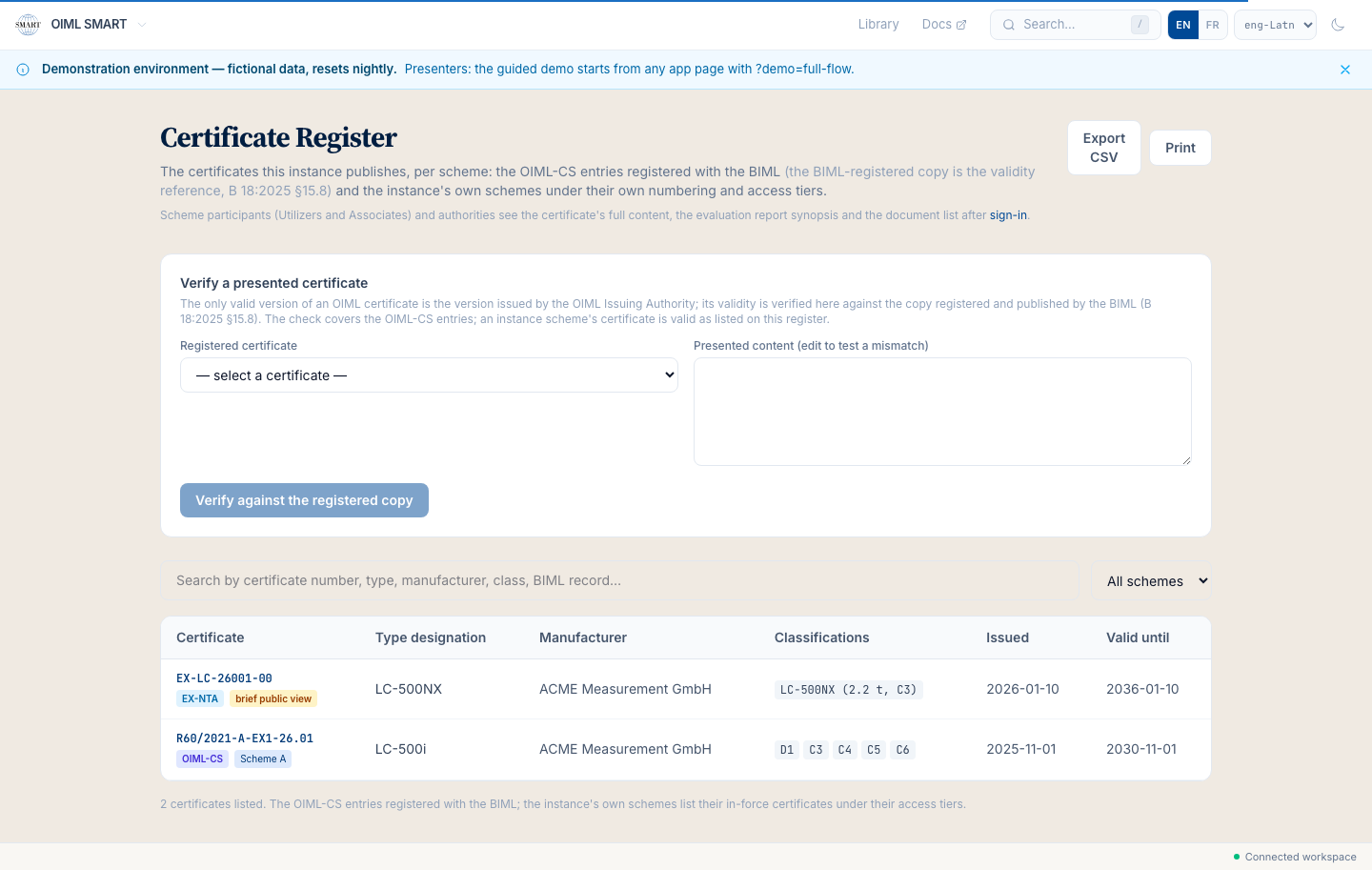
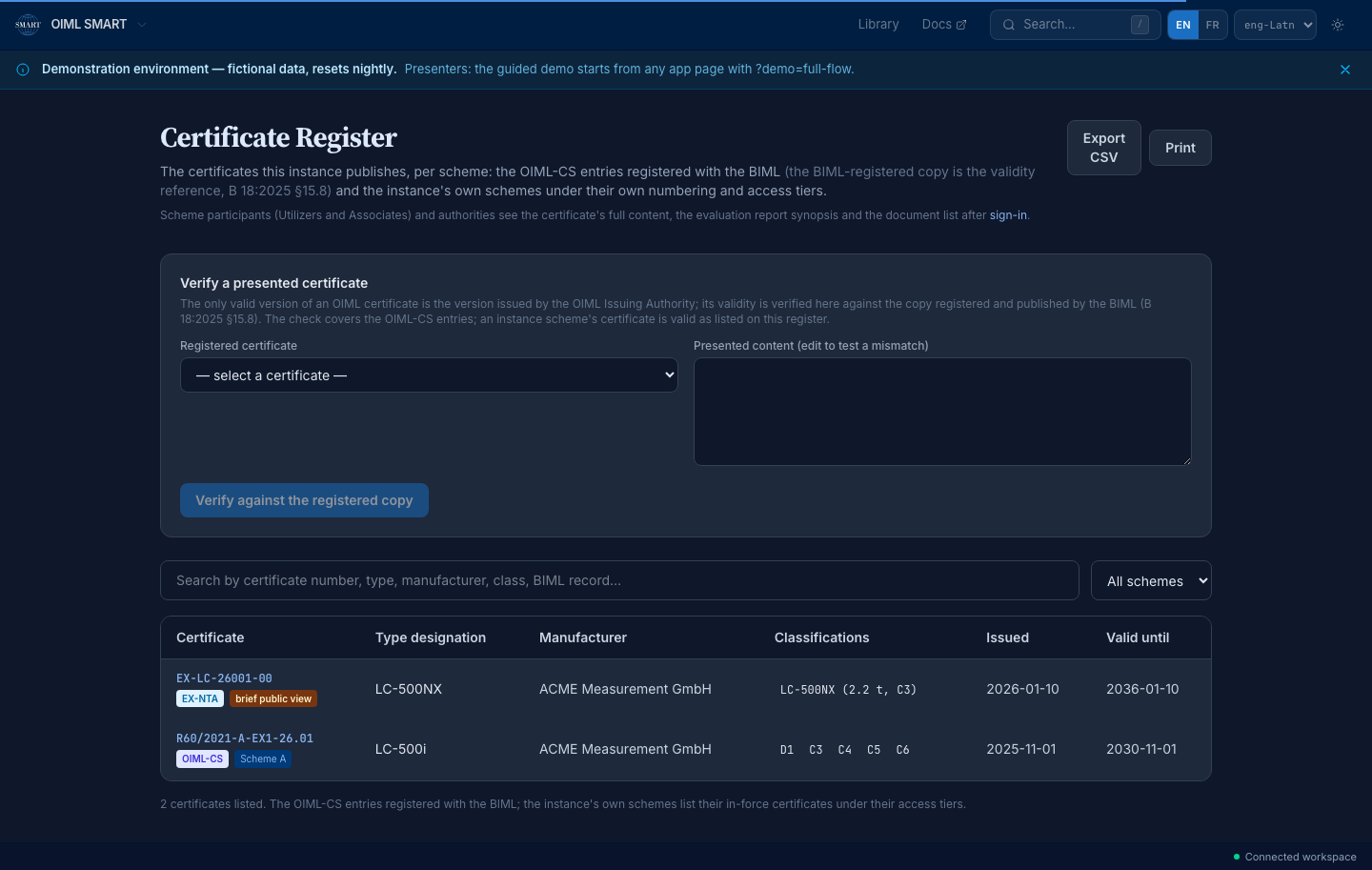
The authority validates the reports against the model, runs the review period, issues the signed certificate, and the BIML registers it: the register anyone can read.
- The evaluation reads the test reports as data; the verdict chain computes from the model, and the decision stays the authority's.
- The certificate issues as signed, time-stamped, schema-validated data (CNML), and registers with the BIML.
- The public register is the validity reference: the registered copy is what verification answers from.
Open the live step ↗no account needed · /app/register
Open the public register (no sign-in): the BIML-registered certificates, browsable by anyone.
The whole flow, narrated: Walkthrough 04 · the evaluation and the certificate, eight steps narrated.
The no-network room: this dated capture carries the moment.
Flow 05 · the applicant's journeySMART
Anyone can verify, in seconds
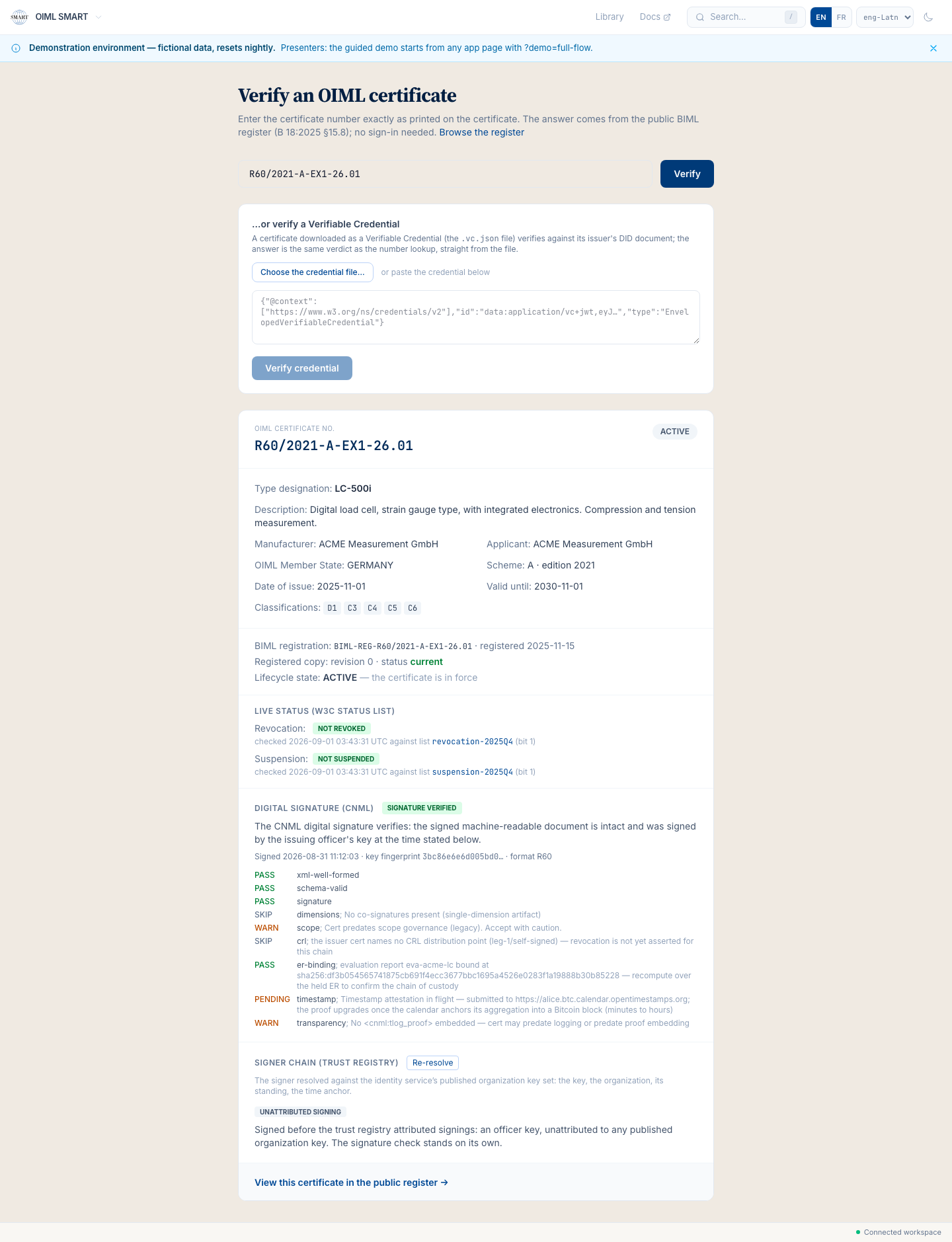
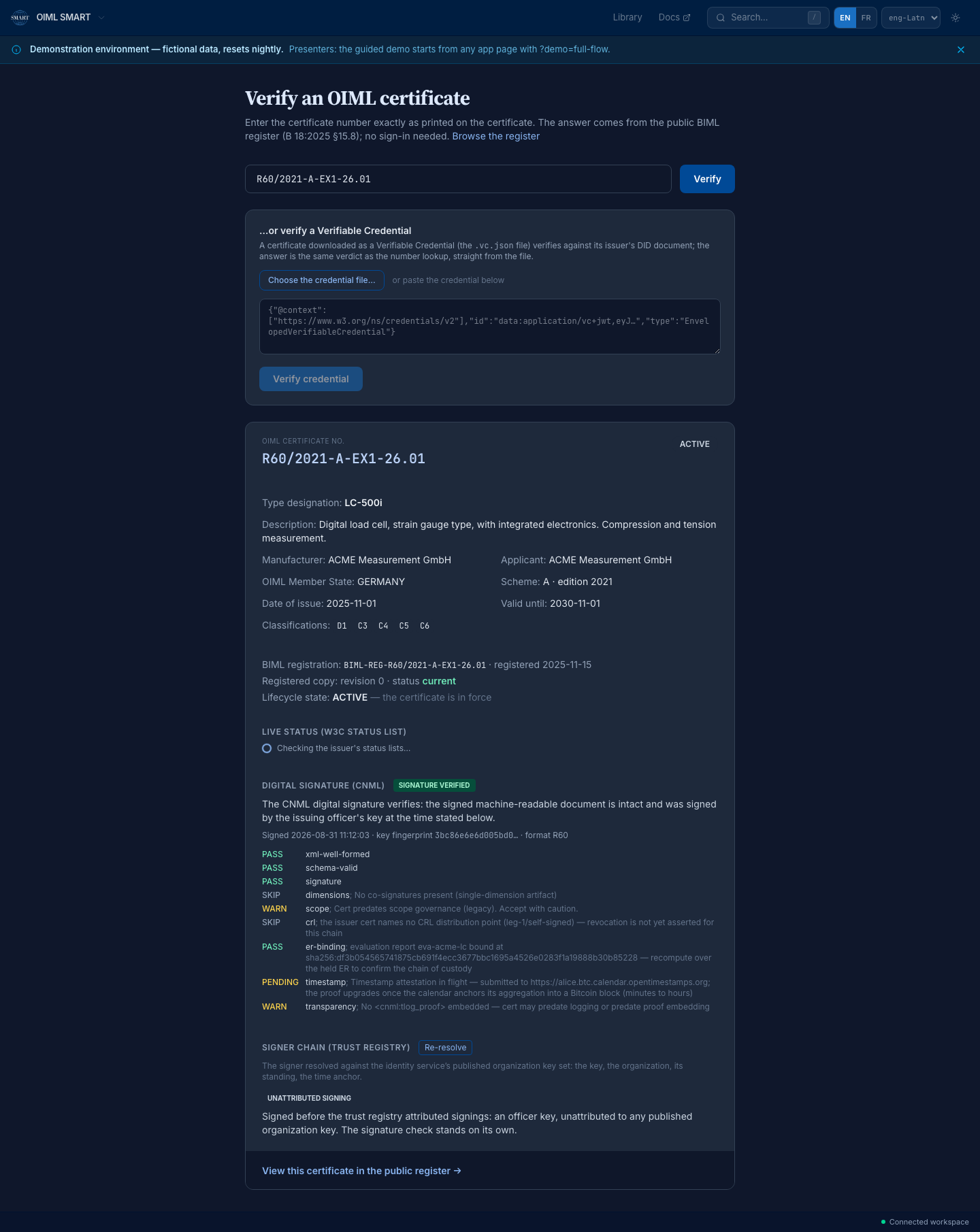
The manufacturer follows every stage, downloads the certificate, and anyone (a customer, a market inspector, another authority) verifies it against the public register. No account, no phone call.
- The applicant is notified at every stage; the application's page is the journey's spine.
- Verification reads the BIML-registered copy plus the live revocation and suspension lists.
- Try it: R60/2021-A-EX1-26.01 answers ACTIVE on the demo today.
Open the live step ↗no account needed · /app/verify
Open the verify page (no sign-in) and enter R60/2021-A-EX1-26.01: the verdict, the registration, the revocation and suspension checks.
The whole flow, narrated: Walkthrough 05 · the applicant's journey, five steps narrated.
The no-network room: this dated capture carries the moment.
The technologies · 1 of 7SMART
SMART Recommendations and Primmel
The Recommendation as a structured, executable model, authored in an open modelling language: one source for the page, the form, the tests, the verdicts, with provenance down to the clause.
- R 60 today: 180 requirements in 14 classes, 62 test procedures, the report forms, all counted from the model, never hand-typed.
- Primmel is the open language the models are authored in: subjects, requirements, processes, packages, developed by Ribose and adopted by OIML SMART as its reference user.
- Four Recommendations ride the pilot: R 60, R 91, R 129, R 144.
- SMART Recommendationsthe technology page
- Primmel ↗the language site
The technologies · 2 of 7SMART+
The SMART Twin
The vision: the Recommendation model as the running instrument's digital twin, the standard declaring the served interface, the compliance engine judging the served evidence continuously.
- Labeled honestly: this is the SMART+ vision, anchored to the roadmap, not a shipped surface.
- The twin serves the instrument's governed aspects; compliance becomes monitorable between assessments, not only at them.
- The SMI Simulation below is how the program rehearses that future today.
- The SMART Twinthe technology page, with the roadmap anchors
The technologies · 3 of 7SMART
The SMI Simulation
Simulated SMART Measuring Instrument Twins (SSTs) with realistic physics behind the governed twin interface: the full certification workflow rehearsed and taught without hardware.
- The classroom runs on it: certify a simulated load cell end to end before touching a real instrument.
- The demo's instrument itself is simulated; the software around it is the production codebase.
- Its production role (twins serving live evidence into certification) rides the SMART+ roadmap.
- The SMI Simulationthe technology page
- Training on the SMI Simulationthe use-case story
The technologies · 4 of 7SMART
CNML: the certificate as signed data
The Certificat Numérique de Métrologie Légale: signed, time-stamped, schema-validated, verifiable by anyone, account-free, offline, built on CalConnect's Signatif framework.
- The certificate keeps its paper meaning; as data it carries its own proof.
- Verification never has to phone home: the trust registry resolves who may sign what.
- The same certificate serves neighboring ecosystems: a W3C Verifiable Credential, an SD-JWT, a DPP conformity attestation, an AAS submodel.
- CNMLthe technology page
- The CNML volumethe format documentation
The technologies · 5 of 7SMART
The identity federation
One account across the services: a single OpenID Provider, every platform instance a relying party, and members may run their own provider from the same software.
- Accounts issue per organization, approved by the organization's own administrator; the join flow knows the real OIML member directory.
- Federation is the sovereignty answer: a member state's own identity provider, same software, its own custody.
- The identity federationthe technology page
- The identity servicethe live service, with captures
The technologies · 6 of 7SMART
The trust registry
The public registry of who may sign what: each organization's signing keys and its standing, resolvable in one anonymous request.
- A verifier never has to trust a deployment; it resolves the signer against the registry.
- The registry proves the negative honestly: an unregistered organization is refused with a named error, and the 404 is the answer being demonstrated.
- The trust registrythe technology page
The technologies · 7 of 7SMART
Dataspace and interop: the standards map
The program speaks the neighboring standards rather than replacing them. Every interop artifact is a projection outward from the authoritative model, never a competing source.
- The federation planes map onto the dataspace vocabulary: the Dataspace Protocol (ISO/IEC 20151), ODRL 2.2, the IDS Reference Architecture Model.
- The models export, generated never authored: ReqIF requirement rows (the DIN DKE SPEC 99200 profile), RDF/OWL with SHACL shapes (the IEC-ISO Core Ontology projection), OpenCDD back-references.
- The certificate serves the neighboring ecosystems today: W3C Verifiable Credential, SD-JWT, DPP conformity attestation, AAS submodel.
- Dataspace and interoperabilitythe technology page, with the planes table and the export doctrine
DeploymentSMART
One codebase, four postures
The CS-operated hub, an IA-only instance, a TL-only instance, the combined IA+TL instance: the deployment profile decides, and a member starts at the size that fits.
- The demo is the hub posture: every role on one deployment.
- Two member instances run in the pilot today: tl.oimlsmart.org (TL-only, the start-small posture) and nmi.oimlsmart.org (IA+TL, the institute shape).
- Member instances submit signed evaluation chains to the CS platform; the register validates and imports them, idempotently.
- Start small, grow: the same codebase grows from a laboratory's instance to a member state's.
- The deployment-mode matrixwhat each posture runs, who signs in, what federates where
- tl.oimlsmart.org ↗the live TL-only pilot
- nmi.oimlsmart.org ↗the live IA+TL pilot
Governance
The committee decides; the text stays
The adopted text is the source. The model derives from it with clause-level provenance, computes verdicts, and records who decided what. The legal acts stay exactly where the law puts them.
- The Recommendation's text remains the gate: new editions join the modelled set through the authoring programme, under the committee's adoption.
- The platform never decides: designation, acceptance, issuance, withdrawal remain the authorities' acts, with better evidence.
- Nothing dies: PDFs keep their meaning, the register coexists with today's, and records mode lets paper-based work enter the record honestly marked.
- The liability surface is the existing one; the platform widens nothing.
- What is OIML SMART?the programme, plainly
- The provenance doctrineclause-level, from the text
The adoption pathSMART
Start where you are; grow when ready
Reading costs nothing, participating costs an account, self-hosting is one deployment under your category's entitlement. Nothing is retired until your regime is satisfied.
- Read: the audience pages, the use cases, the walkthroughs; the public surfaces need no account.
- Reproduce: the demo's guided tour walks the whole chain in 22 steps; the instance resets nightly.
- Pilot: one Recommendation, one authority, one laboratory, the TL-only posture running in the pilot today.
- Self-host: the entitlement matrix quotes who may use what and who may run what, per member category.
- Who can run whatthe entitlement matrix, the single source
- The demo, walkedthe six walkthroughs
The ask
Two asks of the committee
Pilot members, and honest feedback. Everything you saw is running today; the doors are open.
- Pilot members: one Recommendation, one issuing authority, one laboratory. The pilot postures are running; the onboarding starts with a conversation.
- Feedback: info@oimlsmart.org. Guided walkthroughs for committees and working visits are the commonest request.
- The leave-behind: seven per-audience one-pagers, one printable page each, for the members who were not in the room.
- The demo stays up: demo.oimlsmart.org, the cast assumed as personas through the identity service, the guided demo built in.
- The seven one-pagersthe leave-behind, printable
- demo.oimlsmart.org ↗the live instance
- info@oimlsmart.orgthe feedback channel