The program speaks the neighboring standards rather than replacing them: its federation machinery maps onto the planes the dataspace standards name, and its models export to the formats the requirements-management and linked-data ecosystems already consume. The starting point is the committee’s adopted text, so every interop artifact is a projection outward from an authoritative model, never a competing source. The program also builds on open work rather than inventing its own: the models are authored in Primmel (the open language developed by Ribose, adopted by OIML SMART), and the certificate’s trust chain is Signatif (the CalConnect standard), so the two supporting technologies underneath this page are both open, named, and inspectable.
What it does today
- Maps its planes onto the dataspace vocabulary. Identity, data, policy, and catalog are named in dataspace terms below, aligned with the Dataspace Protocol (under standardization as ISO/IEC 20151), ODRL 2.2, and the IDS Reference Architecture Model.
- Serves the certificate to neighboring ecosystems today. The demo’s certificate answers as a W3C Verifiable Credential, an SD-JWT, a DPP conformity attestation, and an AAS submodel; the CNML page carries the four live links with their honest caveat (the demo’s nightly reseed can leave the certificate awaiting its signing pass).
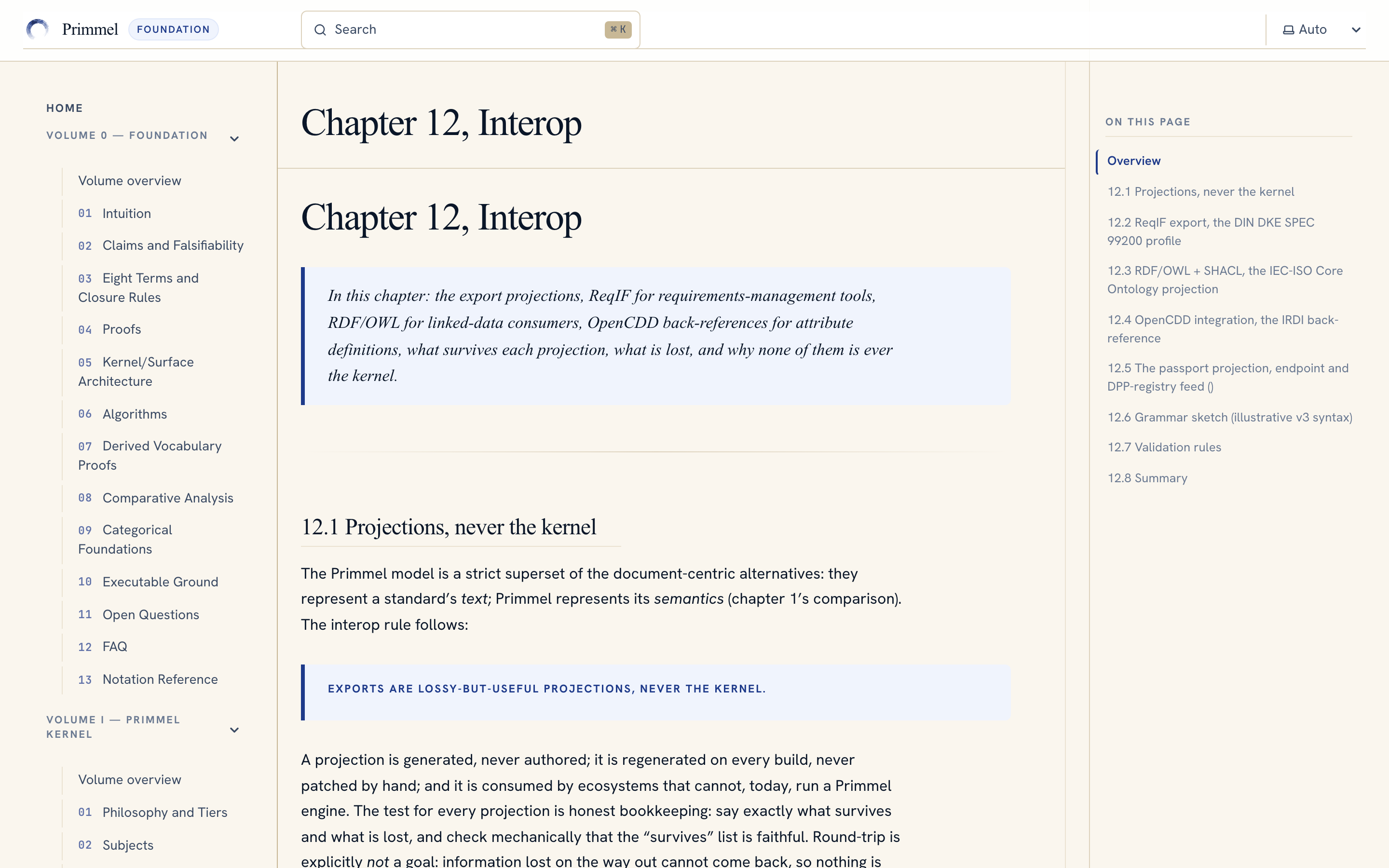
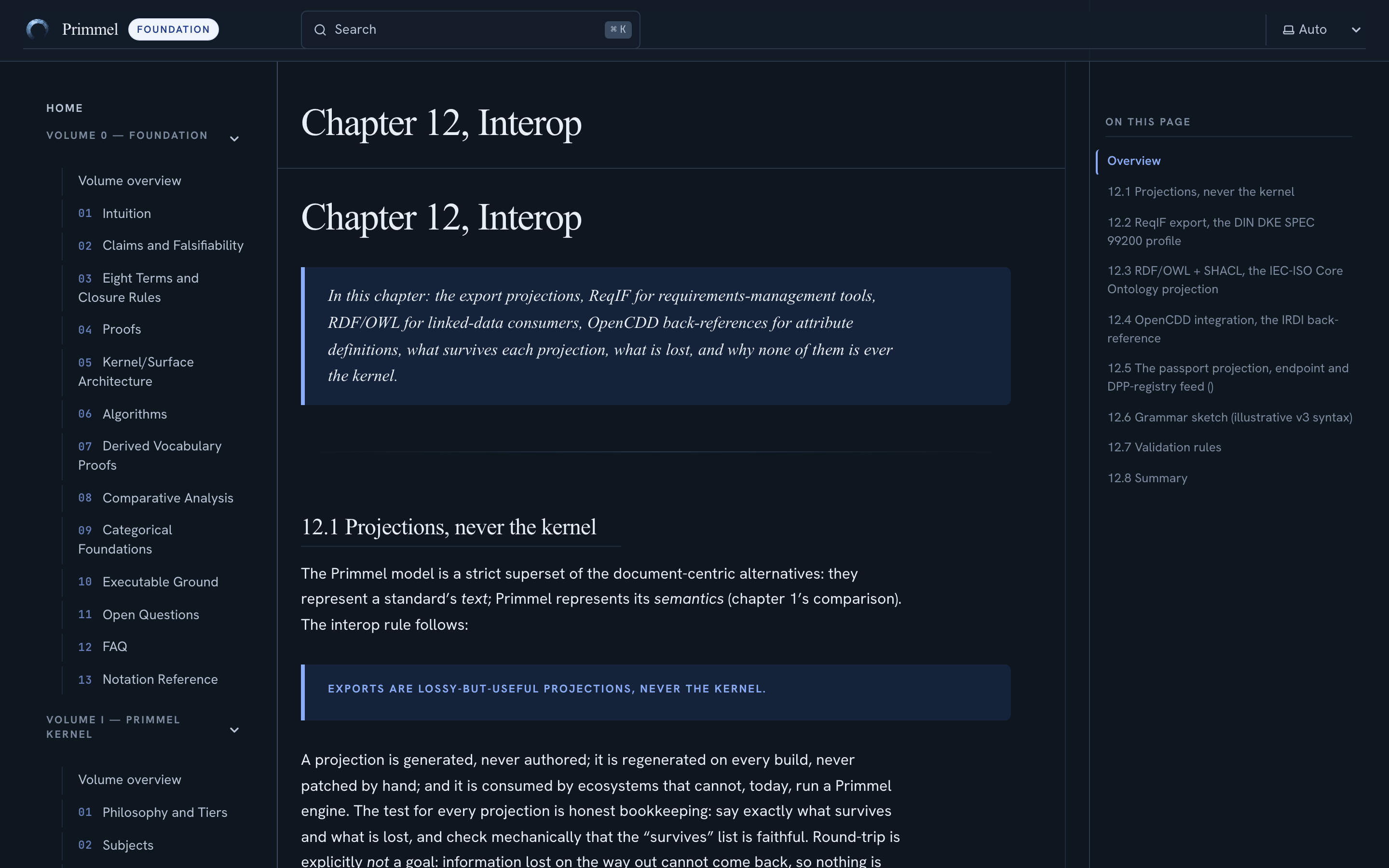
- Exports the models, generated never authored. ReqIF requirement rows (the DIN DKE SPEC 99200 profile, validated against the official OMG schema), RDF/OWL with SHACL shapes (the IEC-ISO Core Ontology projection, machine-checked), and OpenCDD back-references, each stating what it carries and what it leaves behind.
- Keeps custody with the parties. An evaluation’s evidence stays with its laboratory, the decision with its authority, the register with the BIML; evidence moves between instances under declared policy, never into a central data lake.
- Serves the catalog edge. The catalog endpoint is the shipping edge of this work: each instance serves its offered artifact classes with their policy offers.
How it works
The program’s machinery names its planes in dataspace terms:
| Plane | The dataspace term | The program’s answer |
|---|---|---|
| Identity | The trust anchor | The identity service’s organization registry and the trust registry; no parallel trust framework |
| Data | Peer-to-peer exchange | Evidence moves between instances under custody; no central data lake |
| Policy | Usage control | Policies authored as model content, exported as ODRL 2.2 on the wire |
| Catalog | The offer surface | Each instance serves its offered artifact classes with their policy offers |
Policies are Primmel’s own primitives: the semantics are self-contained in the model, and ODRL and the Dataspace Protocol are their exported expressions on the wire. The contract-negotiation lifecycle and the conformance-suite legs are roadmap items in the dataspace program, tracked in the platform repository.
The alignment positions
Digital Product Passport. The passport is a projection of the product model plus its live instance state, served by the instrument’s endpoint under access classes. The CEN/CENELEC JTC24 framework’s eight standardization areas are mapped area by area as authored, gated data: each area is either answered by the frame’s primitives or named as a gap, and a gap left unnamed fails the gate.
Asset Administration Shell. A SMART twin reads as an AAS submodel to
an AAS consumer, and the program adopts the shell concept, the
property/operation duality, and derived submodel skeletons. The
difference is governance: a submodel’s content is whatever its vendor
wrote, while a SMART twin’s projection is declared by the standard,
identical across conforming instruments, carrying freshness semantics and
standing behind a certification verdict. The demo’s certificate already
serves the LegalMetrologyConformity submodel form.
Today (SMART) and the vision (SMART+)
Today · SMART
- The certificate’s four carrier forms (VC, SD-JWT, DPP, AAS submodel) serve from the demo stack today. the DPP form ↗
- The ReqIF, RDF/SHACL, and OpenCDD exports regenerate on every build as projections of the model, never a second source. the doctrine ↗
- The catalog endpoint ships: instances serve their offered artifact classes with policy offers. the demo ↗
The vision · SMART+
- The DSP contract-negotiation lifecycle and the dataspace conformance suite are roadmap items in the dataspace program. roadmap ↗
- The passport as a live, access-classed projection of the product model plus its instance state, served by the instrument’s endpoint at member deployments. Roadmap; the demo’s passport UI currently reports its resolver unreachable, and this page will link it when it serves again. roadmap ↗
Why it exists
Certification data does not live in one organization. An evaluation’s evidence belongs to a laboratory, the decision to an authority, the register to the BIML, and the instrument’s service record to its owner. A central data lake would ask every party to surrender custody; a dataspace lets each party keep custody and exchange under declared policy. Interoperability is therefore a governance property first and a wire format second.
Who may use it, and who may run it
The dataspace surface ships inside the platform, so its determination is the platform’s, quoted from the program’s single entitlement source: the hosted service first, then the self-host software. The Corresponding Member cell on the second row carries the path upward, the ratification narrative on the full matrix page.
| Member State | Corresponding Member | Issuing Authority / Test Laboratory (of a Member State) | Utilizer / Associate | Applicant / public |
|---|---|---|---|---|
| ✅ | ✅ | ✅ their consoles | ✅ designated access | ✅ applicant portal |
OIML-CS SMART Platform (cloud), quoted from the program's single entitlement source; the full matrix, all services by all member categories, lives atWho can run what.
| Member State | Corresponding Member | Issuing Authority / Test Laboratory (of a Member State) | Utilizer / Associate | Applicant / public |
|---|---|---|---|---|
| 🏠 🔄 | ⬆️ available on ratification | operates under its Member State’s 🏠 | — | — |
SMART Platform software (self-host), quoted from the program's single entitlement source; the full matrix, all services by all member categories, lives atWho can run what.
The honest questions
Is this a competing trust framework? No. The identity plane is the program’s own identity service and trust registry, and the certificate’s trust chain is an open CalConnect standard (Signatif). The dataspace work names the program’s machinery in the dataspace vocabulary precisely so no parallel framework accretes.
Why generate exports instead of standardizing on ReqIF or RDF? Because the exports are projections: they carry what the format can hold and say what they leave behind. Round-trip is deliberately not a goal, because information lost on the way out cannot come back, so nothing is re-imported into the kernel. The model stays the single source; the exports regenerate on every build.
What does a dataspace buy a member state over a portal? Custody. A portal centralizes the evidence; a dataspace leaves the laboratory’s evidence with the laboratory and the authority’s decision with the authority, and exchanges under declared, machine-checkable policy. Sovereignty is the architecture, not a promise.
Try it, read it, talk to us
The demo's certificate serves its VC, SD-JWT, DPP, and AAS carrier forms from the live stack. Sign-in runs through the identity service, the demonstration cast assumed as personas; the environment resets nightly.
The export projections with their fidelity bookkeeping: what each format carries, what it loses, and why none of them is the kernel.
info@oimlsmart.org, the programme's front-door address. Alignment conversations with standards bodies and dataspace initiatives are the programme's standing work.