
CNML (Certificat Numérique de Métrologie Légale) is the digital certificate format developed under the OIML SMART program to succeed the PDF-based OIML-CS certificate of conformity. A CNML certificate is data: schema-validated against its Recommendation, cryptographically signed, time-stamped, and verifiable by anyone without an account, without contacting the issuer, and without a network connection. It is OIML’s technology implemented on an open standard: the signature and time-attestation chain is Signatif, the Sealed Interoperable Graduated Non-repudiable Anchored Trust Infrastructure Framework, a CalConnect standard and an ISO/TC 154 work item, so the certificate’s trust machinery is a published, shared framework rather than a bespoke scheme.
What you can do today
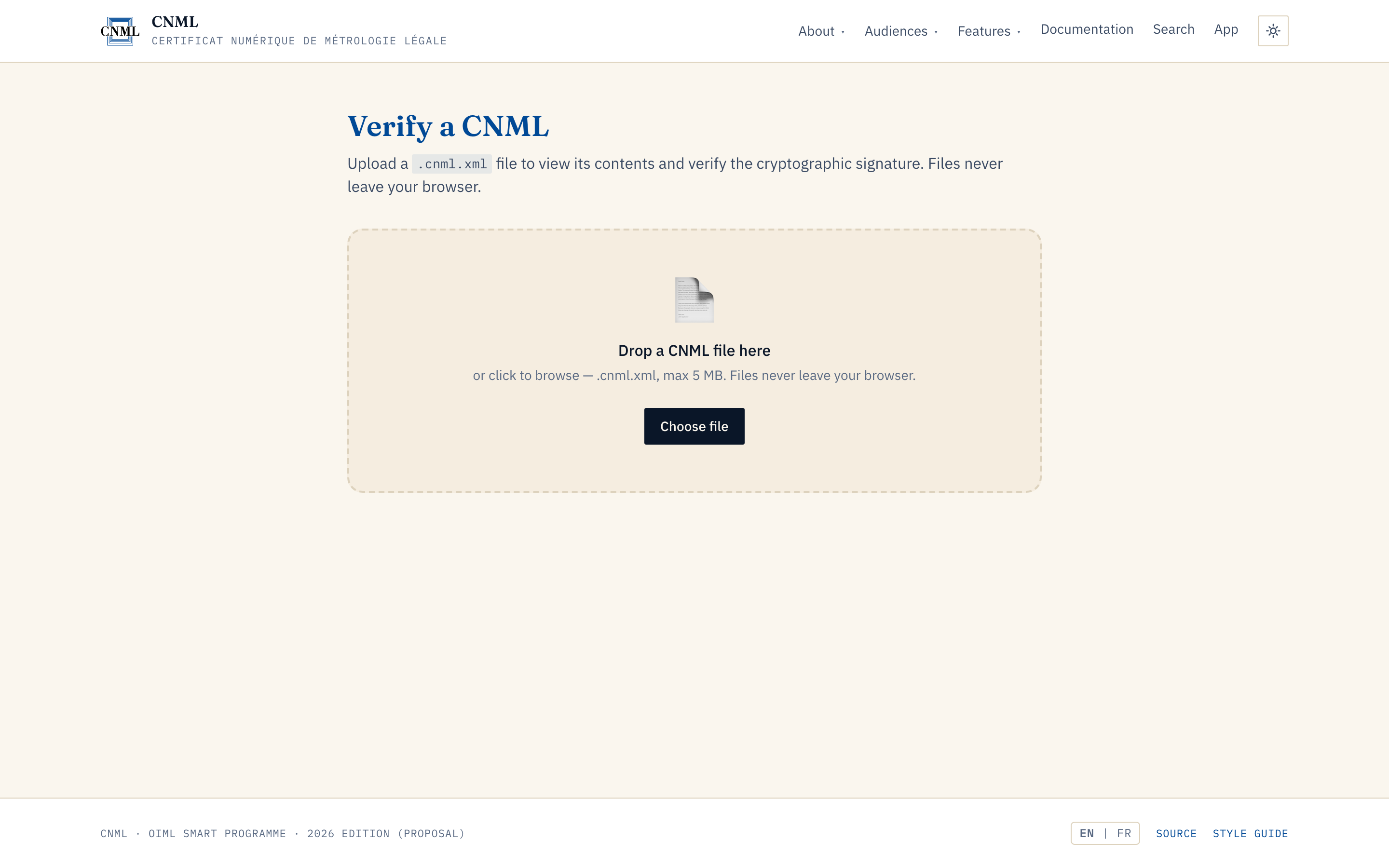
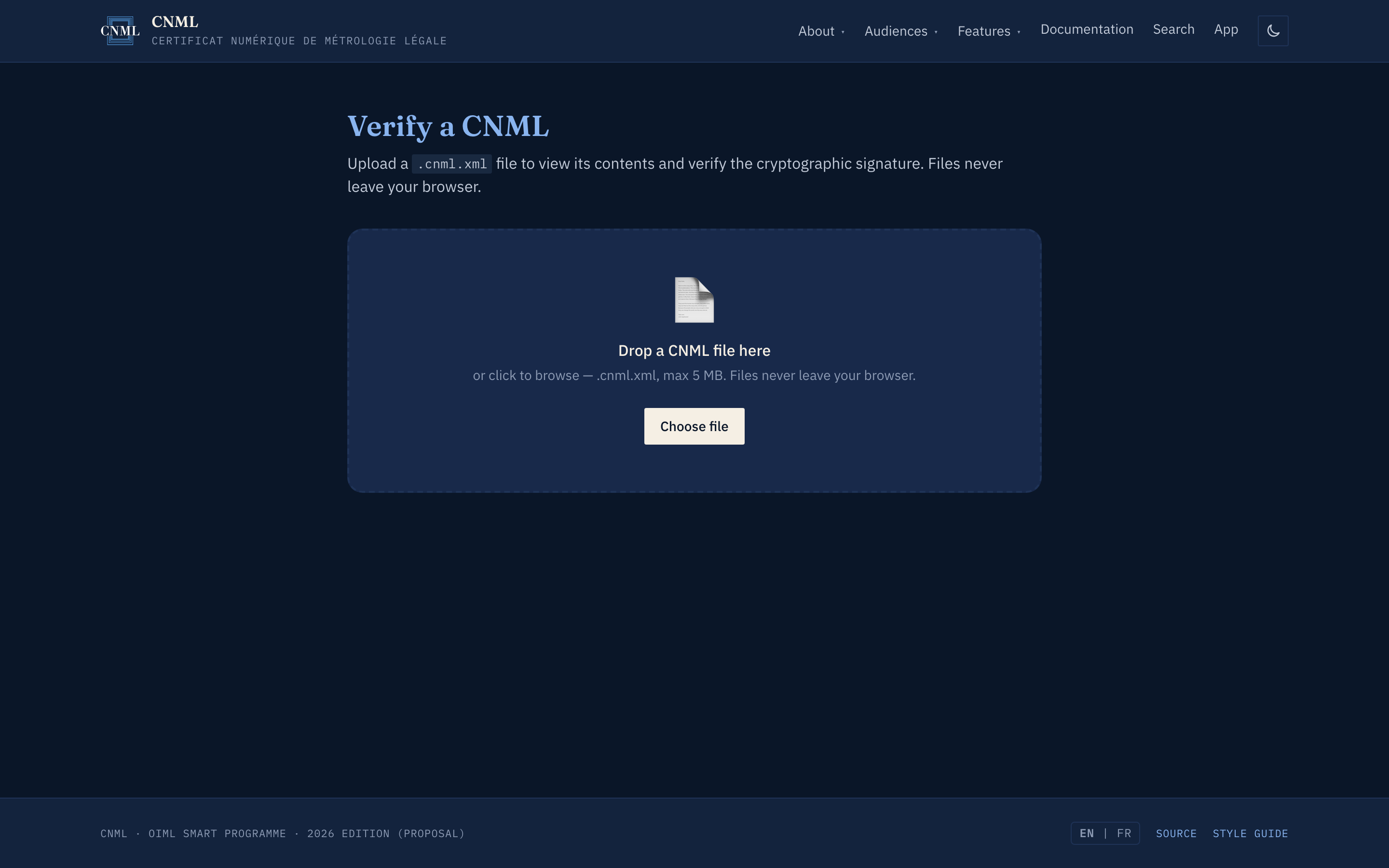
- Verify a certificate in your browser. The verify page runs the nine-check pipeline on a dropped file; nothing leaves your machine, no account, and a downloaded trust-anchor bundle makes the check work offline, indefinitely (the capture above).
- Fetch the demo certificate as a W3C Verifiable Credential. GET the VC form of the demo’s R 60 certificate (
vc+jwt, signed ES256 by the demo’s federation key). - Fetch the same certificate as an SD-JWT. GET the SD-JWT form (
vc+sd-jwt): the selective-disclosure carrier, live on the same certificate. - Fetch the DPP conformity attestation. GET the DPP form: the
oiml-smart/dpp-conformity-attestation/v1payload with its status and suspension URLs, ready to ride the Digital Product Passport’s data carrier. - Fetch the AAS submodel. GET the AAS form: the
LegalMetrologyConformitysubmodel an Asset Administration Shell consumer reads natively. - Resolve the signer’s key without an account. The demo’s signing key resolves by did:web at demo.oimlsmart.org/.well-known/did.json; the production posture lives on the trust registry page.
- Inspect the format. The CNML repository carries the format packages and the browser application; the ten format packages are published on npm under the
@oimlsmartscope, version 1 frozen with an additive-only compatibility rule.
One honest caveat on the demo links: the demo environment reseeds nightly, and while the worked certificate awaits its signing pass those endpoints answer 409 (“carries no signed CNML record”) until the gate re-seals it, which is the signing gate doing its job rather than serving an unsigned artifact.
How it works
The schema is the specification: each modelled Recommendation ships a JSON Schema (twenty-two at the format’s freeze), and a document that fails its schema is never signed. The signature is W3C XMLDSig with Exclusive Canonicalization, ECDSA P-256 by default, with composite signatures combining Ed25519 and the post-quantum ML-DSA-65 (NIST FIPS 204) available so that a forger must break both algorithms. Every signed document carries an OpenTimestamps proof of existence anchored to Bitcoin; the time anchor is a required part of the document, and a verifier’s pipeline reports its absence honestly rather than treating the document as unprovenanced. Issuance rides a five-tier hierarchy in which the BIML Root and the Issuing Authority tiers sign by threshold ceremony, so no single party can produce a signature, and each authority’s key is scoped to its authorized Recommendations by an X.509 v3 extension that the verifier enforces.
This is Signatif’s graduated trust model at work: authorities seal artifacts and delegate under monotonically narrowing scope; verification recomputes a fixed pipeline into an objective coverage report; the scheme’s published policy classifies the report; the verifier’s own risk policy accepts or not.
Verification is a fixed, ordered pipeline of nine checks: well-formedness, schema validity, signature, dimensional co-signatures, issuer scope, revocation, the evaluation-report binding, the timestamp proof, and transparency-log inclusion. The pipeline runs entirely in the verifier’s browser on a dropped file; nothing leaves the verifier’s machine.
Today (SMART) and the vision (SMART+)
Today · SMART
- The verify page is live, account-free, and offline-capable; the format is frozen at version 1 with an additive-only rule. verify ↗
- The demo’s certificate serves four carrier forms today: the VC, the SD-JWT, the DPP attestation, and the AAS submodel. the SD-JWT form ↗
- The VC and DPP compositions are specified and published. the composition spec ↗
The vision · SMART+
- The signed measurement: the twin’s served values sealed at the source, so continuous-compliance evidence carries the same chain of trust as the certificate. Roadmap, tracked as the CNML bridge of the platform’s future wave. roadmap ↗
- The five-tier hierarchy’s production ceremonies (the BIML Root and IA threshold tiers) stood up with the participating authorities. the framework ↗
Why it exists
PDF certificates are reproducible with consumer-grade image editing software, and the widespread availability of generative image models has increased the realism of forged documents. Verification of a PDF means contacting the issuer and trusting the answer. A certificate that is data inverts this: the document carries its own proof, and the verifier checks the proof instead of phoning the issuer.
The format was produced by analyzing every existing published OIML-CS Type Approval certificate and digitizing the resulting model in a manner compatible with OIML SMART and the relevant OIML Recommendations. CNML operates at the type-approval tier under the OIML-CS; the PTB Digital Calibration Certificate operates at the calibration tier under ISO/IEC 17025, and an instrument in legal use typically holds both. The implementation is developed by Ribose on the Signatif framework, and the threshold-cryptography substrate is provided by Confium.
How it interops
The certificate composes with the frameworks its audience meets rather than asking them to change. The composition with W3C Verifiable Credentials is live on the demo’s certificate in two carrier forms (the plain VC and the SD-JWT, for selective disclosure); the composition with the EU Digital Product Passport serves the DPP conformity attestation as the data carrier’s target; and the AAS submodel form lets an Asset Administration Shell consumer read the certificate natively. All four are specified in the format’s composition specification and served by the demo today. A round-trip importer consumes PTB DCC calibration files and produces CNML test-report payloads, and units resolve against the BIPM Digital SI. The program’s own interoperability page places these compositions on the standards map.
Who may use it, and who may run it
CNML is a format, not a service, so no entitlement attaches to verifying: the verify path is public, account-free, and offline by design. Issuance is an act on the OIML-CS SMART Platform under an authority’s signing keys, and the platform’s determination is quoted from the program’s single entitlement source:
| Member State | Corresponding Member | Issuing Authority / Test Laboratory (of a Member State) | Utilizer / Associate | Applicant / public |
|---|---|---|---|---|
| ✅ | ✅ | ✅ their consoles | ✅ designated access | ✅ applicant portal |
OIML-CS SMART Platform (cloud), quoted from the program's single entitlement source; the full matrix, all services by all member categories, lives atWho can run what.
The honest questions
Why not simply sign a PDF? A signed PDF binds the renderer’s pixels; the verifier learns that the bytes are intact, not that the content is a valid certificate. A CNML certificate is data: the schema gate rejects a malformed document before signing, and the verifier recomputes the full pipeline locally, so the content’s shape, scope, and provenance are all checked, not only the signature over the bytes.
What happens if a signing key is compromised? Revocation is immediate and auditable, and the required time anchor does the honest work: an artifact signed before a revocation still verifies, with the answer “valid at the time; the key since revoked, on a stated date”. The trust registry carries the standing half of that answer.
How does CNML relate to the PTB Digital Calibration Certificate? They operate at different tiers and an instrument in legal use typically holds both: the DCC at the calibration tier under ISO/IEC 17025, CNML at the type-approval tier under the OIML-CS. The format ships a round-trip importer that consumes DCC calibration files and produces CNML test-report payloads, and units resolve against the BIPM Digital SI.
Is verification really offline? Yes. The nine-check pipeline runs in the verifier’s browser on a dropped file; nothing leaves the machine, and a downloaded trust-anchor bundle makes the check work offline, indefinitely.
Try it, read it, talk to us
Drop a .cnml.xml file and run the nine-check pipeline in your browser. No account; the file never leaves your machine.
The demo's certificate is issued through the platform's signing gate and carries its OpenTimestamps attestation. Sign-in runs through the identity service, the demonstration cast assumed as personas; the environment resets nightly.
How the certificate composes with W3C Verifiable Credentials, the Digital Product Passport, and the Asset Administration Shell.
info@oimlsmart.org, the programme's front-door address. Verifiers can start without any conversation: the verify page is the whole onboarding.