

A SMART Recommendation is an OIML Recommendation rendered as a structured, executable model: the same source drives the page you read, the forms the laboratory fills, and the verdicts the platform computes. The published text stays authoritative; the model is its machine-actionable companion, with every element traceable to the clause it came from.
Read OIML R 60 as a SMART Recommendation →
What you can do today
- Read a Recommendation as a structured document. OIML R 60, R 91, R 129, and R 144 render on this site with their modelled requirement and test structure, clause-referenced throughout.
- Walk any statement back to the adopted text. Every content element carries its source clause (for example
urn:oiml:pub:r:60-1:2021, clause 5.2); the R 60 page shows the references inline. - Browse the modelled set. The SMART Recommendations site lists the pilot Recommendation (R 60, load cells) and the demo models (R 91, R 129, R 144), with the authoring documentation for new ones.
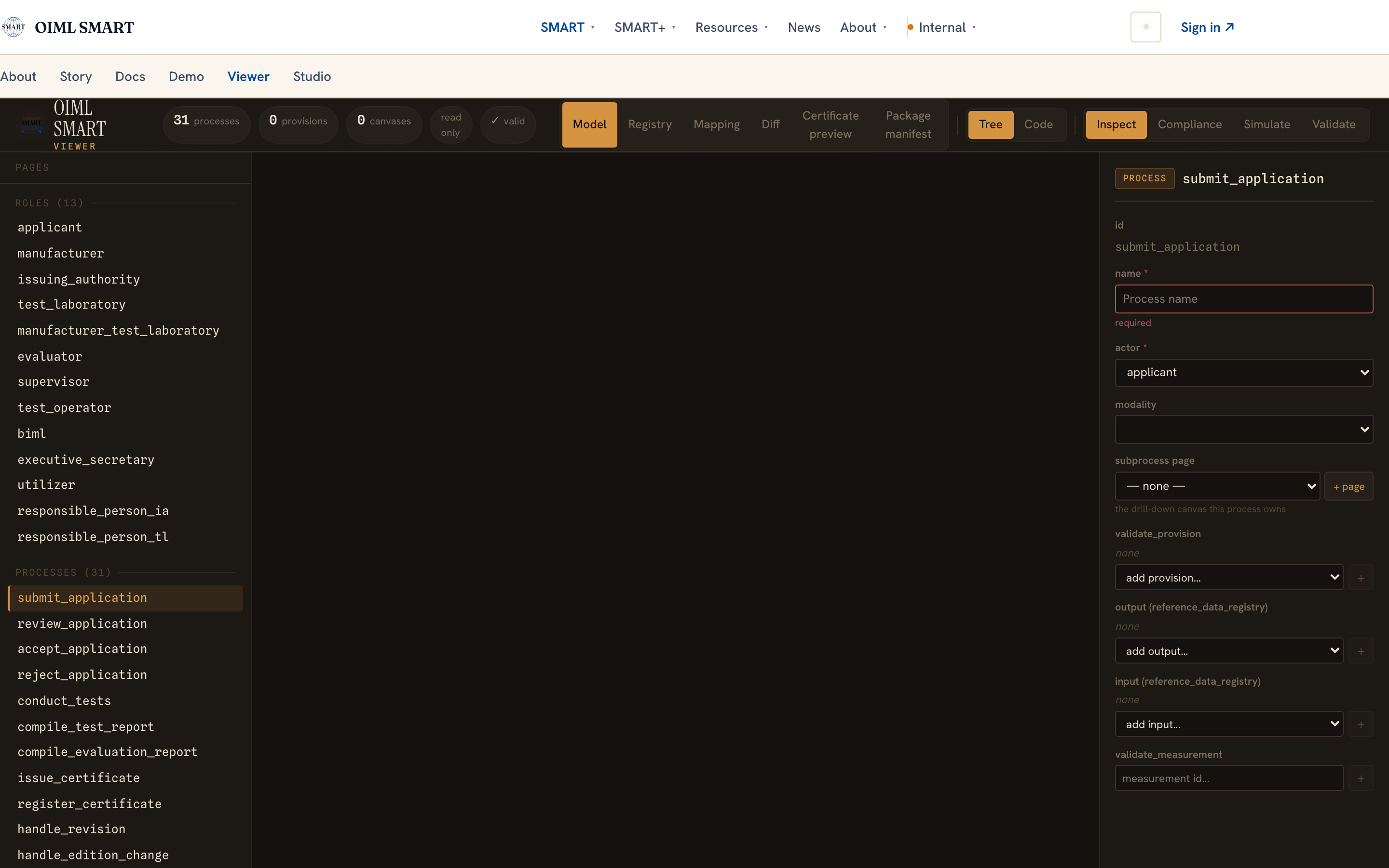
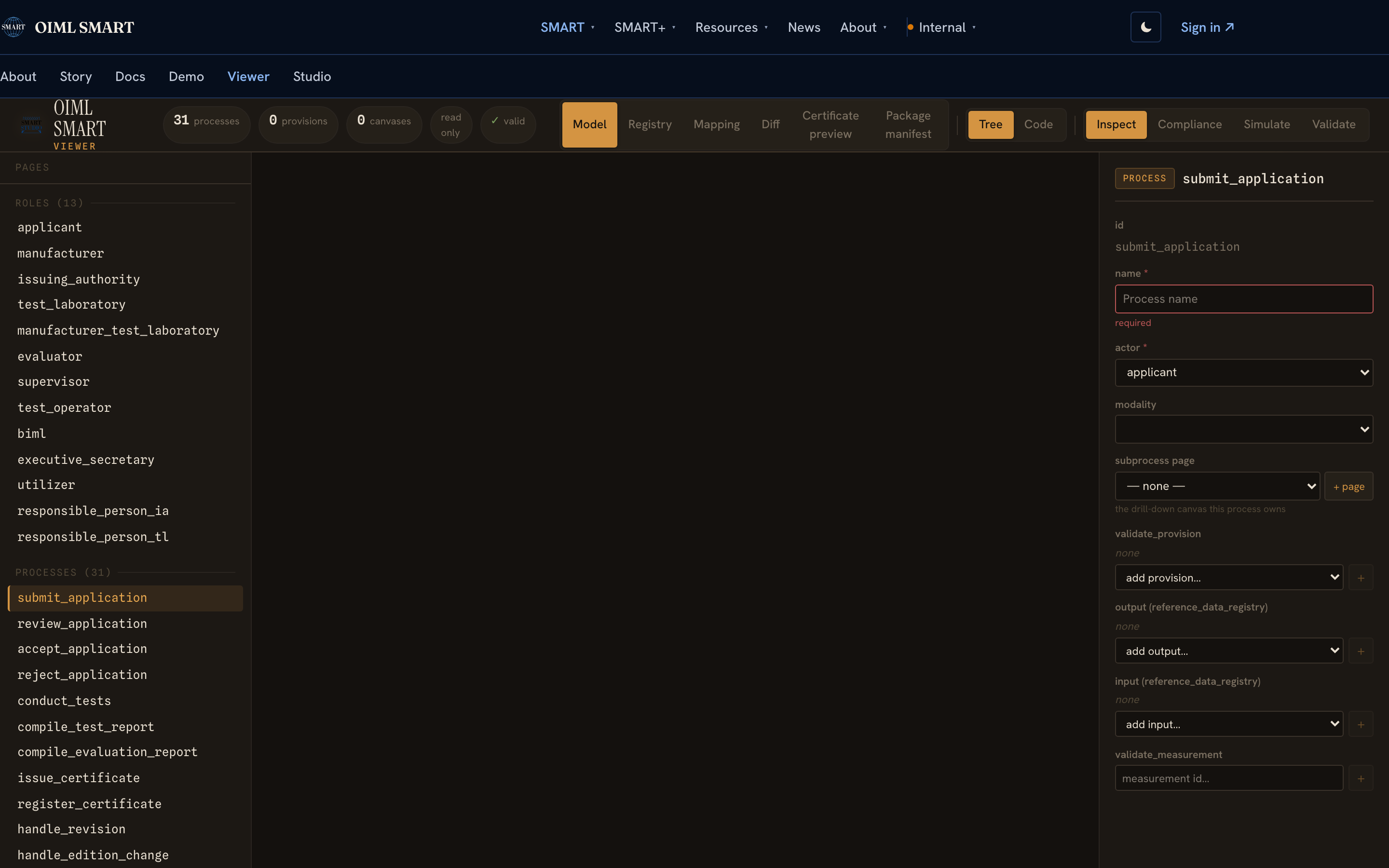
- Open the package as data. The studio viewer renders the published models as a navigable tree: the roles, the processes, the requirements; click any element to inspect its properties (the capture above).
- Watch the model run a certification. The live demo certifies a simulated load cell against the modelled R 60, end to end; sign-in runs through the identity service, with the demonstration cast assumed as personas.
- Gate licensed reference standards per organization. A Recommendation’s reference standards can be carried as licensed content: a laboratory whose organization holds the entitlement walks the standard’s guided procedure inside the test run, and an unlicensed one gets the citation and the plain form — the licensed text never leaves the server without the entitlement, and the whole declare → confirm → unlock process is audited.
- Consume the model in your own tooling. Every surface exports as generated projections: ReqIF for requirements-management tools, RDF/OWL with SHACL shapes for linked-data consumers, OpenCDD back-references for attribute definitions.
How it works
Each Recommendation is authored as a Primmel package: the instrument as a subject with its anatomy, the requirements as constraints bound to the subject’s aspects, the conformance tests that verify each requirement, and the report forms whose fields bind into the same graph. The packages are the single source of truth; the data trees the platform serves are generated artifacts, and a drift guard proves both directions byte-clean, so what the platform runs is what was authored.
The authority stays where the OIML process puts it. The committee’s decision is the text; the model is derived from it and checked against it, never the reverse.
Today (SMART) and the vision (SMART+)
Today · SMART
Why it exists
A Recommendation as published is prose. Every tool that touches it, the editor, the test-bench software, the certificate template, re-encodes the text by hand, and every re-encoding drifts a little from the document the committee adopted. Two laboratories reading the same clause can derive two different test procedures, and the divergence surfaces only when the results are compared. The model removes the re-encoding: the reading, the testing, and the verdict cannot drift apart.
Who may use it, and who may run it
The modelled Recommendations are published content: every member category reads them, and the public surfaces need no account. The determination, quoted from the program’s single entitlement source:
| Member State | Corresponding Member | Issuing Authority / Test Laboratory (of a Member State) | Utilizer / Associate | Applicant / public |
|---|---|---|---|---|
| ✅ | ✅ | ✅ | ✅ | ✅ published |
SMART Recommendations content, quoted from the program's single entitlement source; the full matrix, all services by all member categories, lives atWho can run what.
The honest questions
Does the model replace the published Recommendation? No. The published text stays authoritative; the model is its machine-actionable companion. Every modelled element carries its clause reference precisely so the derivation can be audited against the adopted text, and the platform’s gates fail when the two drift apart.
Which Recommendations are covered? R 60 (the pilot, load cells), with R 91, R 129, and R 144 as demo models. New Recommendations follow the authoring documentation on the SMART Recommendations site; the committee’s adoption process does not change.
What happens when a Recommendation is revised? Editions are first-class in the underlying language: the package pins its source edition, and the reference toolchain’s model diff shows exactly what a revision changes, so downstream deployments regenerate rather than patch by hand.
Do I need an account, or software, to read one? Neither. The pages render on the open web, and the studio viewer runs in the browser with no sign-in.
Try it, read it, talk to us
The applicant portal opens on the Applicant persona, signed in through the identity service; the LC-500i file shows the modelled R 60 running the whole chain. The instance resets nightly.
How a Recommendation becomes a model: the package layout, the provenance discipline, the checks.
info@oimlsmart.org, the programme's front-door address. Questions about modelling a specific Recommendation are welcome: the pilot set is the worked example.