

The SMART Platform
The certification workflow as a running service: an application goes in, a signed, registered certificate comes out, and every verdict between is computed from the modelled Recommendation. One platform serves the OIML-CS centrally, and the same software runs as a member's own instance.
The production certification hub. Sign-in is through the OIML SMART identity service; to look before you ask for anything, the demo instance runs the same software with its fictional cast, signed in through the same service as personas.
What you can do
Seven acts, each performed against the live services before this page listed it. The console acts are performed on the demo instance, which runs the same software in demo posture; the dated capture under each act is the audit artifact, re-produced by scripts/capture-services.ts on every refresh.
1. Work from the modelled Recommendation, not a PDF. The hub publishes the four SMART Recommendations (R 60, R 91, R 129, R 144) with their requirement, test, and form counts; the workflow's verdicts are computed from these models, so the standard the applicant reads is the standard the evaluation executes.
The catalogue: the standards the workflow executes — captured 2026-08-29 by scripts/capture-services.ts 2. File and track an application as an applicant. The manufacturer files against the modelled Recommendation, declares the model family, ships samples, and watches verdicts arrive: five applications and three certificates sit on the pilot applicant's record, each with its state.
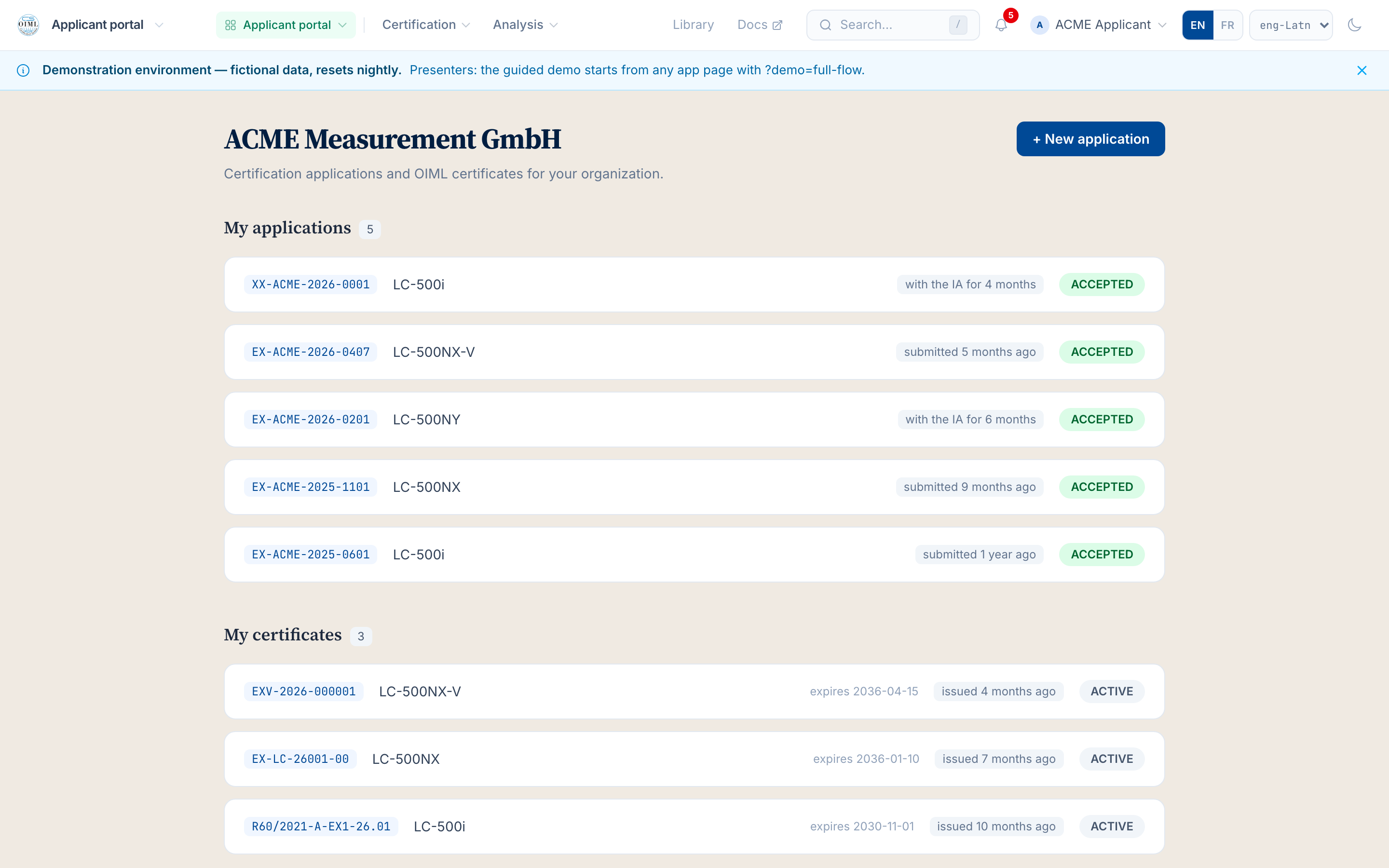
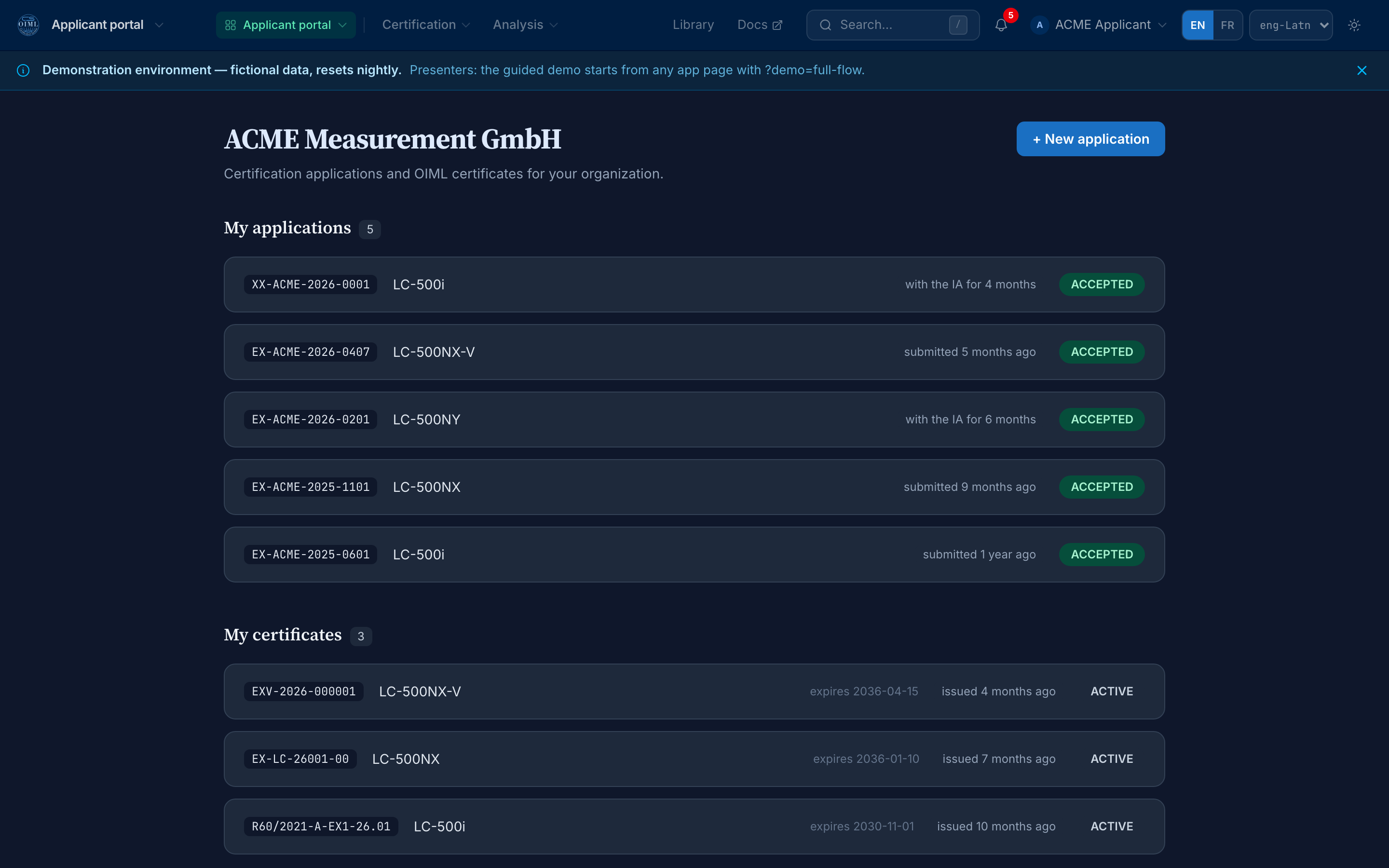
The applicant portal, performed on the demo instance (the same software) — captured 2026-08-29 by scripts/capture-services.ts 3. Run the authority's desk as an Issuing Authority. Review the application, request samples, dispatch the structured test request, judge the evaluation, sign and issue the certificate: the review queue, the twelve pilot projects, and the certificate ready to issue are all on the console.
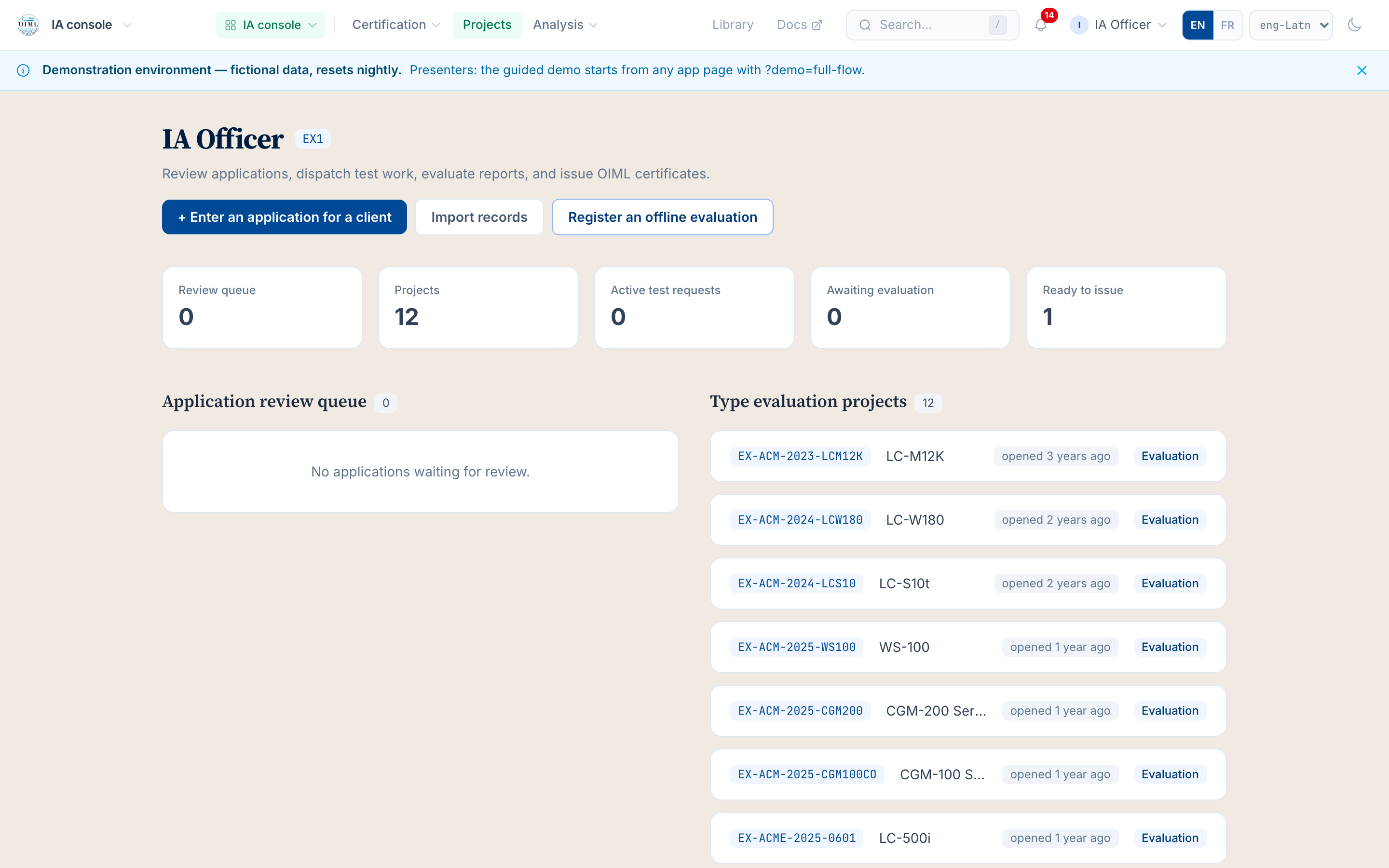
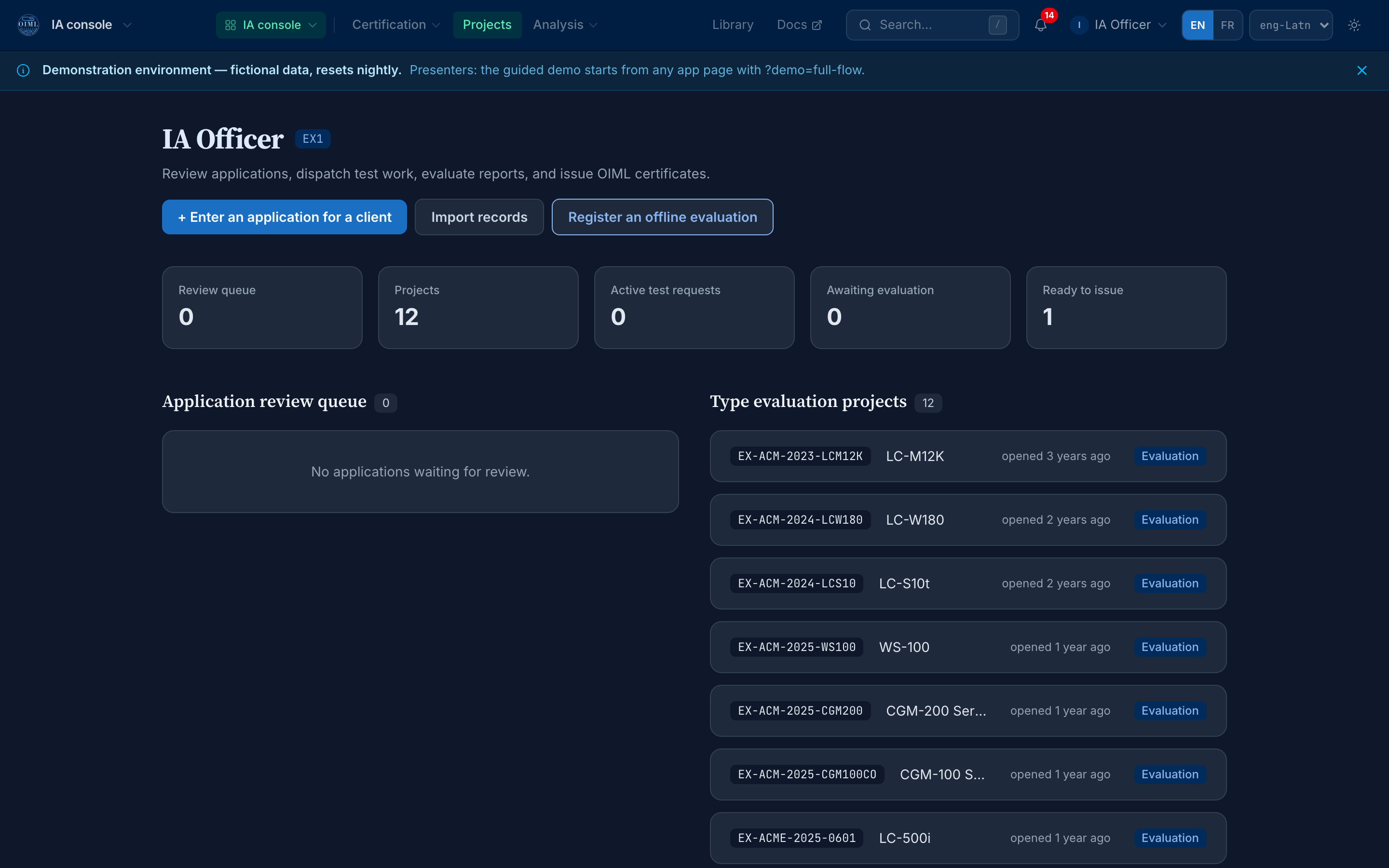
The IA console, performed on the demo instance — captured 2026-08-29 by scripts/capture-services.ts 4. Run the bench as a Test Laboratory. The laboratory's inbox receives the dispatched test request; evidence is captured once at the bench, and the test report is generated from the run itself. The ANR axis declares which Additional National Requirement tests the laboratory can perform, per Recommendation and country.
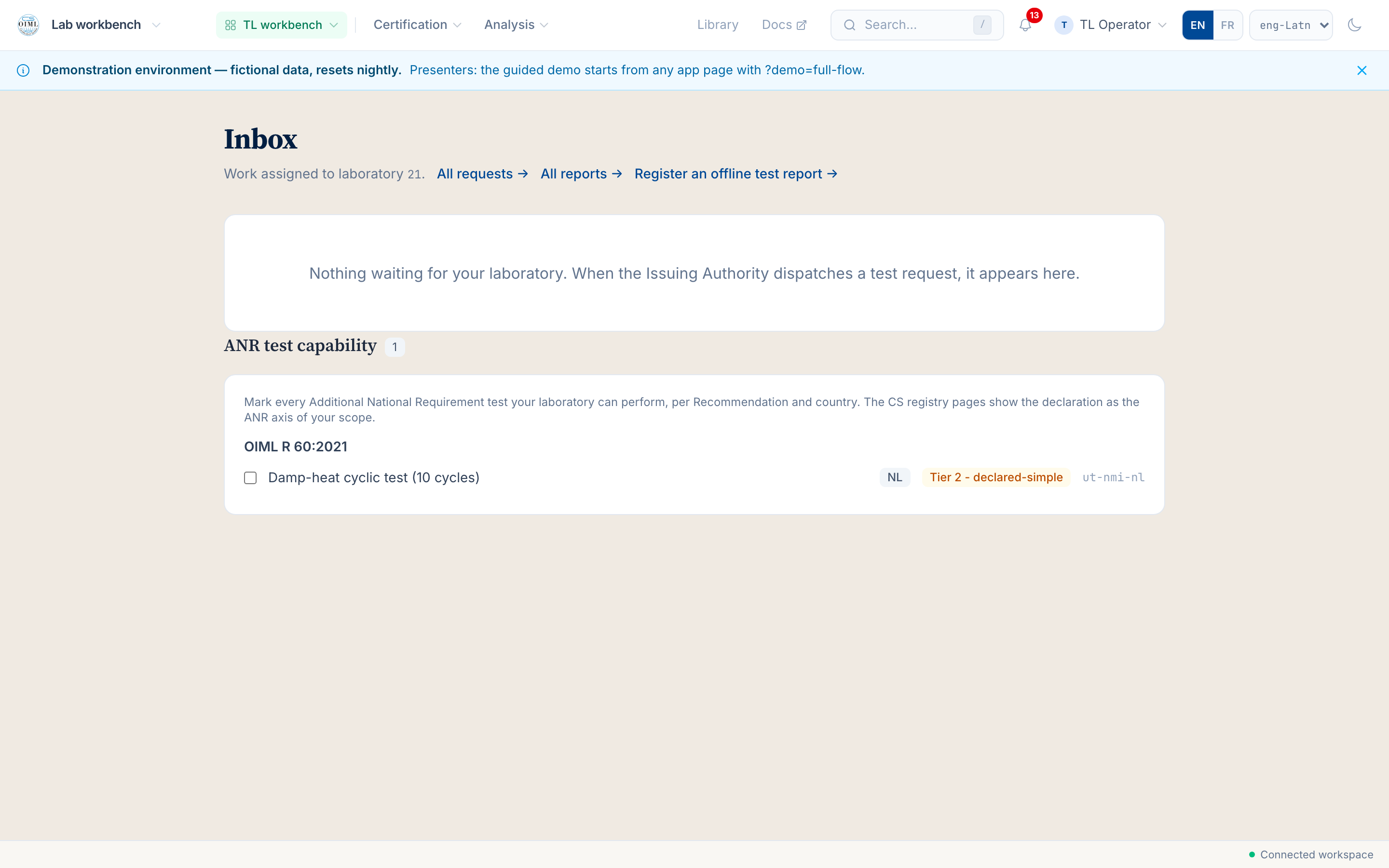
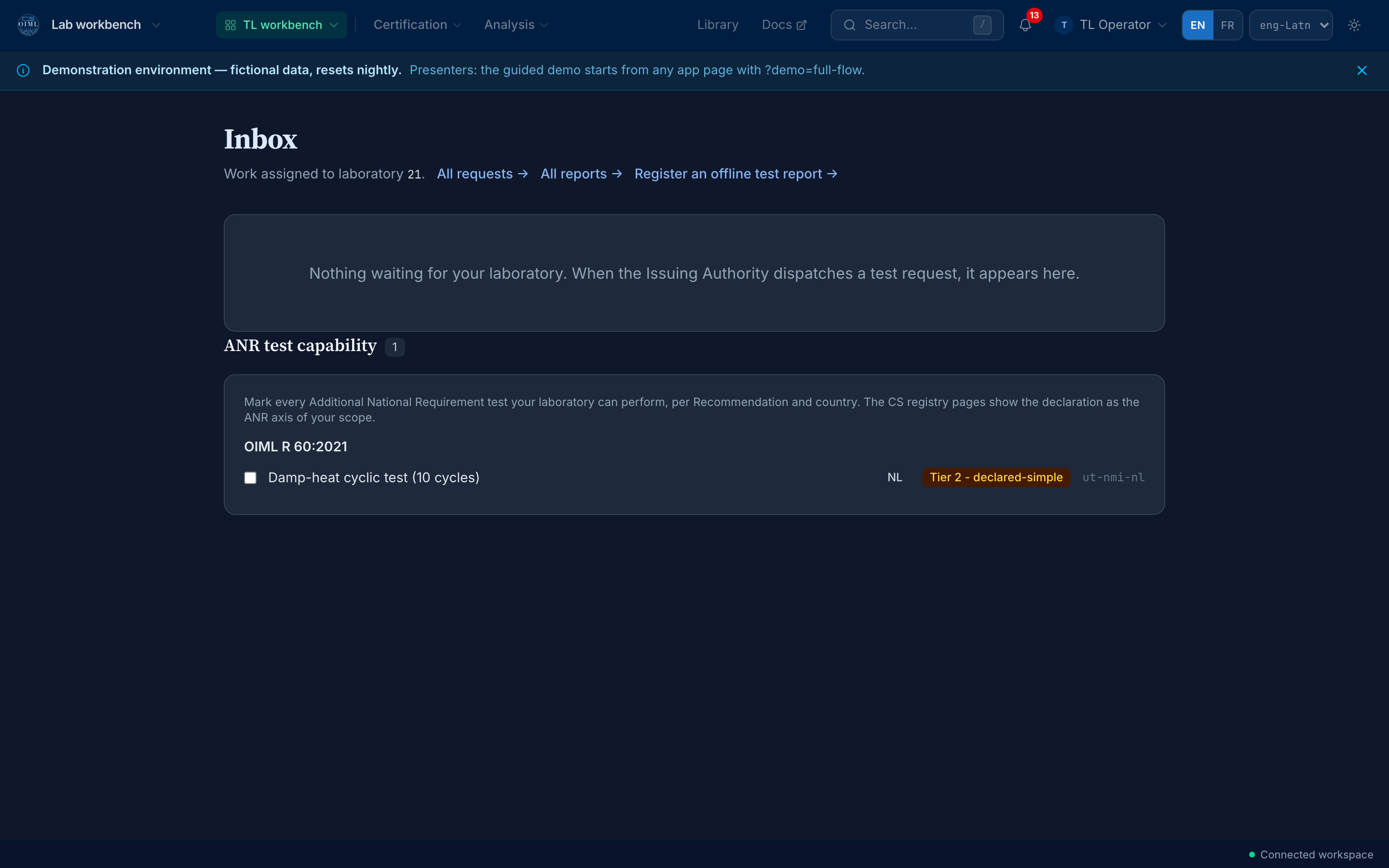
The TL workbench, performed on the demo instance — captured 2026-08-29 by scripts/capture-services.ts 5. Register the certificate as the BIML. Issued certificates arrive in the registration inbox, and the registered record is the public face of the scheme: the worked-example certificate shows registered, with its registration id and date.
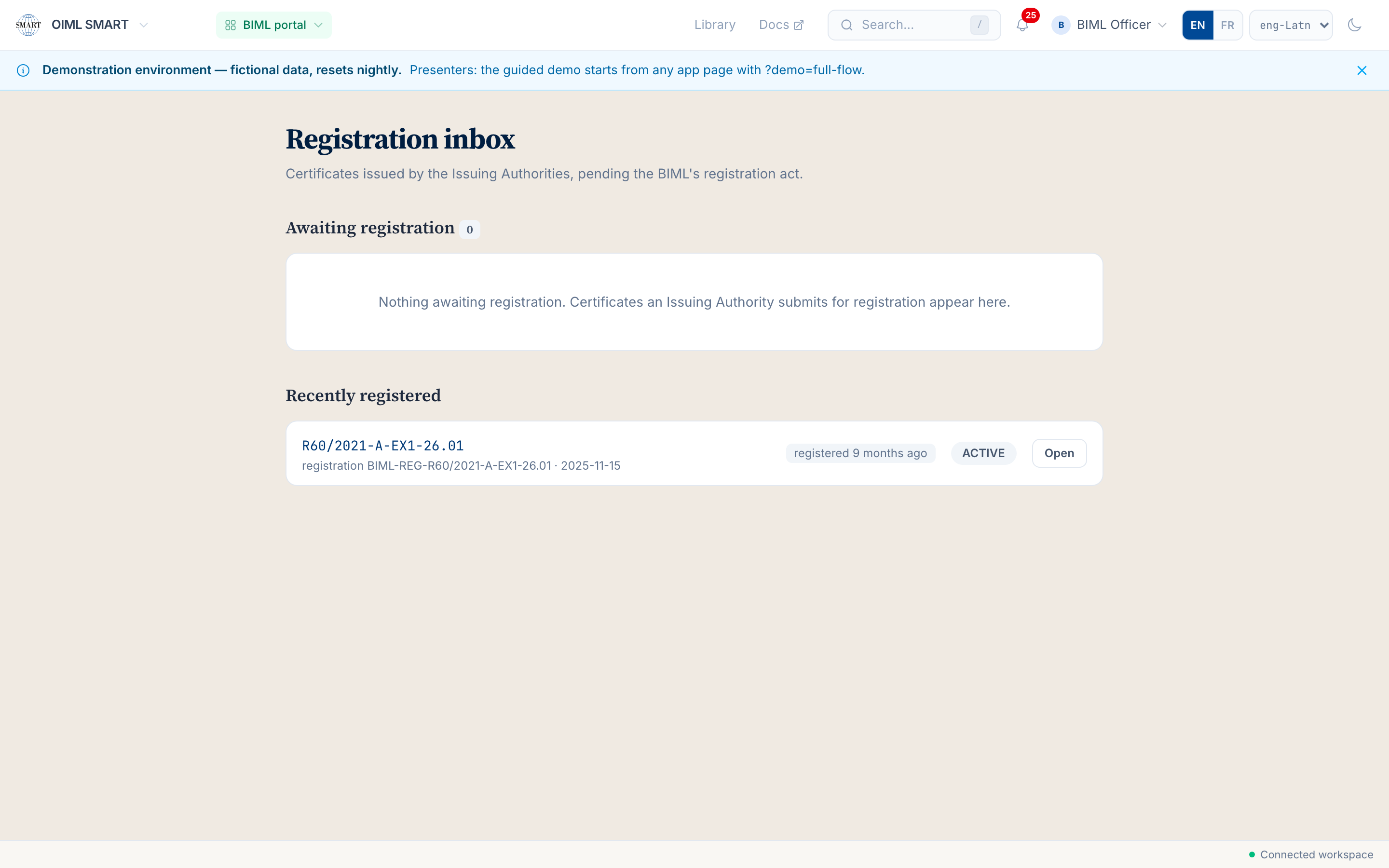
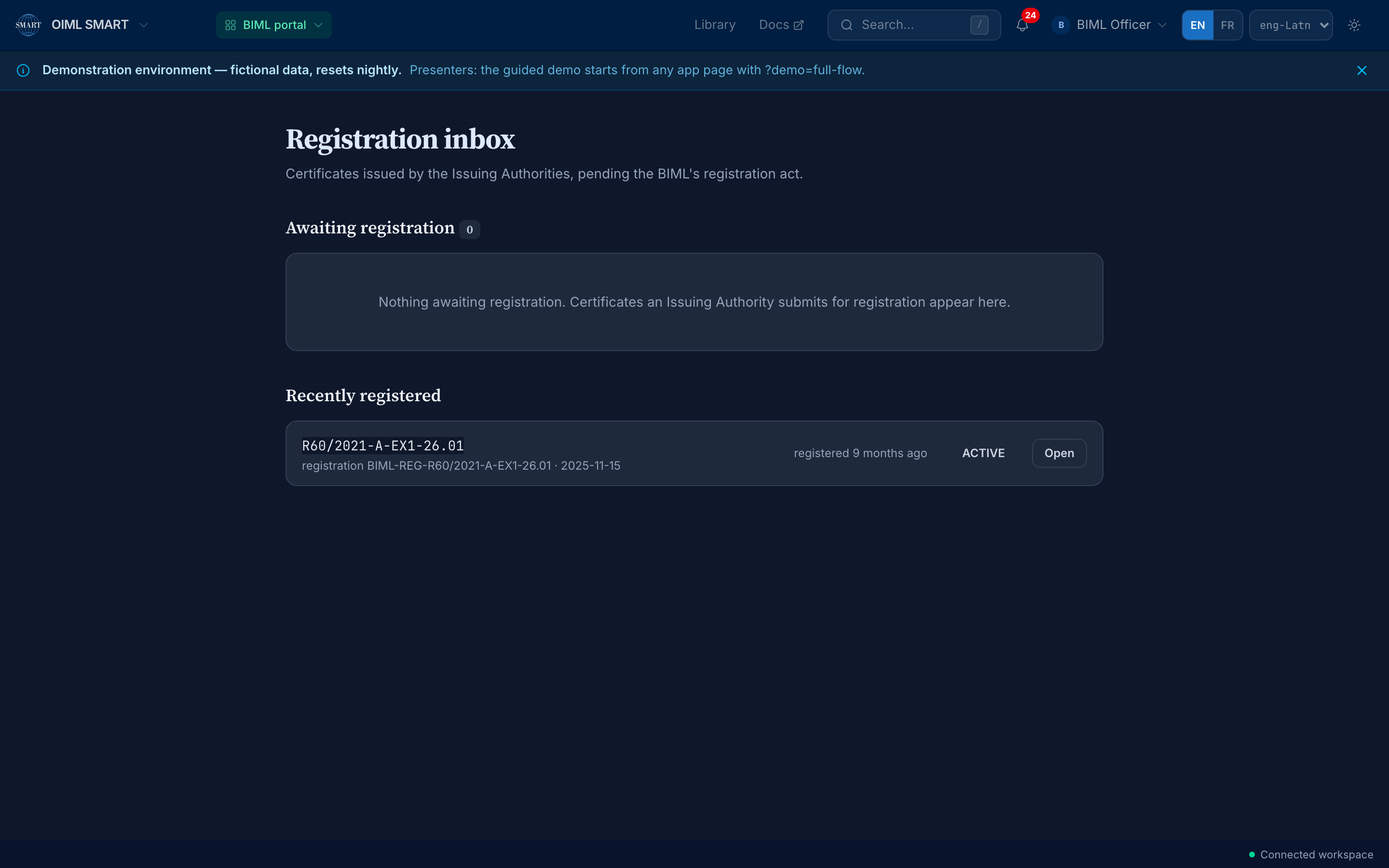
The BIML console, performed on the demo instance — captured 2026-08-29 by scripts/capture-services.ts 6. Hold the certificate, then verify it against the public register. The issued certificate renders as the full OIML document (classification table, conditions, revision history, signature block), and the verify page checks its number against the public BIML register with no sign-in, down to the W3C Status List revocation and suspension bits.
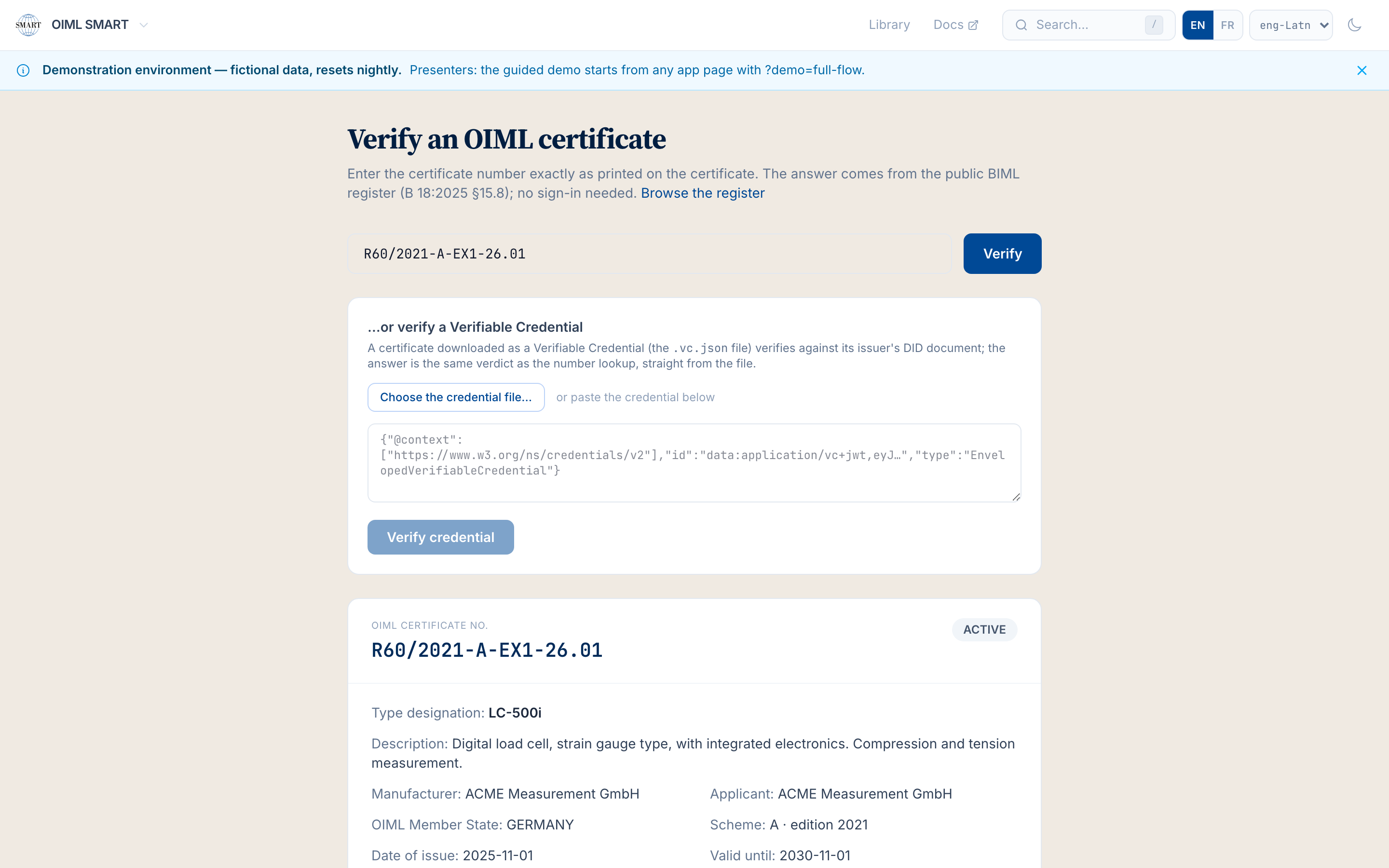
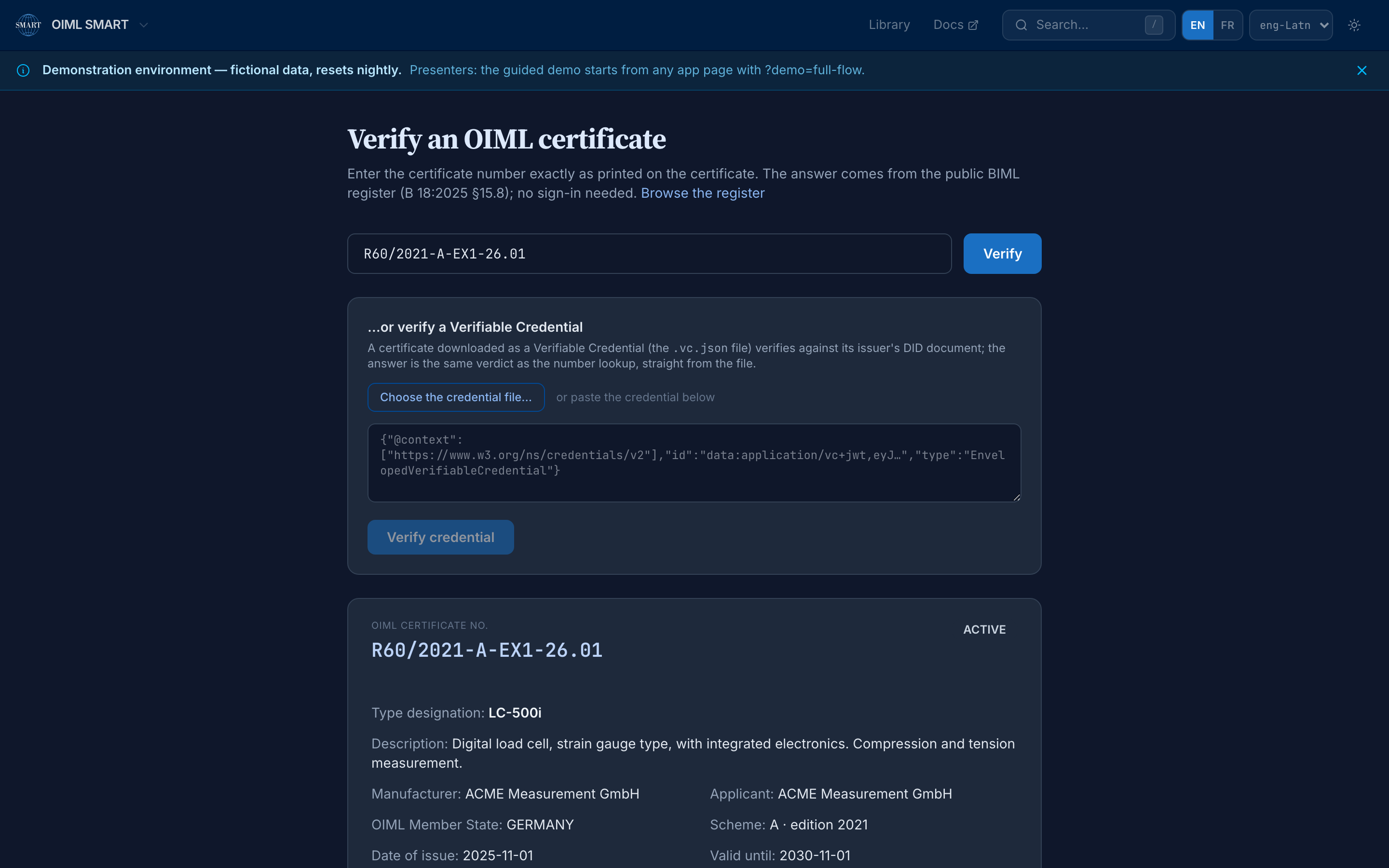
The public register's verdict, performed on the demo instance — captured 2026-08-29 by scripts/capture-services.ts 7. See the instance kinds running. One codebase, four postures decided by the deployment profile: the CS-operated hub, an IA-only instance, a TL-only instance, and the combined IA+TL posture. The pilot instances answer live; an authority-operated instance submits its completed evaluation chains to the CS platform as signed packages, and the register verifies the signature chain on import.
The IA+TL posture (pilot) — captured 2026-08-29 by scripts/capture-services.ts 
The TL-only posture (pilot) — captured 2026-08-29 by scripts/capture-services.ts
How it works
One record carries the whole chain: the applicant files, the authority reviews and dispatches, the laboratory captures evidence at the bench, the evaluation rolls the test reports up into computed verdicts, the certificate issues as a CNML document, and the BIML registration publishes to the same record the workflow wrote to all along. The public verify page closes the loop: anyone can check the number against the register, no account needed.
The full matrix, the two topologies (the shared platform; IA-operated with signed submission), and the rolling-upgrade runbook ship with the member repository's deployment volume. The component deep-dive is the OIML-CS SMART platform page.
SMART today, SMART+ next
SMART · LIVE TODAY
Everything in the inventory above is SMART, the certification tier: the modelled Recommendations, the workflow, the consoles, the CNML certificate, the register. It is running, it is probed once a minute, and every capture on this page is dated.
SMART+ · THE ROADMAP TIER
SMART+ is the platform extended past issuance: the instrument's digital twin serving governed values, the monitor judging them continuously, the certificate becoming a live, re-computed state instead of a point-in-time snapshot. The twin runtime is piloted on the demo today; the deployable compliance engine and the cryptographically signed serves are roadmap, anchored on the SMART Twin page and the SST page. Nothing in this section is present tense.
How to get access
- Request an OIML SMART account through the identity service's join flow: id.oimlsmart.org → Request an account (/op/join). Pick your organization from the participants register; approval comes from your own organization's administrator. The full walk is on the identity service page.
- Sign in at platform.oimlsmart.org → Enter App. Your role's console is the one your organization's registration opens.
- To try the workflow with no real evaluation at stake, use the demo instance: the fictional cast signs in through the same identity service, each seat assumed as a persona.
Running your own instance is the Member State self-host entitlement: the deployment runbook (topologies, rolling upgrades) ships with the member repository, and an authority or laboratory operates its instance under its proposing member state's entitlement.
Status
| Status-page row | Declared availability | Declared latency |
|---|---|---|
| Platform hub | 99.9% / 30d | p95 ≤ 2 s |
| NMI instance | 99.5% / 30d | p95 ≤ 2.5 s |
| TL instance | 99.5% / 30d | p95 ≤ 2.5 s |
The demo hub is probed separately as its own row; see the demo instance page.
Probed once a minute with a content assertion per row; the live actuals (30/90-day uptime, p95) are onstatus.oimlsmart.org, a number is never rounded up to meet a target.
Who can use it, who can run it
The hosted service and the self-host software carry different entitlements, quoted separately from the single source:
The hosted OIML-CS SMART Platform
| Member State | Corresponding Member | Issuing Authority / Test Laboratory (of a Member State) | Utilizer / Associate | Applicant / public |
|---|---|---|---|---|
| ✅ | ✅ | ✅ their consoles | ✅ designated access | ✅ applicant portal |
OIML-CS SMART Platform (cloud), quoted from the program's single entitlement source; the full matrix, all services by all member categories, lives atWho can run what.
The SMART Platform software (self-host)
| Member State | Corresponding Member | Issuing Authority / Test Laboratory (of a Member State) | Utilizer / Associate | Applicant / public |
|---|---|---|---|---|
| 🏠 🔄 | ⬆️ available on ratification | operates under its Member State’s 🏠 | — | — |
SMART Platform software (self-host), quoted from the program's single entitlement source; the full matrix, all services by all member categories, lives atWho can run what.
The honest questions
Does the platform widen our authority's liability?
No. The platform computes verdicts from the modelled Recommendation; the judgment, the signature, and the decision remain the authority's own acts, exactly as today. The same holds for the OIML-CS: the scheme's liability posture is unchanged by the software that carries its workflow.
Must we self-host to stay sovereign?
No. The hosted platform serves every member category, and using it never requires running anything. Self-hosting is the Member State entitlement for those who want their own data residency, and the identity piece any member may run is config-only; the matrix above quotes both postures from the single source.
Do our PDFs and existing processes die?
No. The Recommendation's text stays; the model joins it. Certificates still render as the familiar document (the print view is there on the certificate page); the CNML original and the public register verification are additions, not replacements. Gradualness is the design, not a migration promise.
What does running our own instance cost?
The deployment postures are deliberately minimal-ops: one service, one database, the rolling update channel. The deployment runbook ships with the member repository; the honest headline is that a member instance is operations a national metrology institute's IT already runs, not a new kind of infrastructure.
Where to go next
The same software in demo posture. The applicant portal and the IA console are the two consoles to see first; the login page lists the cast as persona cards, signed in through the identity service.
The developer quickstart and the docs federation: the workflow model, the deployment profiles, the data conventions.
info@oimlsmart.org, the programme's front-door address. Pilot participation and deployment questions land here.
Verified 2026-08-29: platform.oimlsmart.org, nmi.oimlsmart.org, and tl.oimlsmart.org all answered live; the console acts were performed on the demo instance (the same software) by scripts/capture-services.ts; the sign-in path walked to the identity service's join flow. The captures and their assertions are in public/img/services/manifest.json.