

Your market’s extra rules, declared as data instead of annexes. A Utilizer’s officer knows the problem by heart: her market’s regulation adds requirements the Recommendation does not cover, and today those live as an annex table in a PDF that every applicant, authority, and laboratory re-reads and re-interprets on their own. On the platform the Additional National Requirements are declared content: the scheme’s own rule applies (Utilizers and Associates may specify ANRs, and when they do, the relevant test procedures must also be defined), the declaration is moderated before it is live, and the workflow carries the declared set into the dispatch, the evaluation, and the certificate.
Assume the Utilizer Officer (XG) persona through the identity service: the declaration registry for your market and the declare form. The instance resets nightly.
The story
The lifecycle, as one market runs it. The Utilizer’s officer declares her market’s additional requirement, with its test procedure, because the scheme requires both together. She picks the path that fits her organization today: where the market can model, the requirement is a Primmel constraint and the procedure a Primmel process, dispatchable and evaluable exactly like a conformance test; where it cannot yet, the declared-simple path takes the title, the description, the procedure as text, and the reference document, and never blocks on modelling. A registry officer reviews the declaration; only APPROVED is live. The authorities and their laboratories then declare which ANR tests they can perform. When an applicant targets her market, the wizard names the country and the declared ANRs ride the application chain; the dispatch covers the ANR tests alongside the Recommendation’s own; the certificate records the coverage per country. And where an evaluation honestly does not cover one, the record says so, with the reason: never a silent gap.
What you can do today
Every act below was performed against the live demo by the scripted capture apparatus before it was listed; each figure names its capture date and links the live surface.
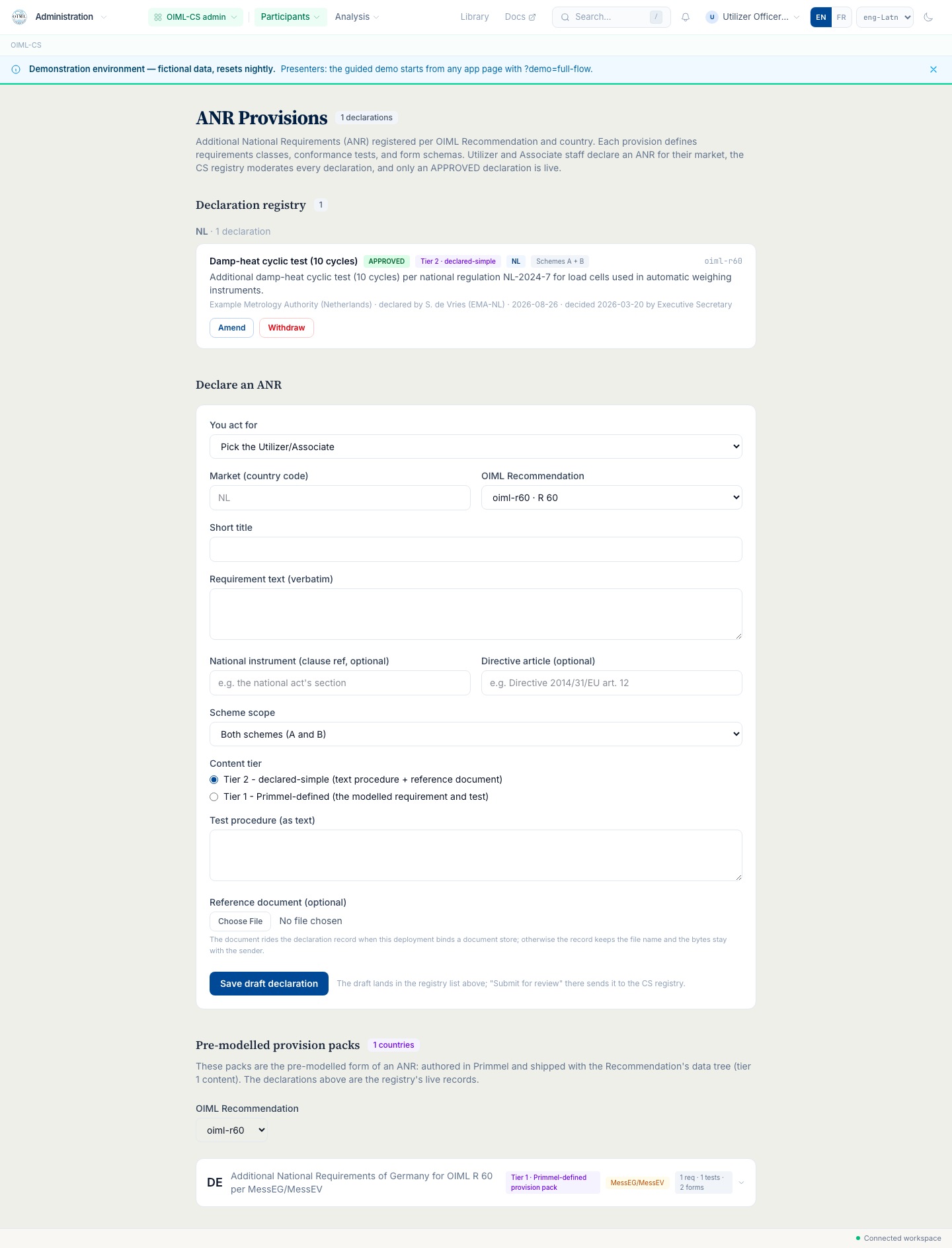
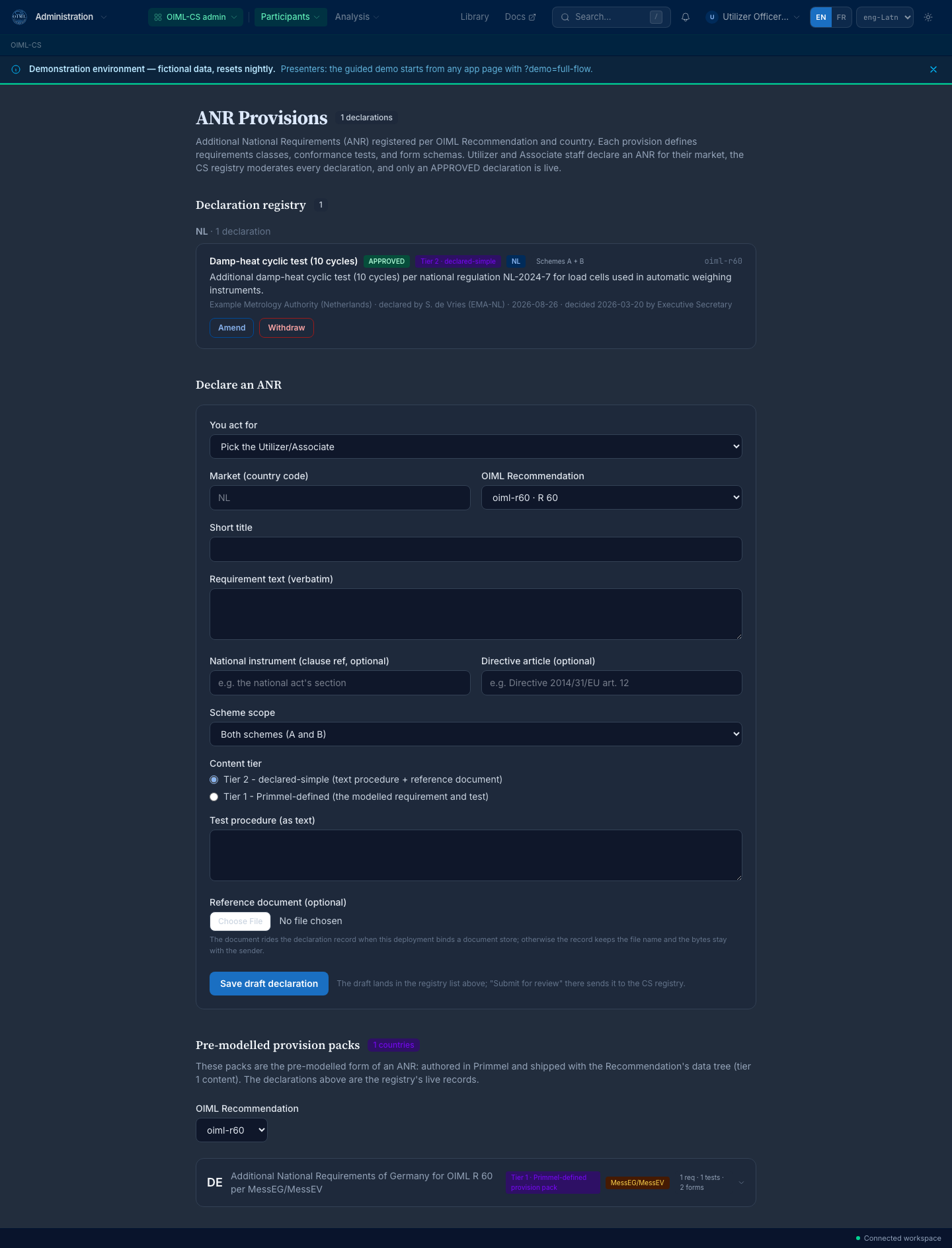
Read your market’s ANR registry. The ANR provisions surface carries the declaration registry with its moderation states: today’s live example is the Luggnagg declaration, a damp-heat cyclic test (10 cycles) per the national regulation XG-2024-7 for load cells in automatic weighing instruments, declared by the Luggnagg Metrology Institute, decided by the Executive Secretary, APPROVED for schemes A + B. The same page carries the pre-modelled provision packs, the tier-1 form: Germany’s additional requirements for R 60 per MessEG/MessEV, authored in Primmel and shipped with the Recommendation’s data tree. Assume the Utilizer Officer (XG) persona through the identity service’s account chooser.
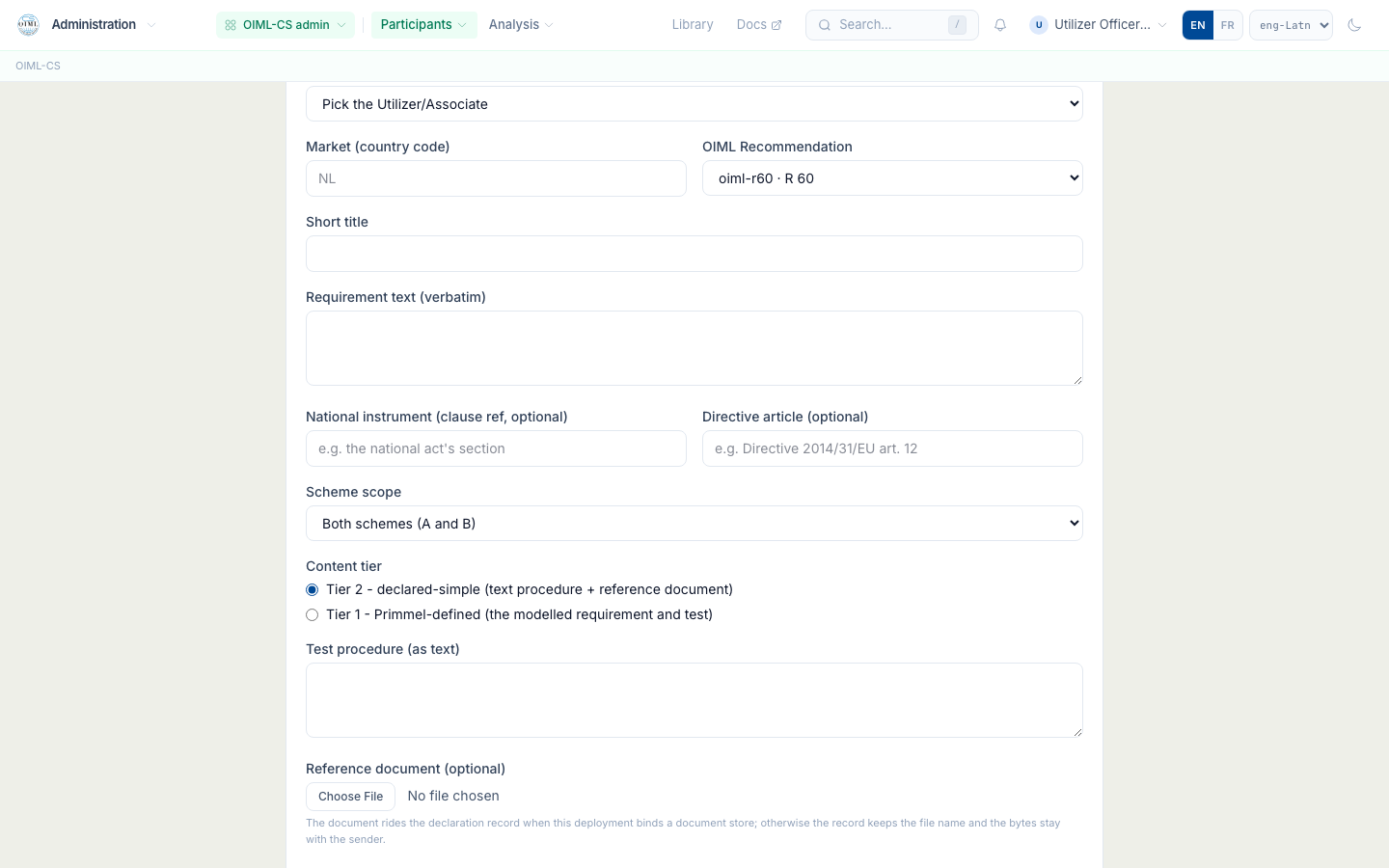
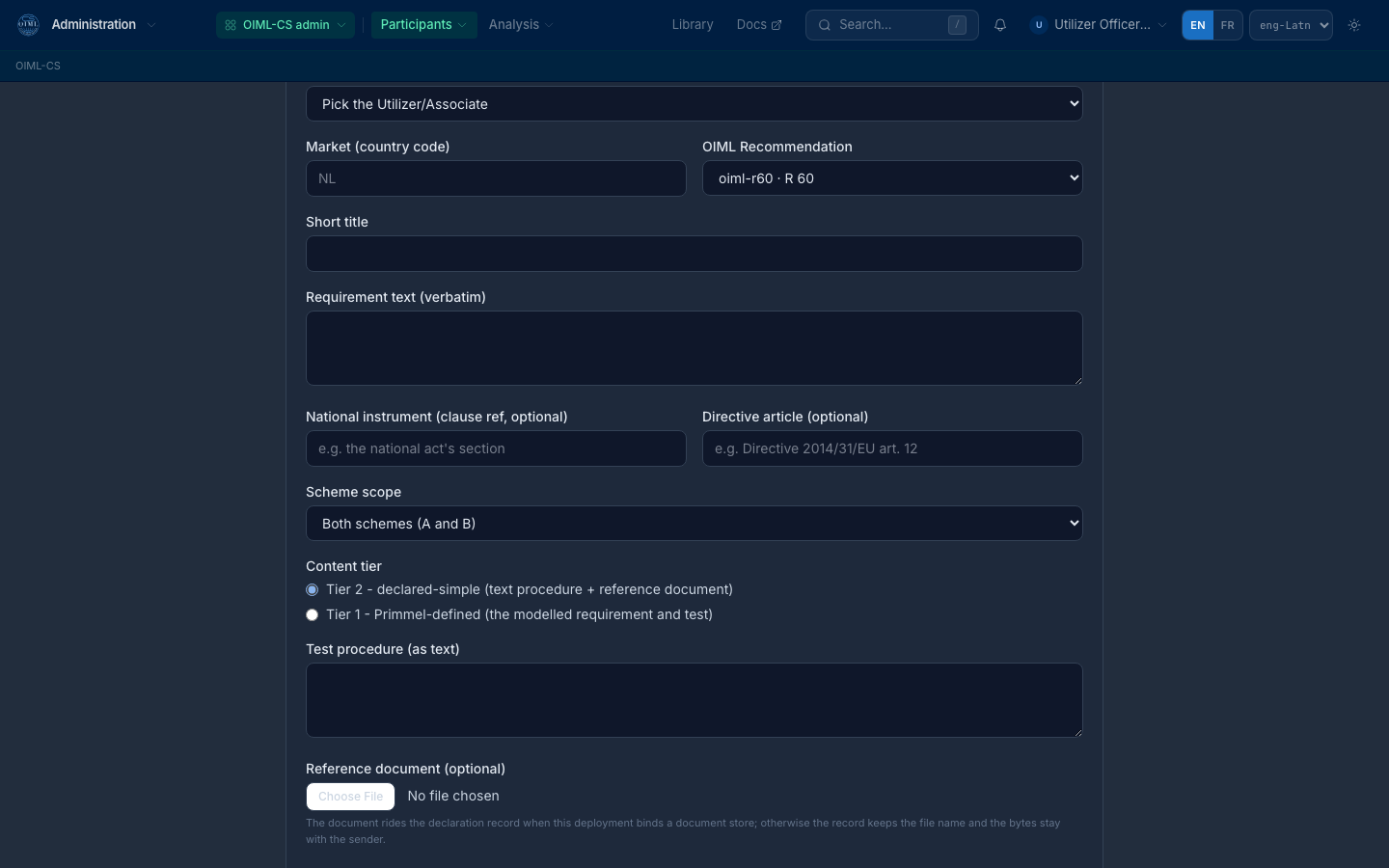
Open the declare form. Both paths start here, and the form says so: the content-tier radio offers tier 2, declared-simple (the procedure as text plus the reference document), and tier 1, Primmel-defined (the modelled requirement and test). The draft files into the registry list; submit for review sends it to the CS registry; only APPROVED is live.
Declare capability where your authority stands. The authority’s own console carries the ANR test-capability card: mark every ANR test your authority can perform, per Recommendation and country, and the CS registry pages show the declaration as the ANR axis of your scope. Assume the Issuing Authority persona for the console.
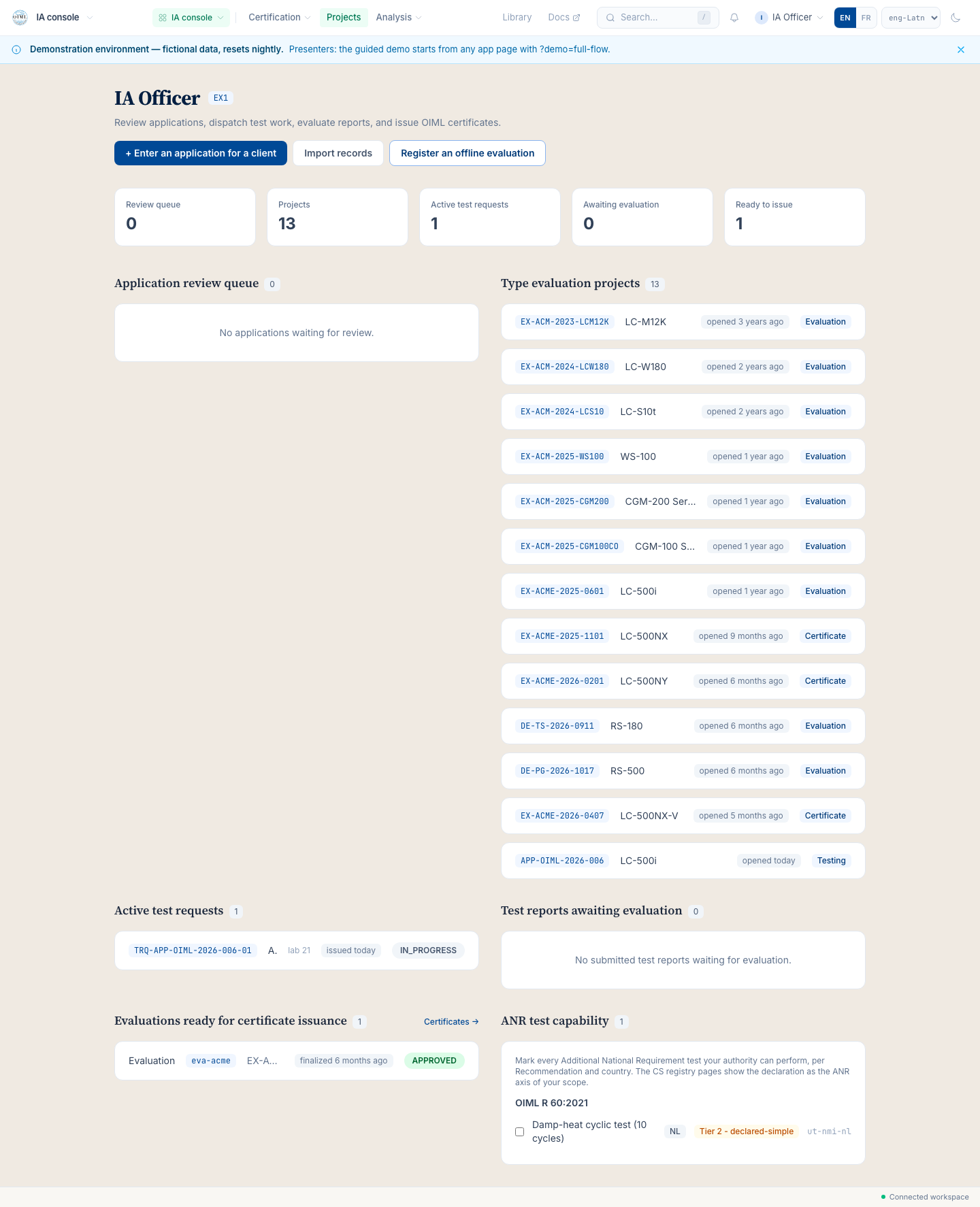
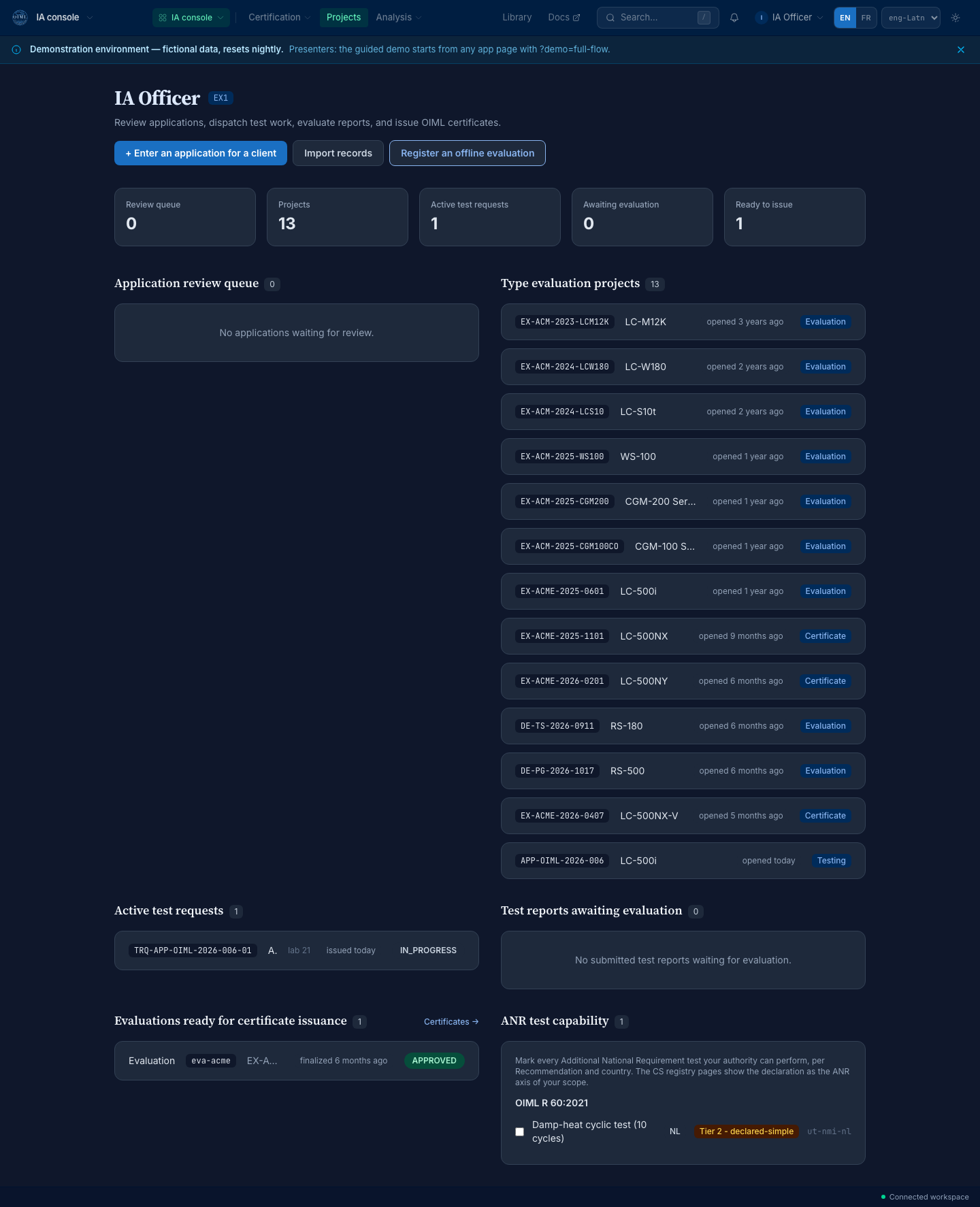
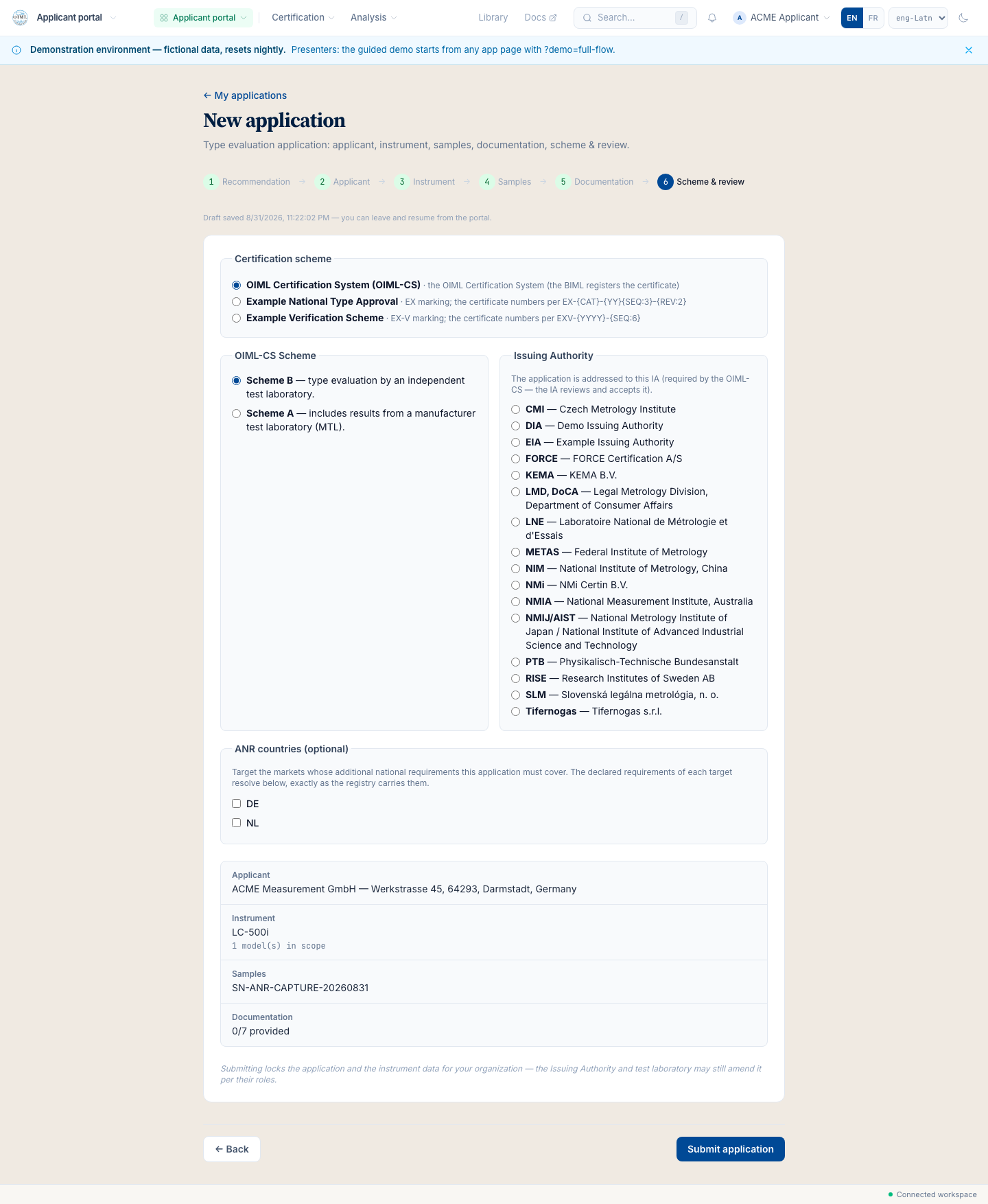
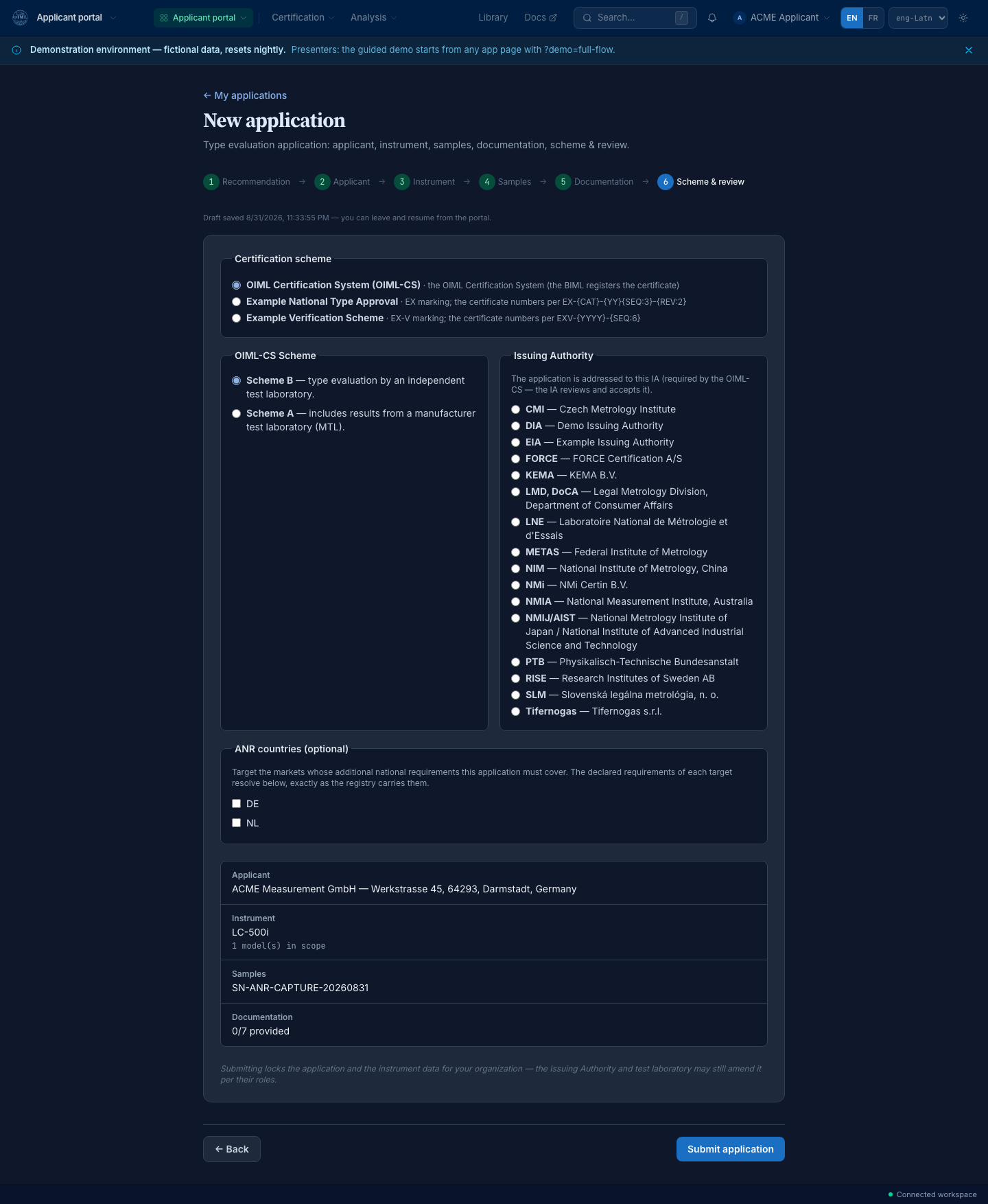
Target a market in the application wizard. The scheme step names the target countries, and the declared ANRs for those countries appear exactly where the applicant makes the commitment: for R 60 today the fieldset carries DE and XG, resolved exactly as the registry carries them. Assume the Applicant persona and start an application.
How it works
The three tiers are a migration path, not a caste system: a declared-simple (tier 2) provision gains its modelled reference when the model lands, and the coverage history keeps both forms’ provenance. Tier 1 provisions dispatch their modelled steps like any conformance test; tier 2 provisions dispatch the generic evidence-collection shape, the operator reads the declared procedure and the platform collects the evidence against it; tier 0 is the honest bypass, recorded per country with its reason, so the certificate’s ANR section never hides a gap.
Today (SMART) and the vision (SMART+)
Today · SMART
- The ANR declaration registry with moderation: only APPROVED provisions are live. the registry ↗
- The application wizard resolves the declared ANRs for the targeted countries; the set rides the chain. the wizard ↗
- The utilizer surfaces for designated markets, scoped per designation. the audience page ↗
The vision · SMART+
- Per-country Primmel packages as the shared tier-1 library: a market models once, every authority and laboratory reuses. the language site ↗
- ANR coverage verified chain-level by the receiving market, not re-read from the certificate prose. roadmap ↗
The honest questions
Who decides an ANR is real?
Your market does, exactly as today; the platform never invents requirements. The declaration carries the legislation reference and the test procedure, and the scheme’s moderation reviews it before it is live. The platform’s discipline is that what applies is declared, and what is declared is visible to exactly the parties it applies to.
We cannot model our requirements in Primmel yet. Are we locked out?
No; that is what the declared-simple path is for. Tick the known archetype or enter the requirement and the procedure as text, upload the reference document, and the declaration works: dispatchable, evaluable, recorded. When the model lands later, the provision is promoted and the coverage history keeps both forms’ provenance. Never blocked on modelling.
Does an ANR change the Recommendation?
No. The Recommendation’s own conformance model stays exactly what the OIML publishes; ANR classes live alongside it as additional, country-scoped content. The certificate’s ANR section records the coverage per country, so what was evaluated against the Recommendation and what was evaluated against a market’s addition is never blurred.
What if an evaluation does not cover a declared ANR?
Then the record says so, per country, with the reason: the tier-0 bypass. The certificate’s ANR section reads covered or not evaluated, honestly, for each targeted market. A silent gap is the one outcome the flow is built to make impossible.
Where to go next
The Utilizer Officer (XG) persona, assumed through the identity service: the registry, the declare form, the moderation states.
The Utilizer and Associate picture: what designation opens, the ANR surface among it.
info@oimlsmart.org: your market's ANR table is the conversation; bring the annex PDF and we will show you its declared form.