
The Vocabulary
Every term of legal metrology, linked: the VIM and VIML edition series, the curated OIML Complete Vocabulary, and the G 18 registry of how the publications actually use each term. Every concept has its own URL, so a citation can point at the term itself.
Public, no account. Search, browse the datasets, or open the graph view.
What you can do
Six acts, each performed against the live service before this page listed it; the dated capture is the audit artifact, re-produced by scripts/capture-services.ts on every refresh.
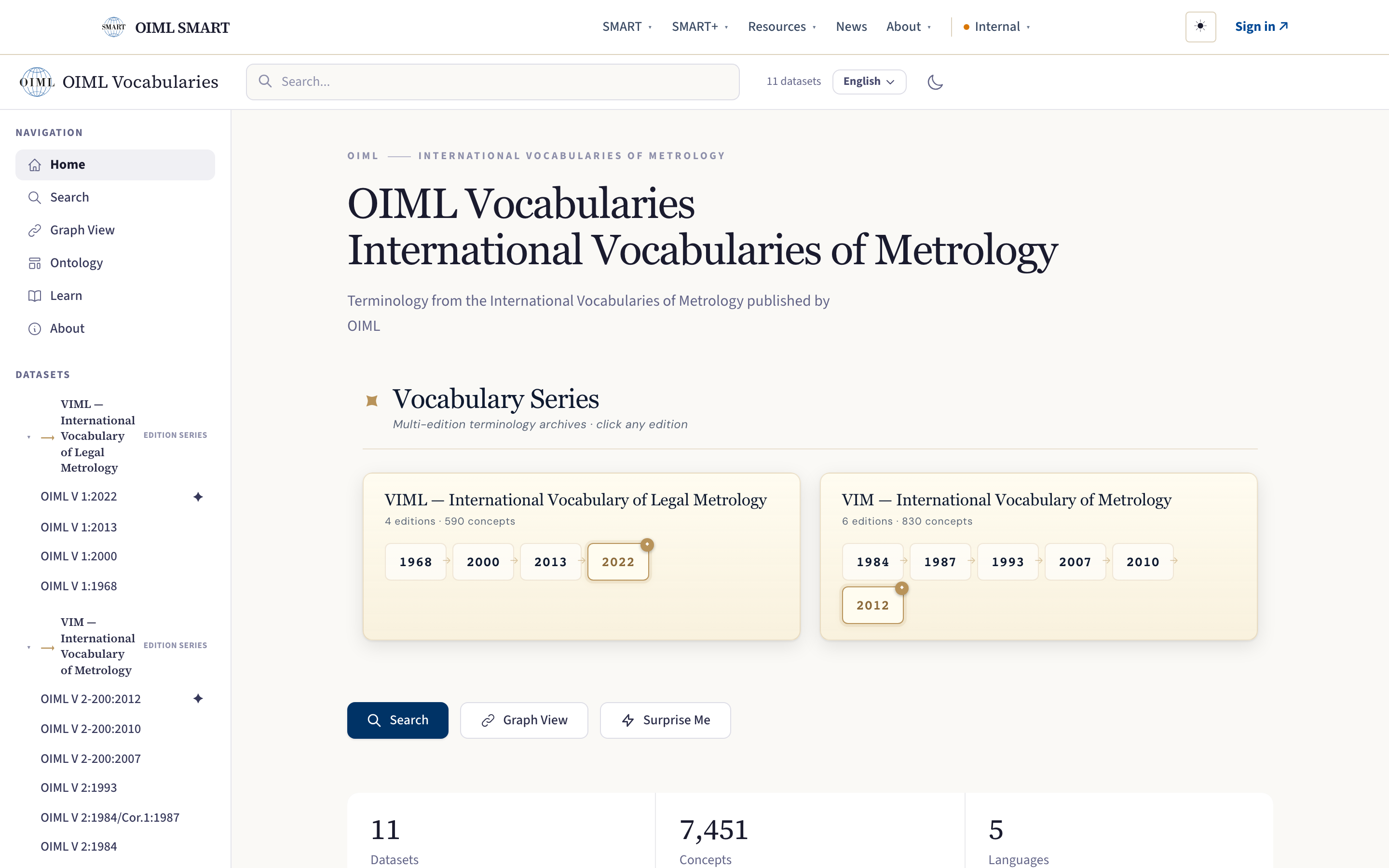
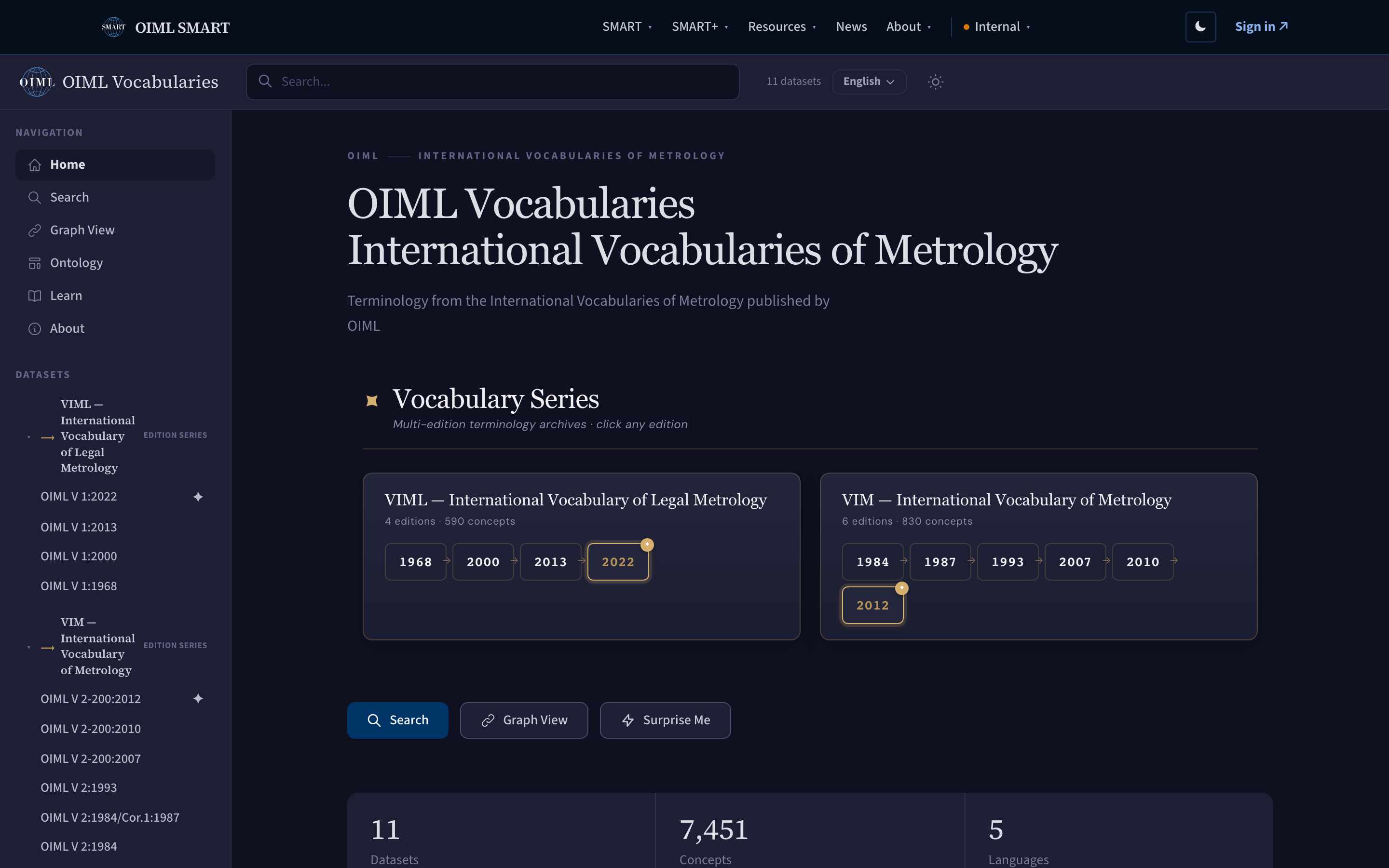
1. Browse the whole terminology collection. Eleven datasets: the VIML and VIM edition series (every edition, the current one marked), the curated Complete Vocabulary collection across both, and the counts on the face: 7,451 concepts, five languages.
Every edition, the current one marked — captured 2026-08-29 by scripts/capture-services.ts 2. Search every edition at once. One query returns the term wherever it lives: calibration surfaces in the VIML 2022, each VIM edition back to 1984, and the curated collection, each hit with its concept number.
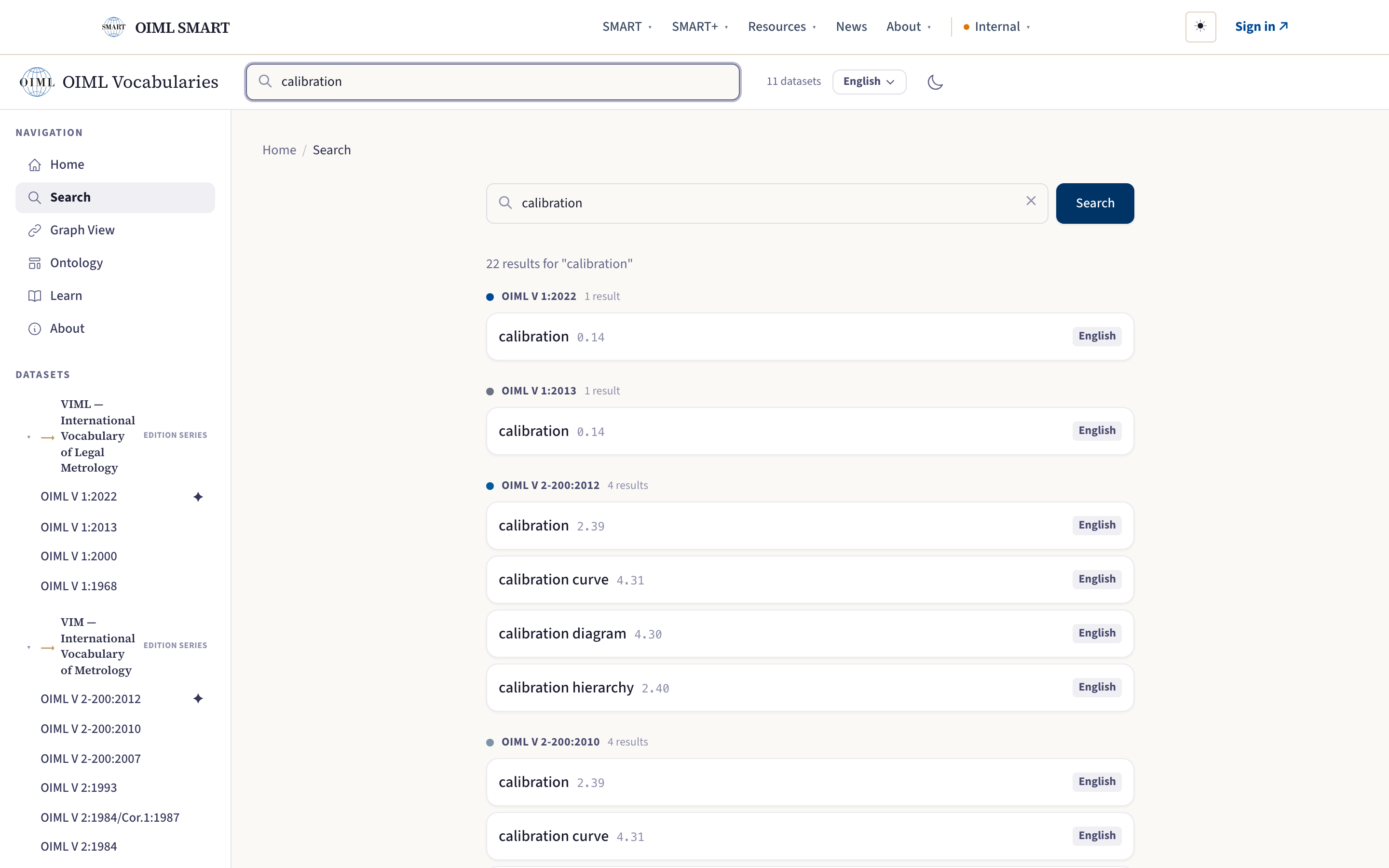
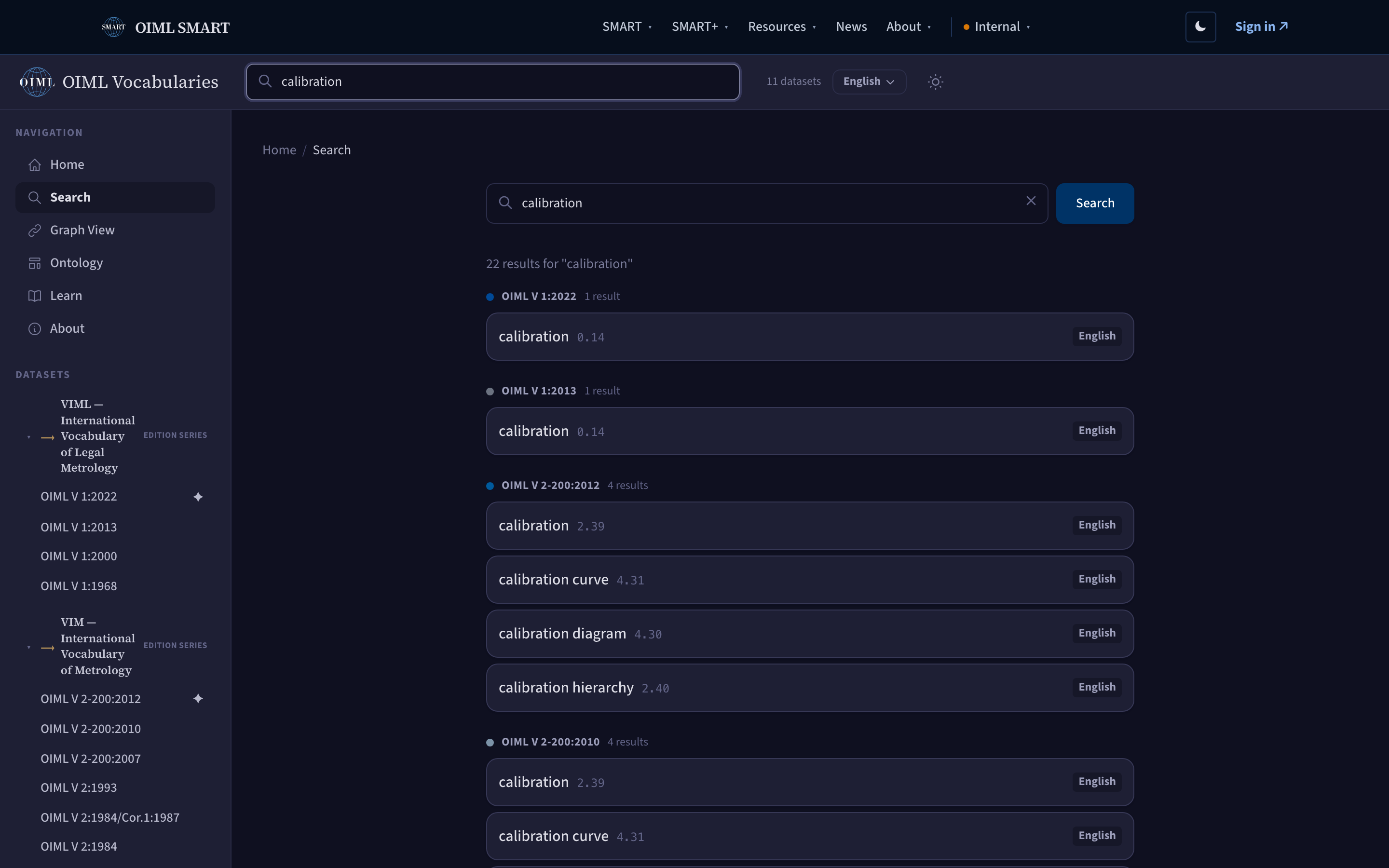
One query, every edition, each hit numbered — captured 2026-08-29 by scripts/capture-services.ts 3. Open a concept and cite the term itself. Calibration hierarchy (VIM 2.40) opens with its definition, its partitive relations, its edition series, and its canonical URI. Citing a term means copying its URL; the citation points at the concept, not at a page range in a PDF.
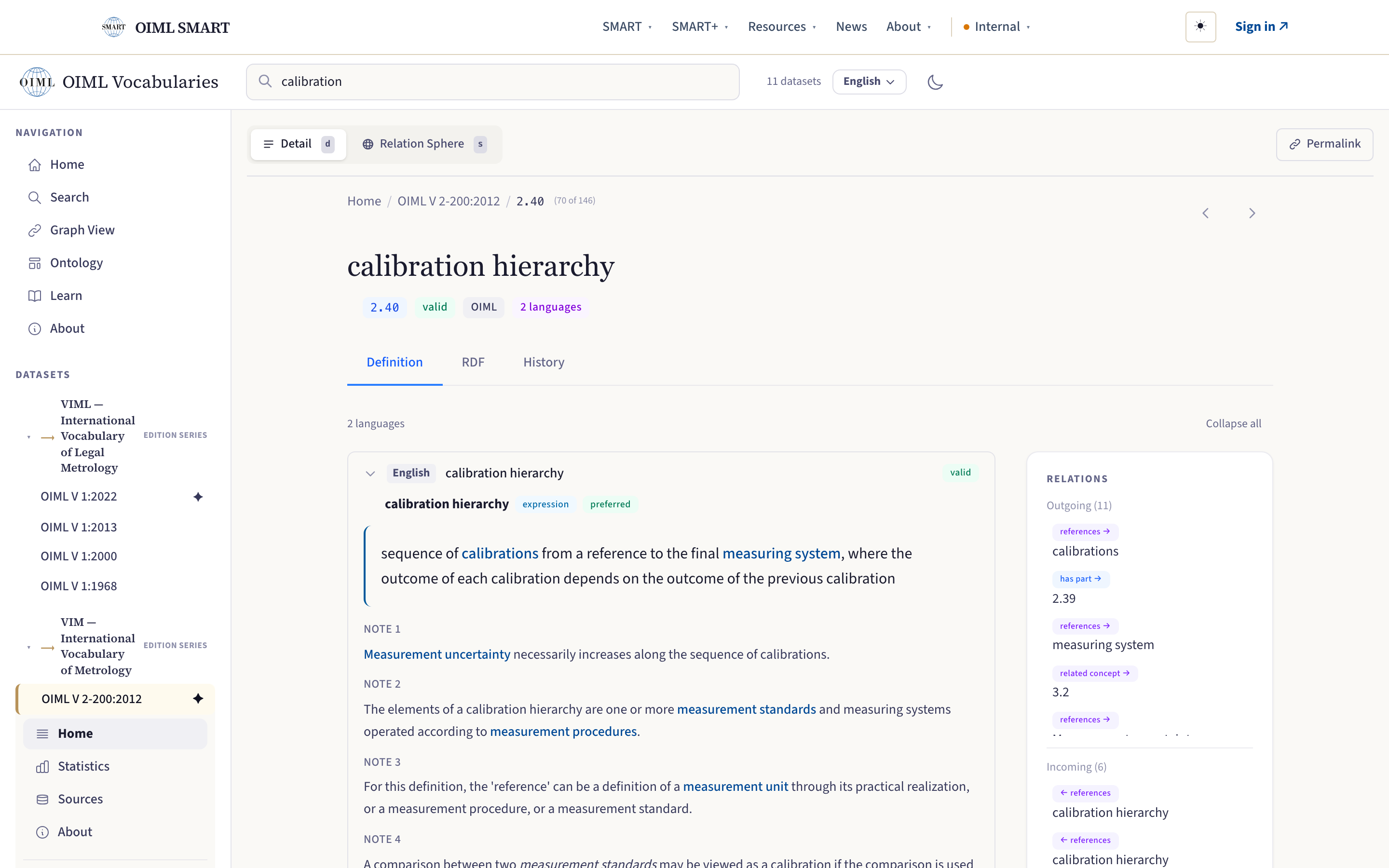
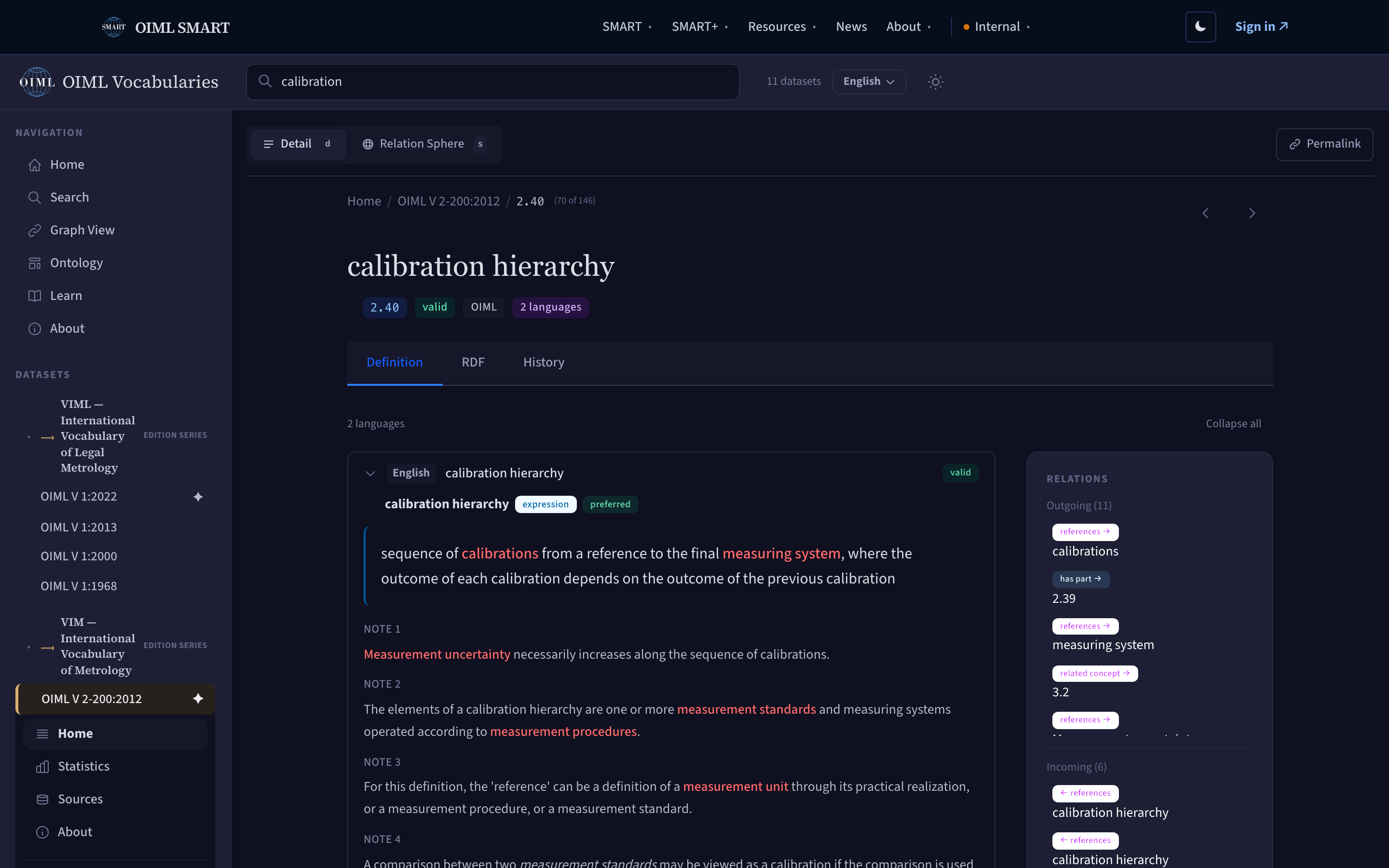
One concept, one URL, the relations drawn — captured 2026-08-29 by scripts/capture-services.ts 4. Read a term across languages. The concept page carries its languages (English and French on the capture above; the datasets span five), so a translator works from the governed term, not a paraphrase.
5. See the relations drawn. The graph view renders the term relations as a navigable graph: the structure between concepts, not just the alphabet of them.
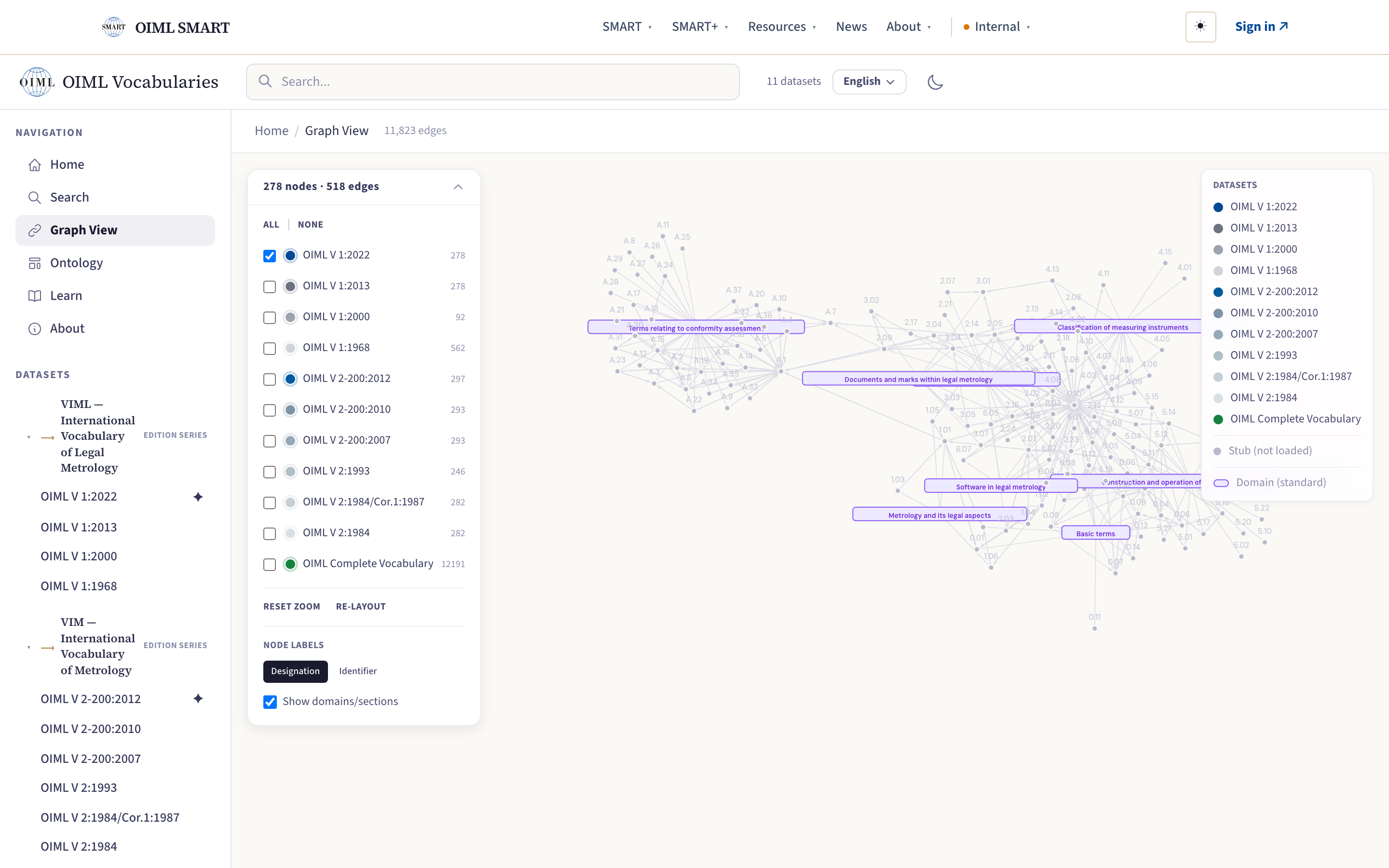
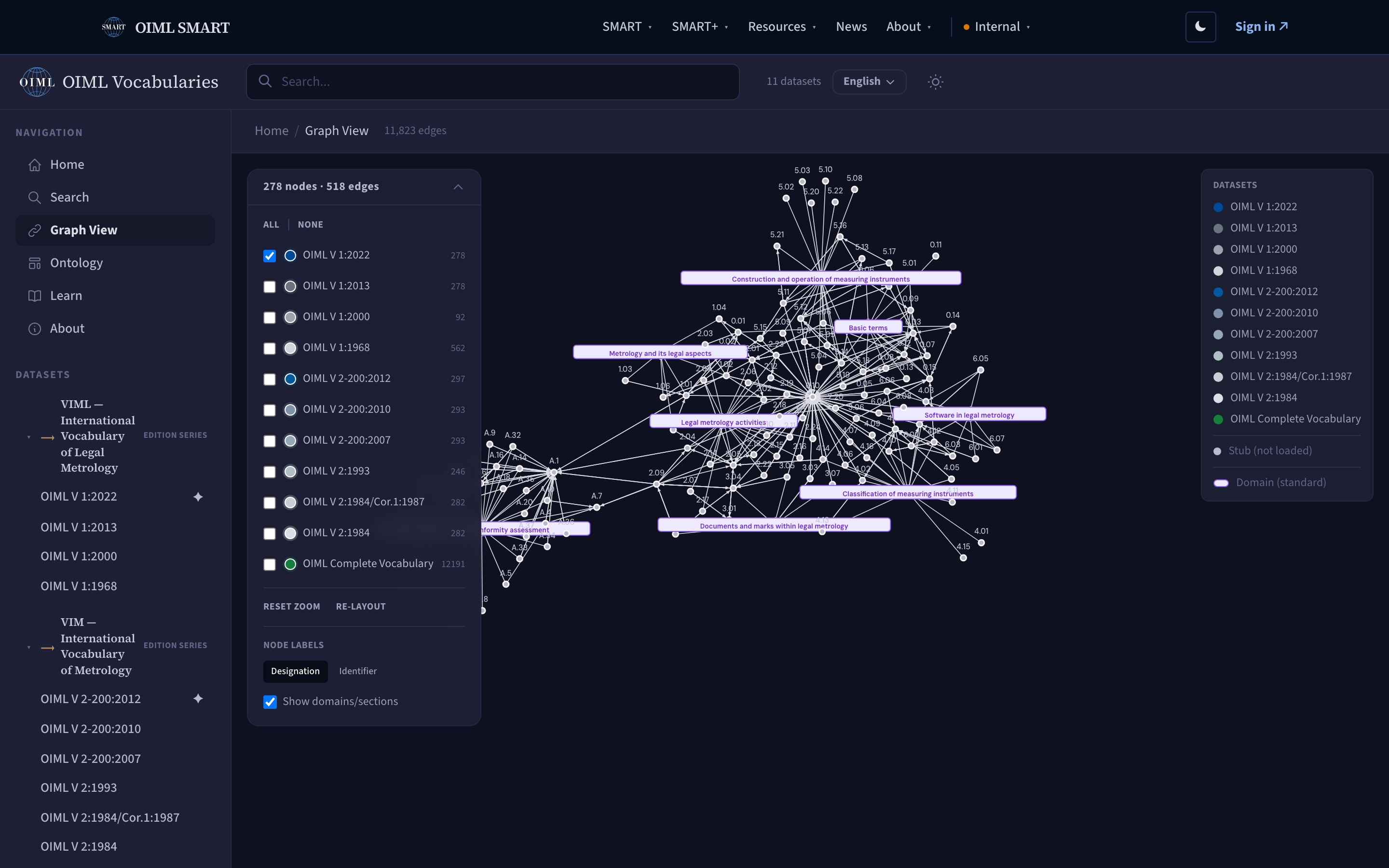
The graph view: the relations, drawn — captured 2026-08-29 by scripts/capture-services.ts 6. Anchor your own artifacts to the governed concept. The platform's models and forms reference vocabulary terms by their concept URLs, and yours can too; the dataset detail, edition by edition with concept counts, lives on this site at Vocabularies.
How it works
The vocabularies are published as datasets, not documents: each edition is a structured concept set, the curated collection collates across the series, and the G 18 registry collates where each term is actually used across the Recommendations and checks each usage against the vocabulary definition.
SMART today, SMART+ next
SMART · LIVE TODAY
The datasets, the search, the concept URLs, the graph, the G 18 usage registry: all live, all performed above.
SMART+ · THE ROADMAP TIER
The twin's served registers and the dataspace's shared vocabularies name governed concepts the same way, so the term a certificate cites is the term a twin serves: that anchoring is roadmap, carried on the dataspace and interop page. Today the vocabulary serves the publications and the models, and this page claims only that.
Status
| Status-page row | Declared availability | Declared latency |
|---|---|---|
| Vocabulary surface | 99.9% / 30d | p95 ≤ 2 s |
Probed once a minute with a content assertion per row; the live actuals (30/90-day uptime, p95) are onstatus.oimlsmart.org, a number is never rounded up to meet a target.
Who can use it, who can run it
| Member State | Corresponding Member | Issuing Authority / Test Laboratory (of a Member State) | Utilizer / Associate | Applicant / public |
|---|---|---|---|---|
| ✅ | ✅ | ✅ | ✅ | ✅ public |
The Vocabulary, quoted from the program's single entitlement source; the full matrix, all services by all member categories, lives atWho can run what.
The honest questions
Why not just cite the PDF?
A PDF citation points at a document and a page; a concept URL points at the term. When a Recommendation, a model, or a form anchors to the concept, every reader resolves the same definition, in their language, with its relations.
Which edition is current?
The series marks it (VIML 2022, VIM 2012 today), and the older editions stay browsable: a 1993 citation still resolves to the 1993 concept, so historical documents remain checkable against the vocabulary they were written in.
Do I need an account?
No. The vocabularies are public artifacts of the OIML; the service asks for nothing.
Where to go next
Search is the fastest way in; the graph view is the most surprising.
Edition by edition, with concept counts: the vocabularies as published datasets.
info@oimlsmart.org, the programme's front-door address. Terminology and translation questions land here.
Verified 2026-08-29: the service answered live and every act above was performed headlessly (the dataset browse, the cross-edition search, the concept page with its URI and languages, the graph view). The captures and their assertions are in public/img/services/manifest.json.