

Ommisa
Ommisa is the OIML SMART assistant. Ask a question about legal metrology in your own language and get an answer that cites the exact publication, edition, and clause for every claim. When the OIML corpus does not contain the answer, the service says so instead of inventing one.
The assistant itself. The public corpus answers without an account; an OIML SMART account opens the member tier.
What you can do
Six acts, each performed against the live service before this page listed it; the dated capture is the audit artifact, re-produced by scripts/capture-services.ts on every refresh.
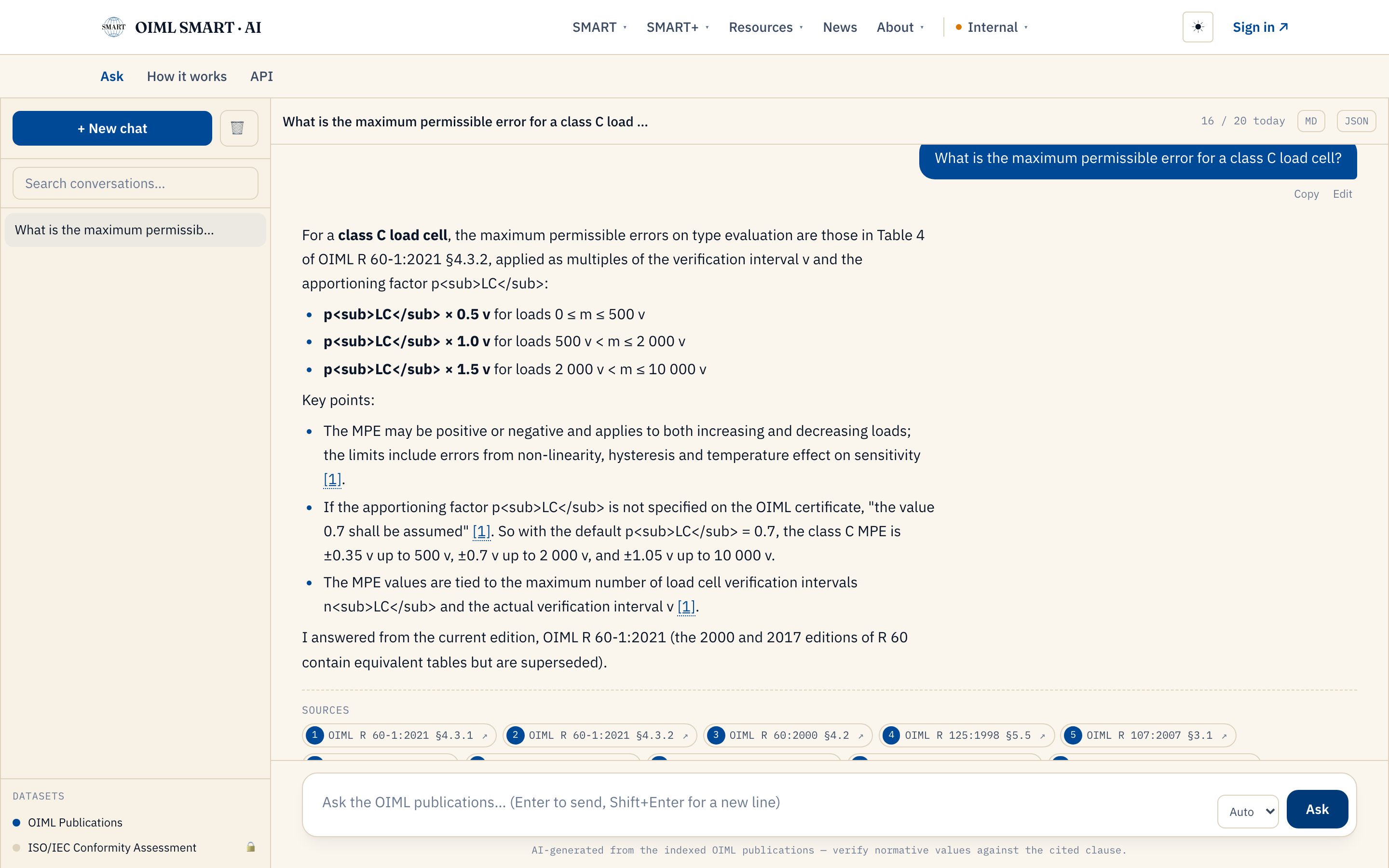
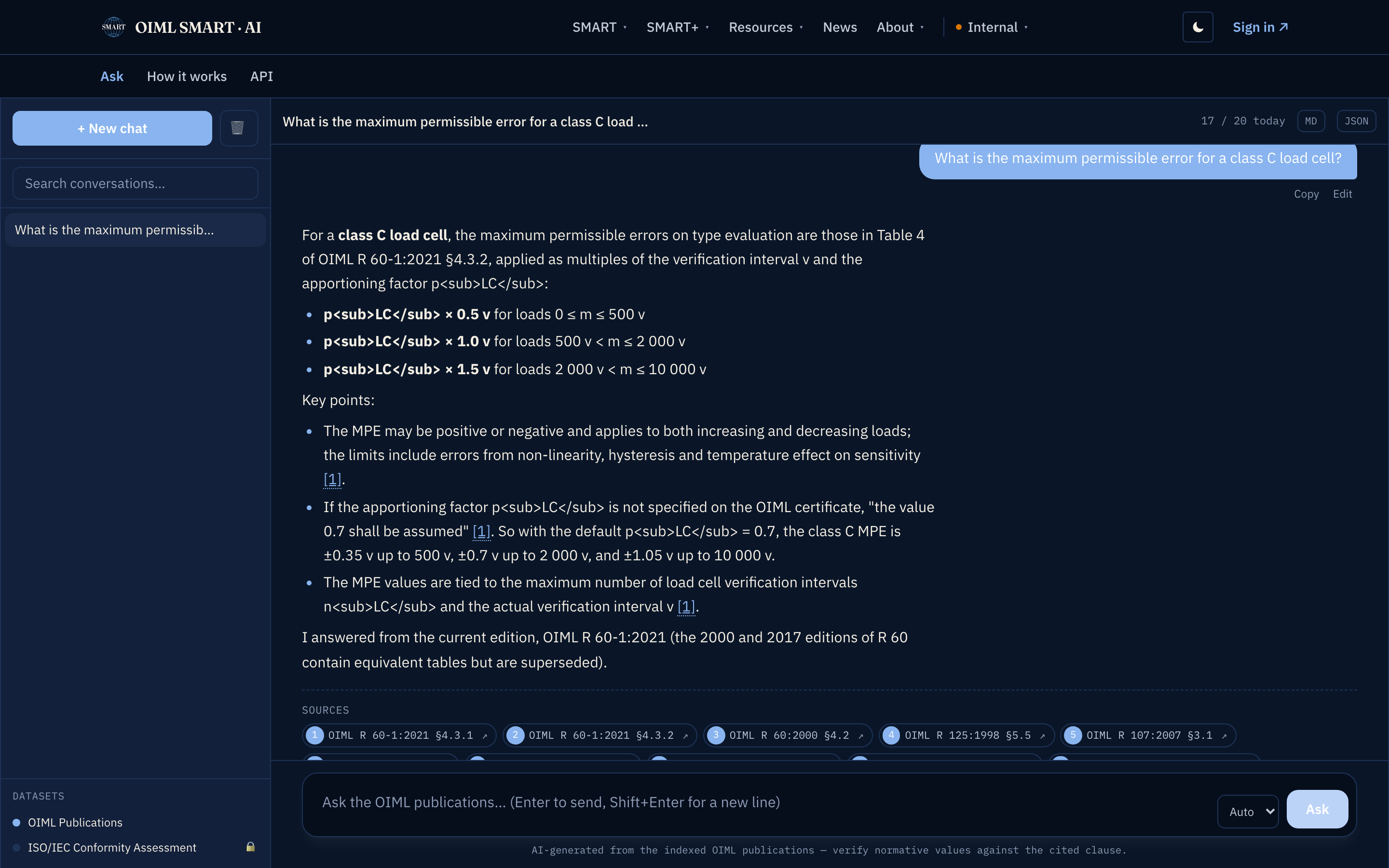
1. Ask a question and check the answer against its citations. Every claim carries an inline citation, and the SOURCES panel names the publication, edition, and clause, so the answer is the start of your check, not the end of it. The capture below is a real ask (the class C load-cell MPE), and the service itself flagged that the detailed table came from a superseded edition.
The citations and the honesty note, both live — captured 2026-08-29 by scripts/capture-services.ts 2. Watch it refuse. An off-corpus question gets a plain refusal ("I don't have information on this in the indexed OIML publications"), and refusals are never cached. The service would rather say nothing than invent something.
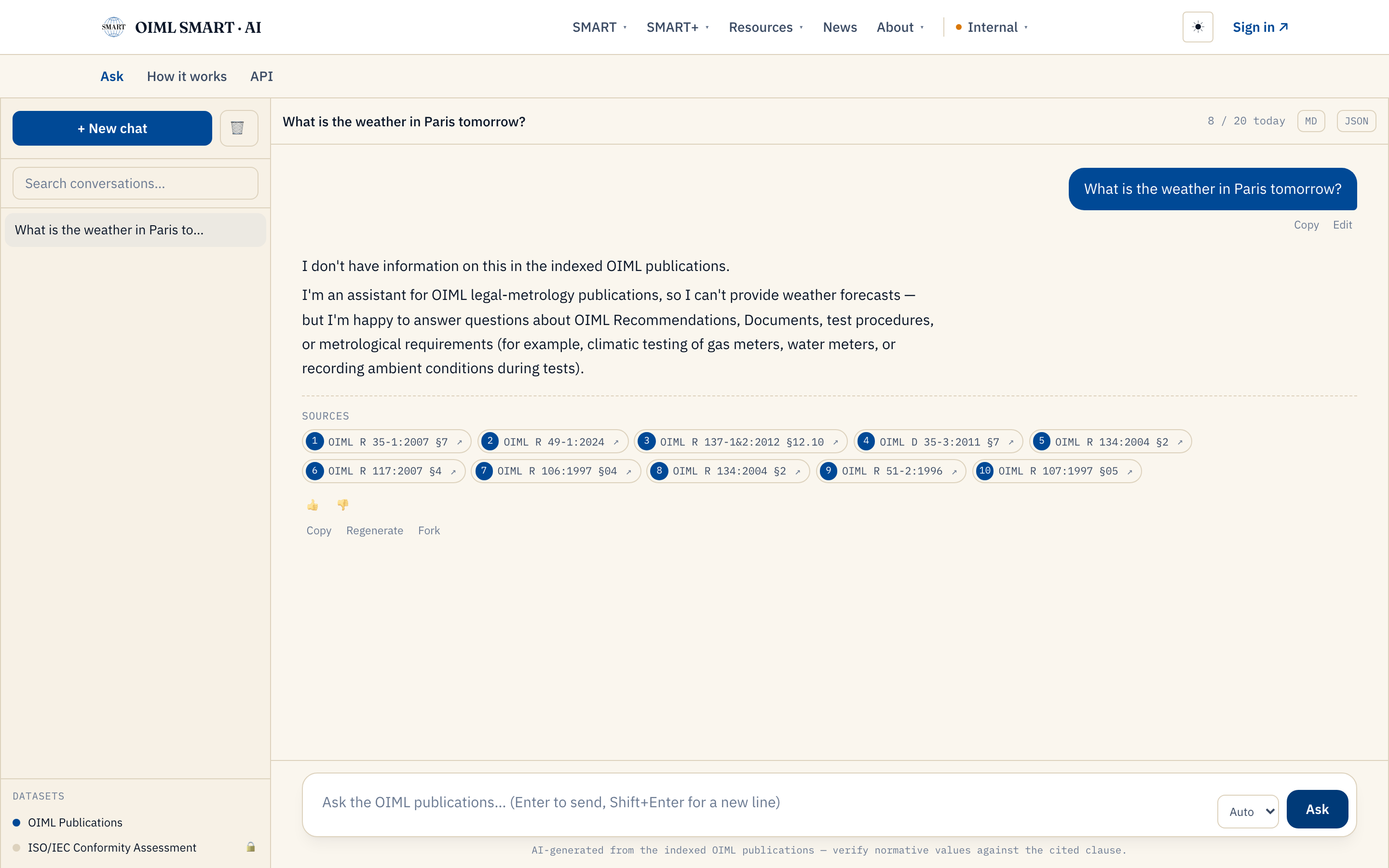
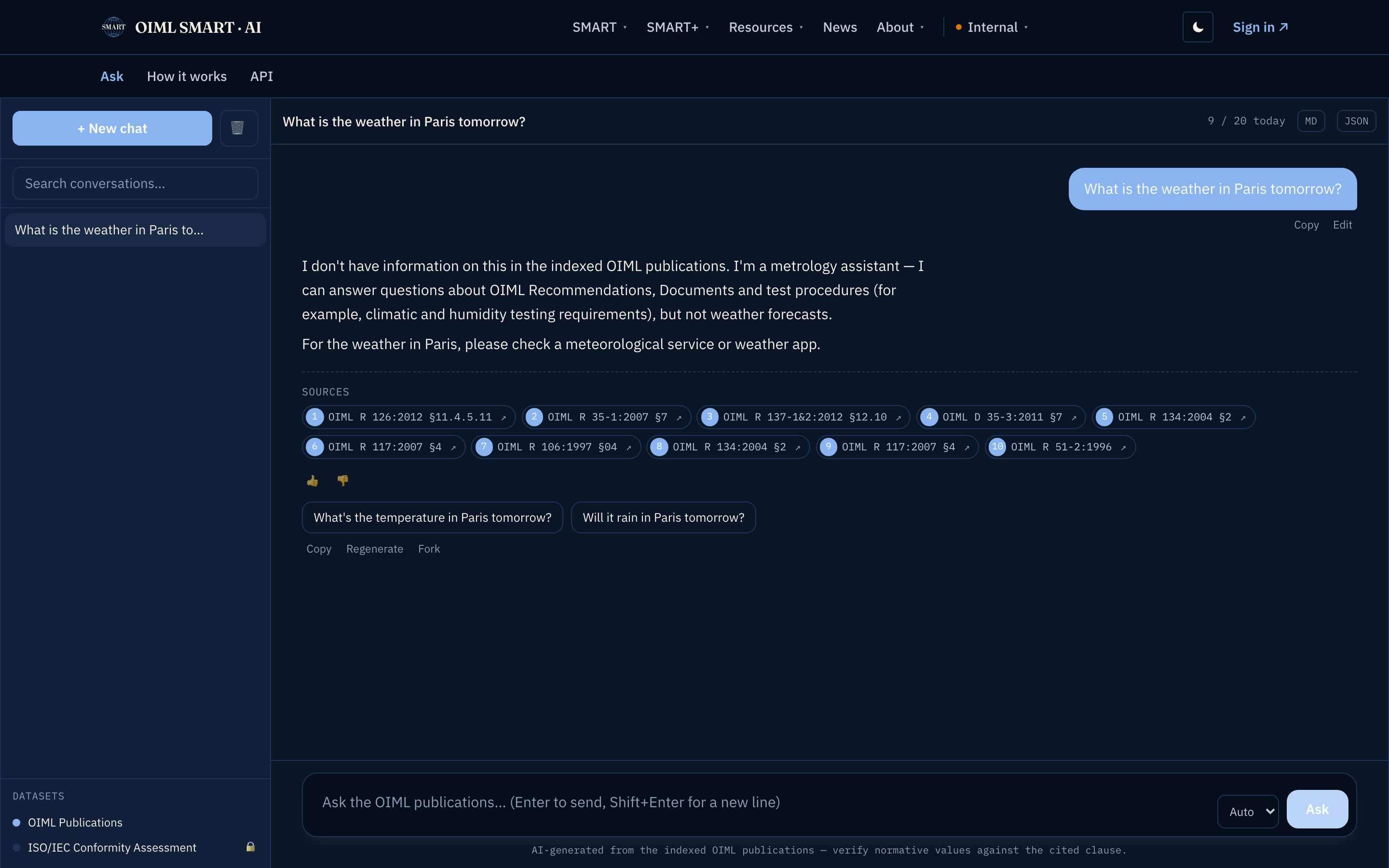
The off-corpus refusal, performed live — captured 2026-08-29 by scripts/capture-services.ts 3. Answer in your language. Answers come back in English, French, German, Spanish, Arabic, or Polish, with auto-detection; the citations stay anchored to the source clause regardless of the answer's language.
4. See what it reads. The datasets list is on the surface: the OIML publications corpus (close to 900 documents) answers on the public tier, and the conformity-assessment corpus shows locked until you sign in with the OIML SMART account, the member tier.
5. Read its own account of itself. The How it works tab is the honest machinery: what happens between your question and the answer, including what the system does not do, and the reminder that language models can still get things wrong, which is why the citation is on every claim.
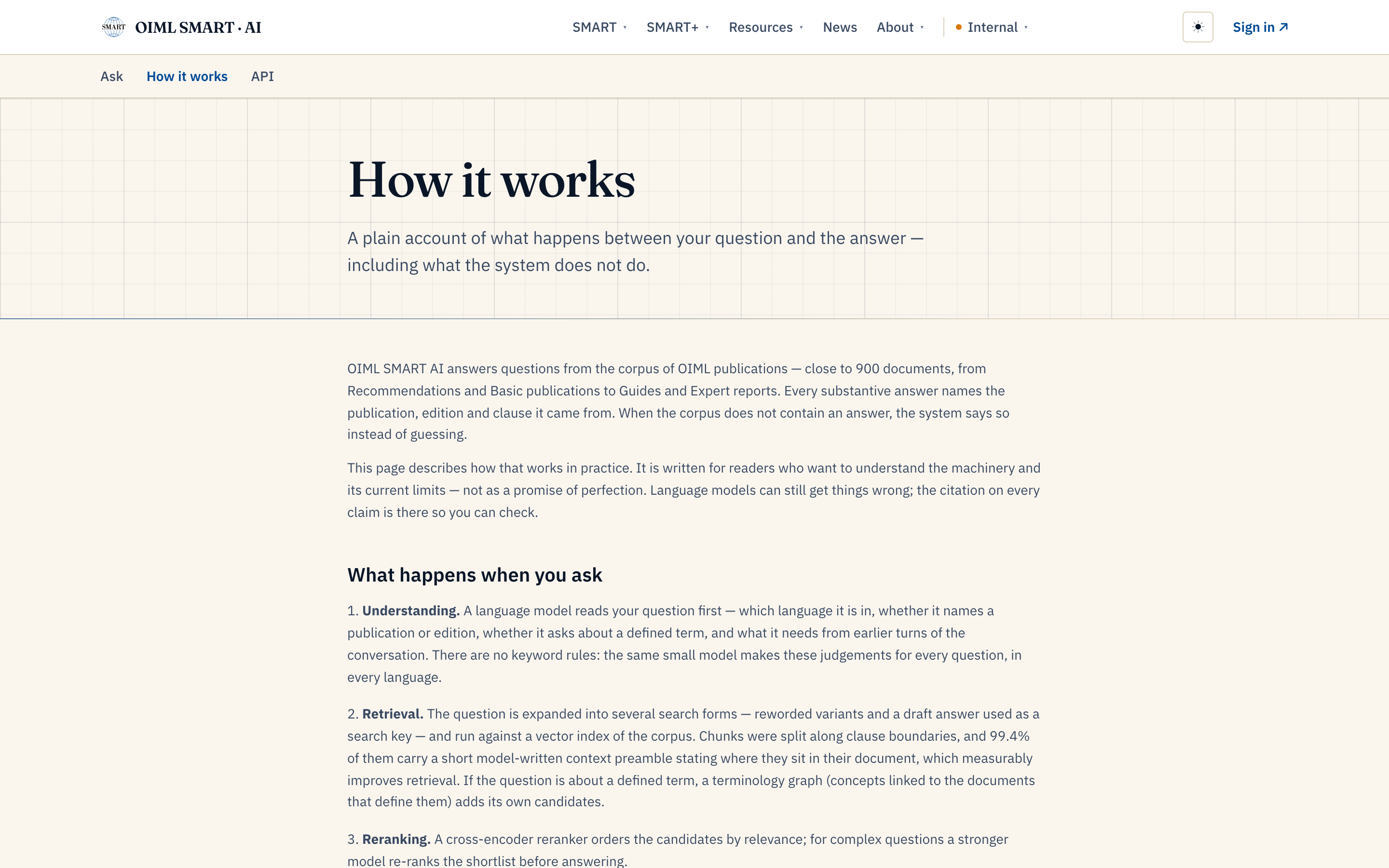
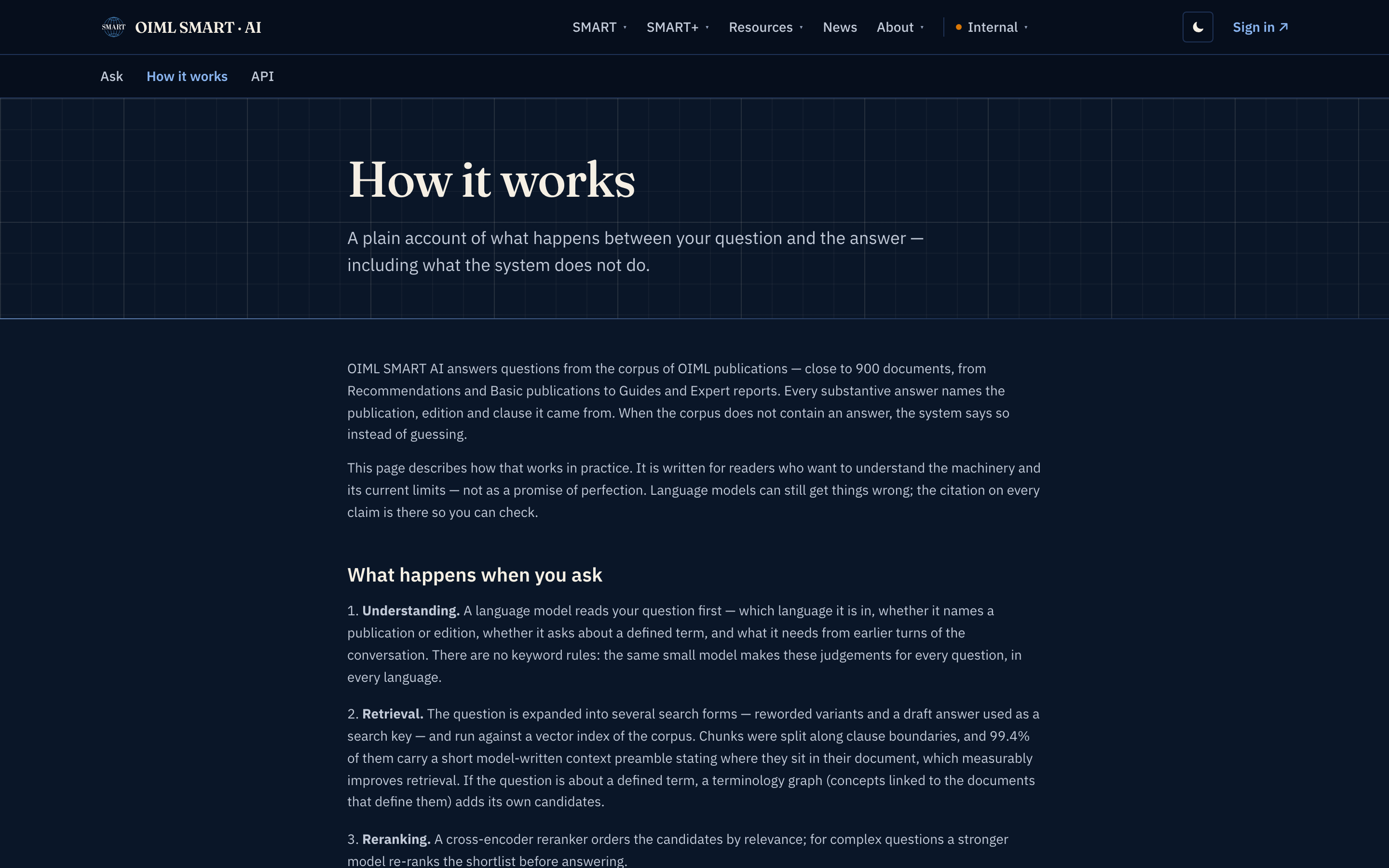
The service's own account, including its limits — captured 2026-08-29 by scripts/capture-services.ts 6. Build on the API. The API tab documents the endpoints toolmakers call: anonymous asks (20 questions a day per address), the member tier (300 a day, the stronger model, conversation sync), and API keys, with SSE streaming or complete JSON.
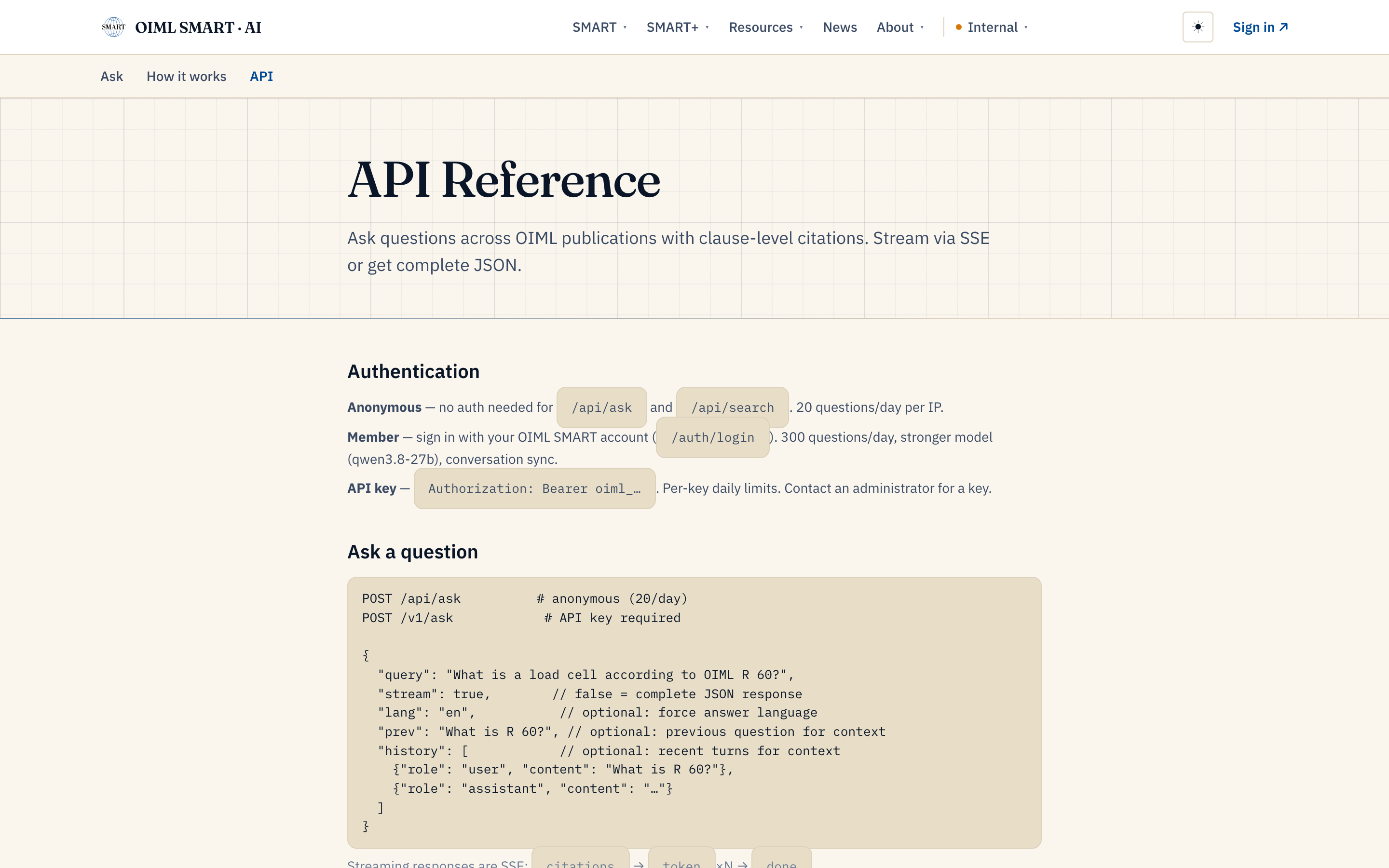
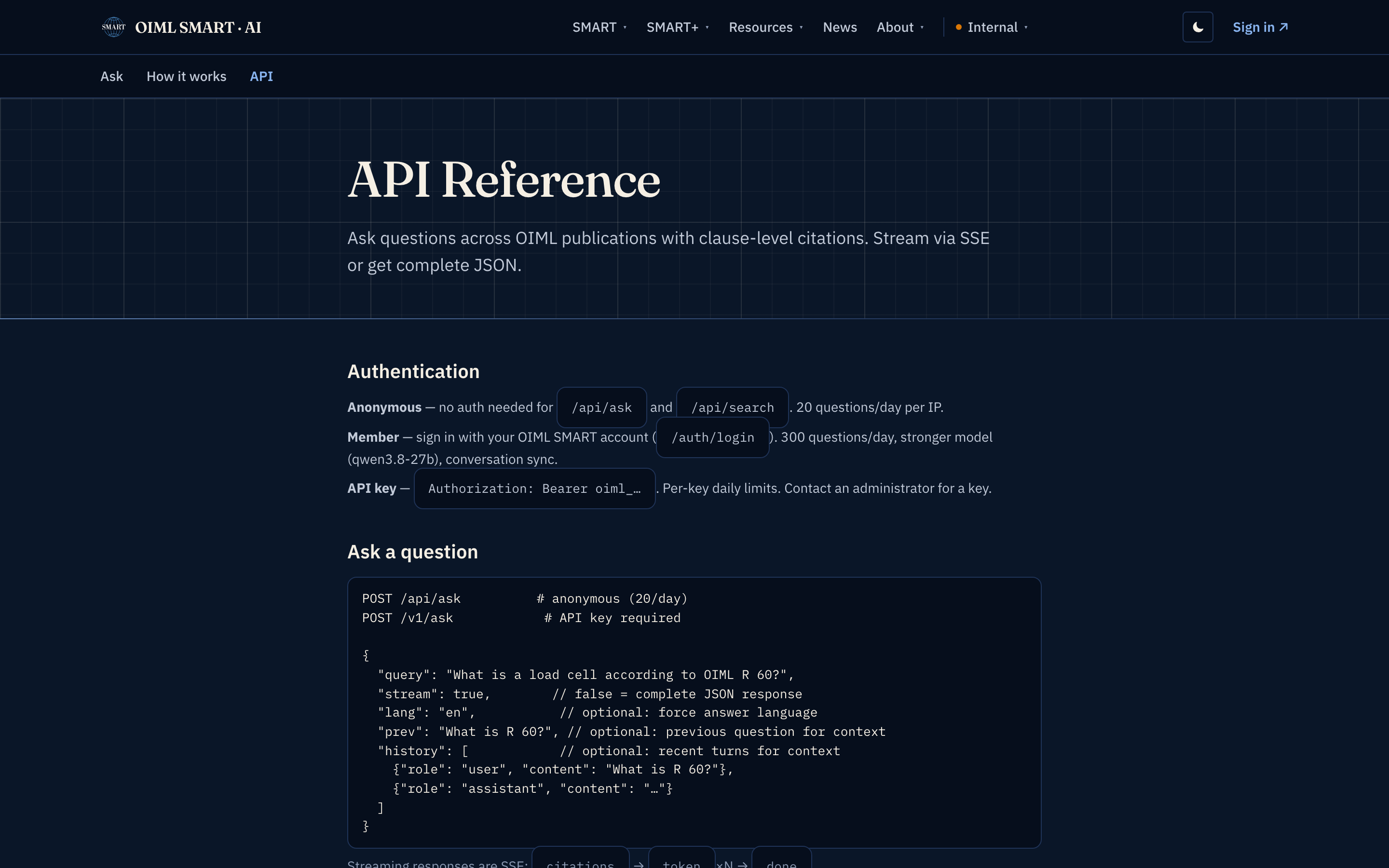
The API reference, with the honest tier limits — captured 2026-08-29 by scripts/capture-services.ts
How it works
A retrieval-augmented question-answering service over the OIML library, indexed along clause boundaries. Before the language model answers, it is given passages retrieved from that corpus, and it may only use those; normative values are quoted verbatim so they can be checked against the cited clause.
The full account of how it works and where it falls short is the programme's own write-up: OIML SMART AI: answers with citations from OIML publications.
SMART today, SMART+ next
SMART · LIVE TODAY
The publications corpus, the cited answers, the refusals, the languages, the API: all live, all performed above. The member tier rides the OIML SMART account from the identity service.
SMART+ · THE ROADMAP TIER
Ommisa is a SMART-tier service. As the SMART+ record grows (twin verdicts, signed measurements, continuous-compliance evidence, the SMART Twin story), the corpus it can cite grows with it, under the same discipline: cite the clause or say nothing. That extension is roadmap; today the corpus is the publications library, and this page says so.
Status
| Status-page row | Declared availability | Declared latency |
|---|---|---|
| Ommisa | 99.5% / 30d | p95 ≤ 3 s |
Probed once a minute with a content assertion per row; the live actuals (30/90-day uptime, p95) are onstatus.oimlsmart.org, a number is never rounded up to meet a target.
Who can use it, who can run it
| Member State | Corresponding Member | Issuing Authority / Test Laboratory (of a Member State) | Utilizer / Associate | Applicant / public |
|---|---|---|---|---|
| ✅ member tier | ✅ member tier | ✅ | ✅ per designation | — |
Ommisa, the AI service, quoted from the program's single entitlement source; the full matrix, all services by all member categories, lives atWho can run what.
The honest questions
Can I trust the normative values it gives me?
Trust the citation, then check it. Normative values are quoted verbatim so you can hold them against the cited clause, and the service prints that reminder on every answer. For a certified evaluation, the cited publication is the authority, never the answer.
What does it do when the library has no answer?
It refuses, plainly, and the refusal is never cached. The capture above is a live refusal to a weather question; the same posture applies to metrology questions outside the indexed corpus.
What does the member tier change?
The daily allowance (300 questions against the anonymous 20), the stronger model, conversation sync, and the locked conformity-assessment corpus. The account is the OIML SMART account; approval comes from your own organization, as the identity service page walks through.
Does it read documents outside the OIML library?
No. The corpus is the OIML publications library (Recommendations, Documents, Basic publications, Guides, Expert reports), indexed along clause boundaries. A question it cannot ground in that corpus is a question it declines.
Where to go next
The assistant's own site: what it answers, where it runs, the discipline it keeps, and what it does not do.
The public corpus answers without an account. The example questions on the Ask tab are a good first click.
The workflow the assistant answers questions about, running live. The cast signs in through the identity service, each seat assumed as a persona.
info@oimlsmart.org, the programme's front-door address. Corpus coverage questions and API keys land here.
Verified 2026-08-29: the cited answer and the off-corpus refusal were both performed live against the service by scripts/capture-services.ts; the How it works and API tabs answered 200 with the stated tier limits. The captures and their assertions are in public/img/services/manifest.json.