

Apply once. Follow it live. Hold a certificate that answers for itself. As an applicant you file against the Recommendation’s model, watch every stage of the evaluation as it happens, and receive a certificate your customers and authorities verify on their own, any time, with no account and no phone call to anyone.
Assume the Applicant persona through the identity service (the instance resets nightly) and open the applications list below.
What you can do
Every act below was performed against the live demo by the scripted capture apparatus before it was listed; each figure names its capture date and links the live surface. An act that cannot be performed does not list.
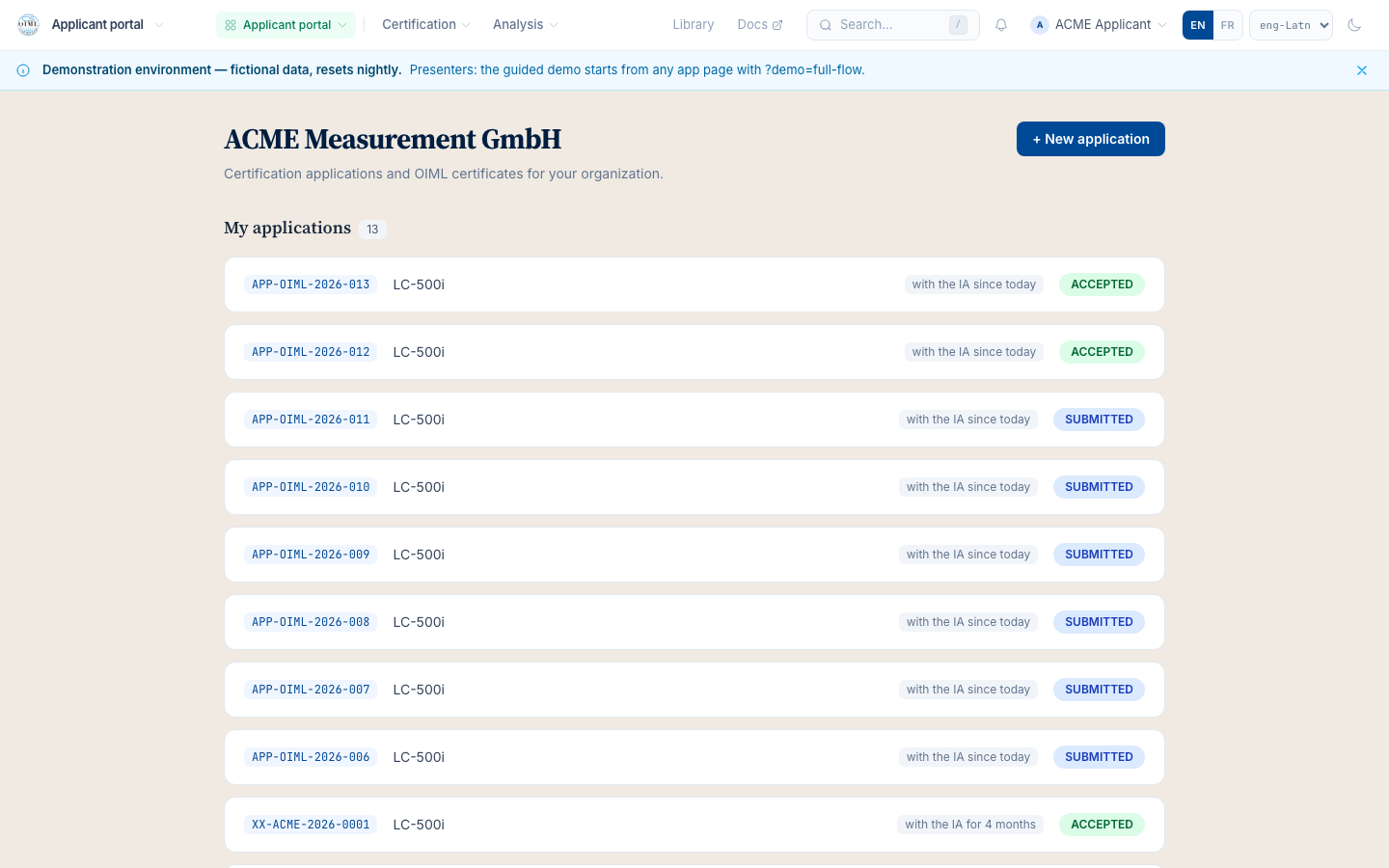
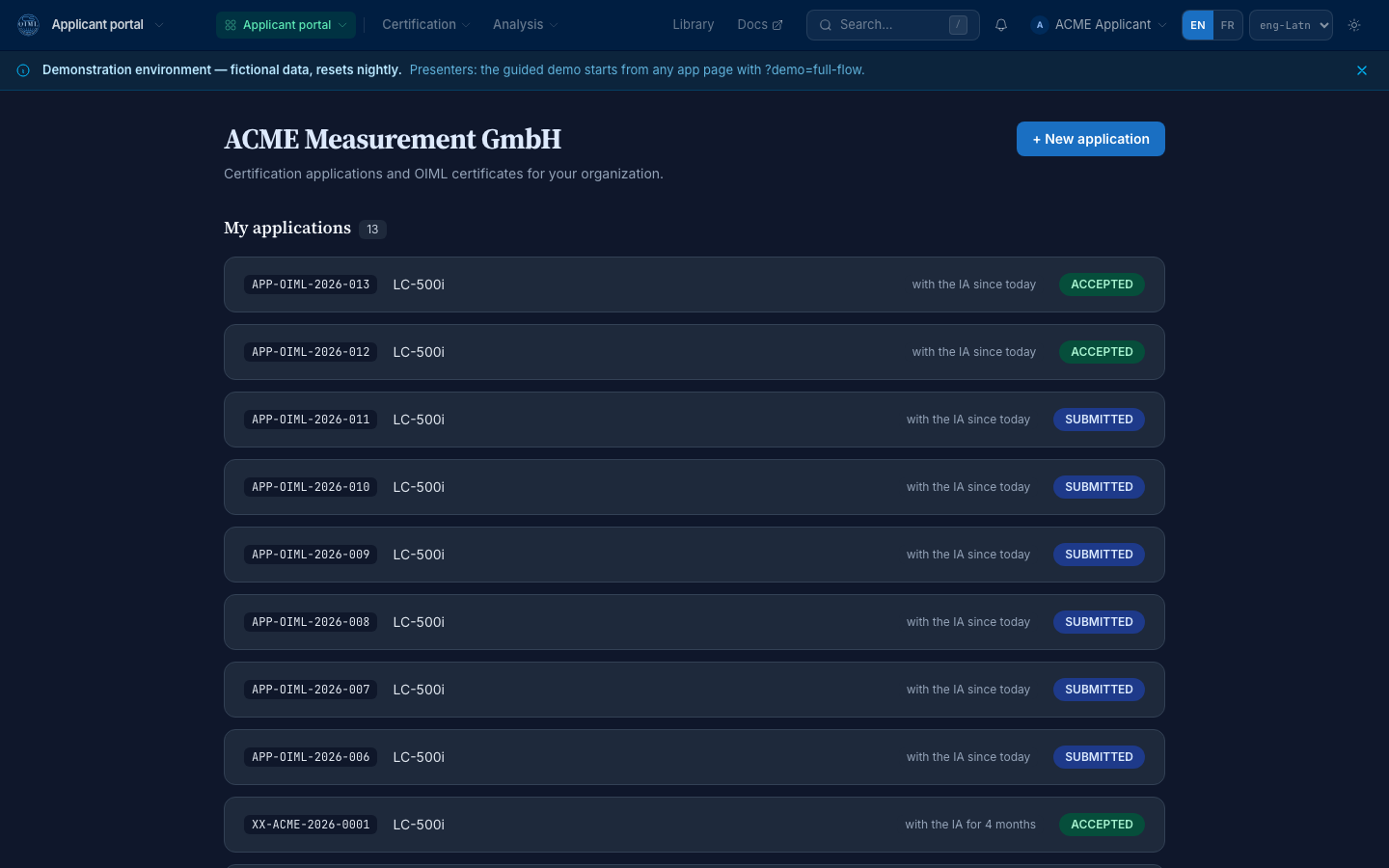
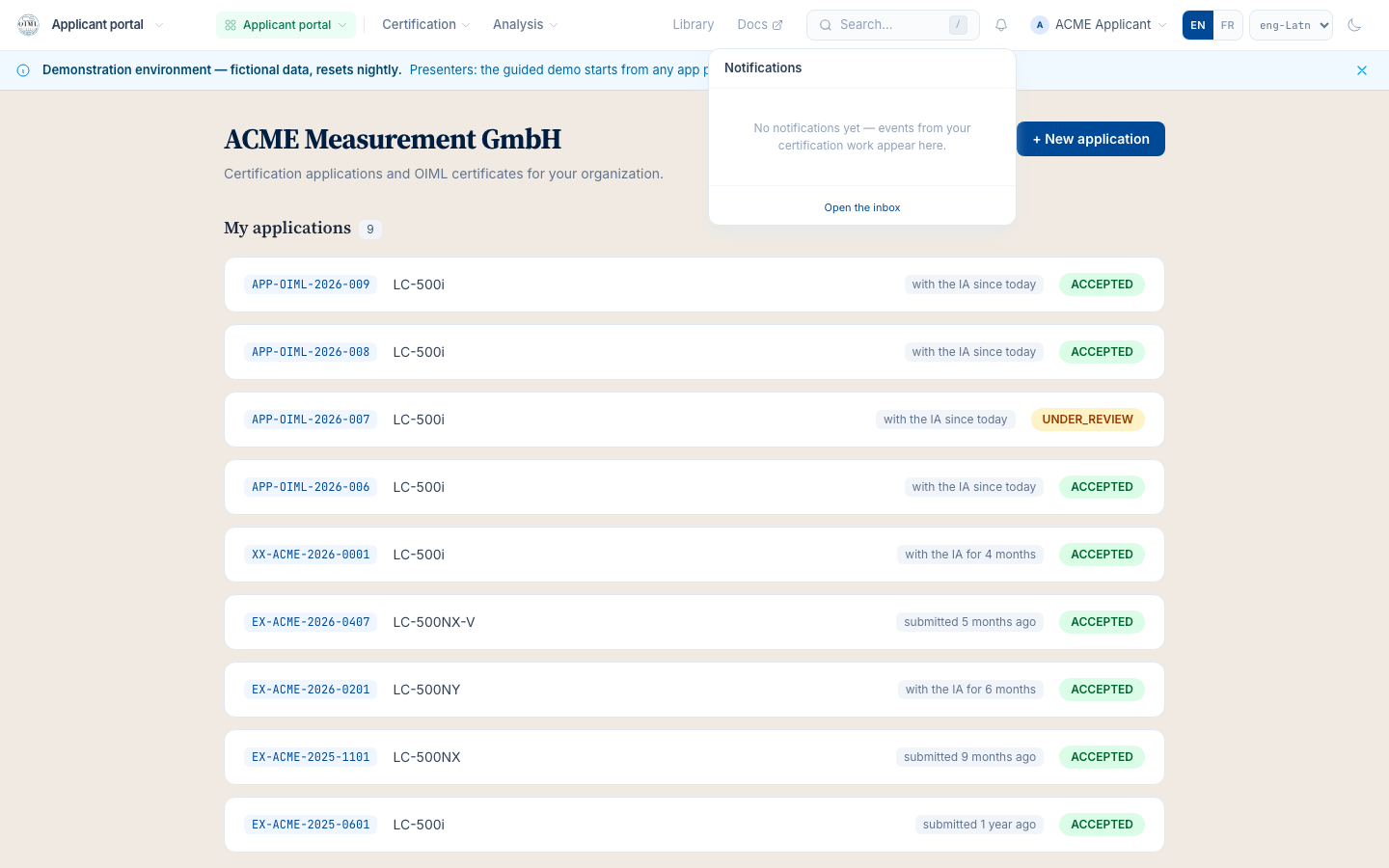
See every application your organization has filed, with its status and its age, oldest visible first. No more searching inboxes for where a file stands.
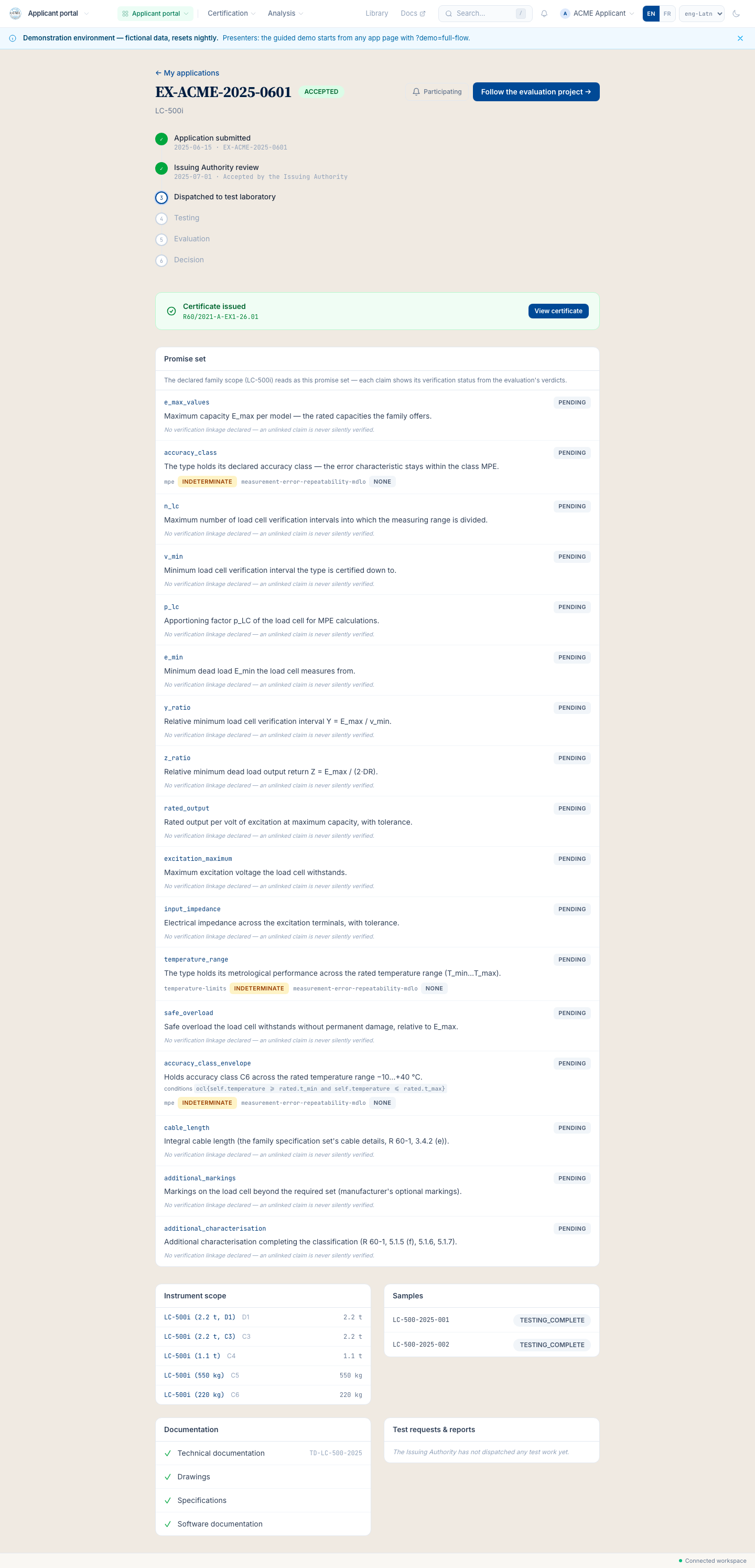
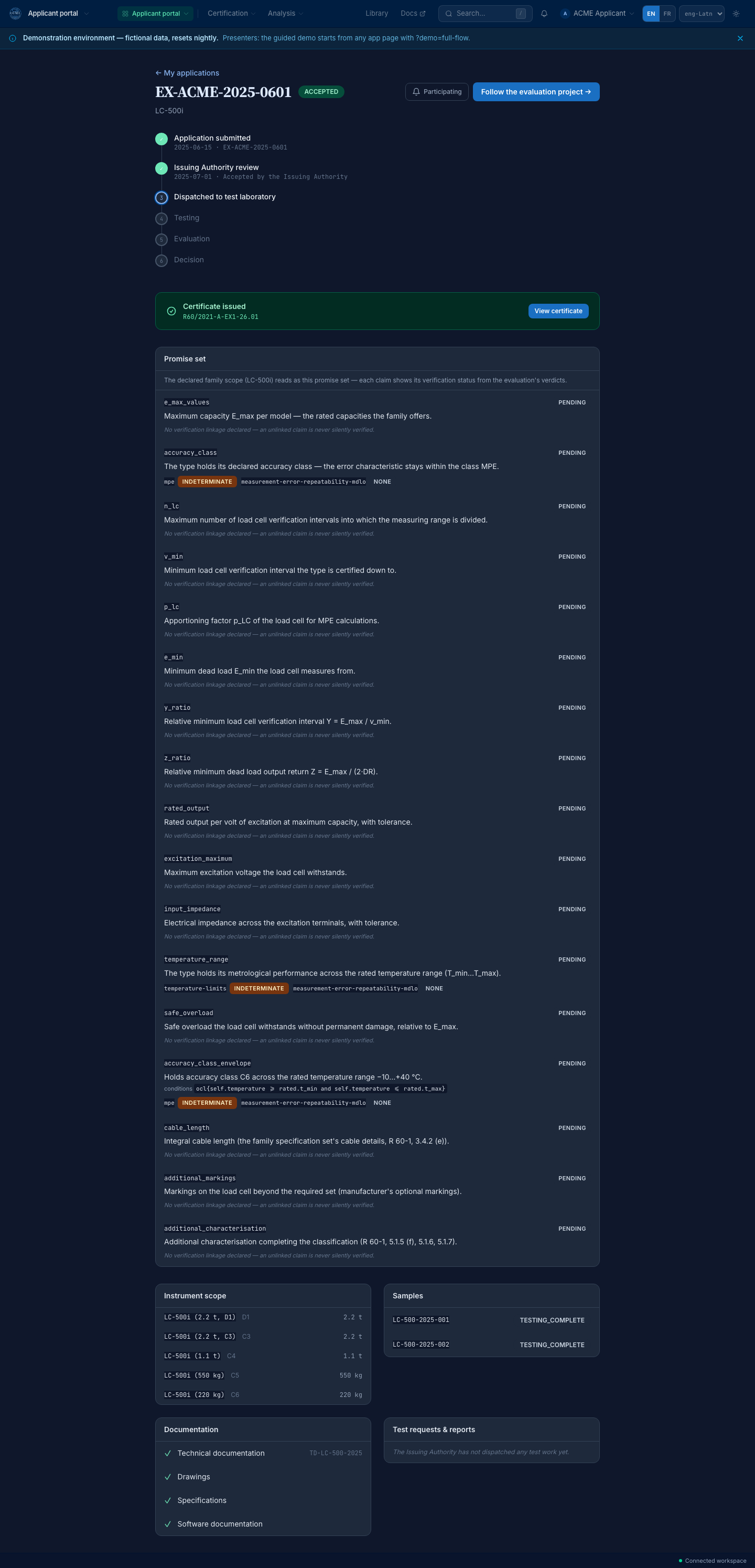
Open one application and get the whole file. The six-stage journey, the participating parties, the samples, and the promise set: your declared scope reads as claims, each carrying its verification status from the evaluation’s verdicts. An unlinked claim is never silently “verified”.
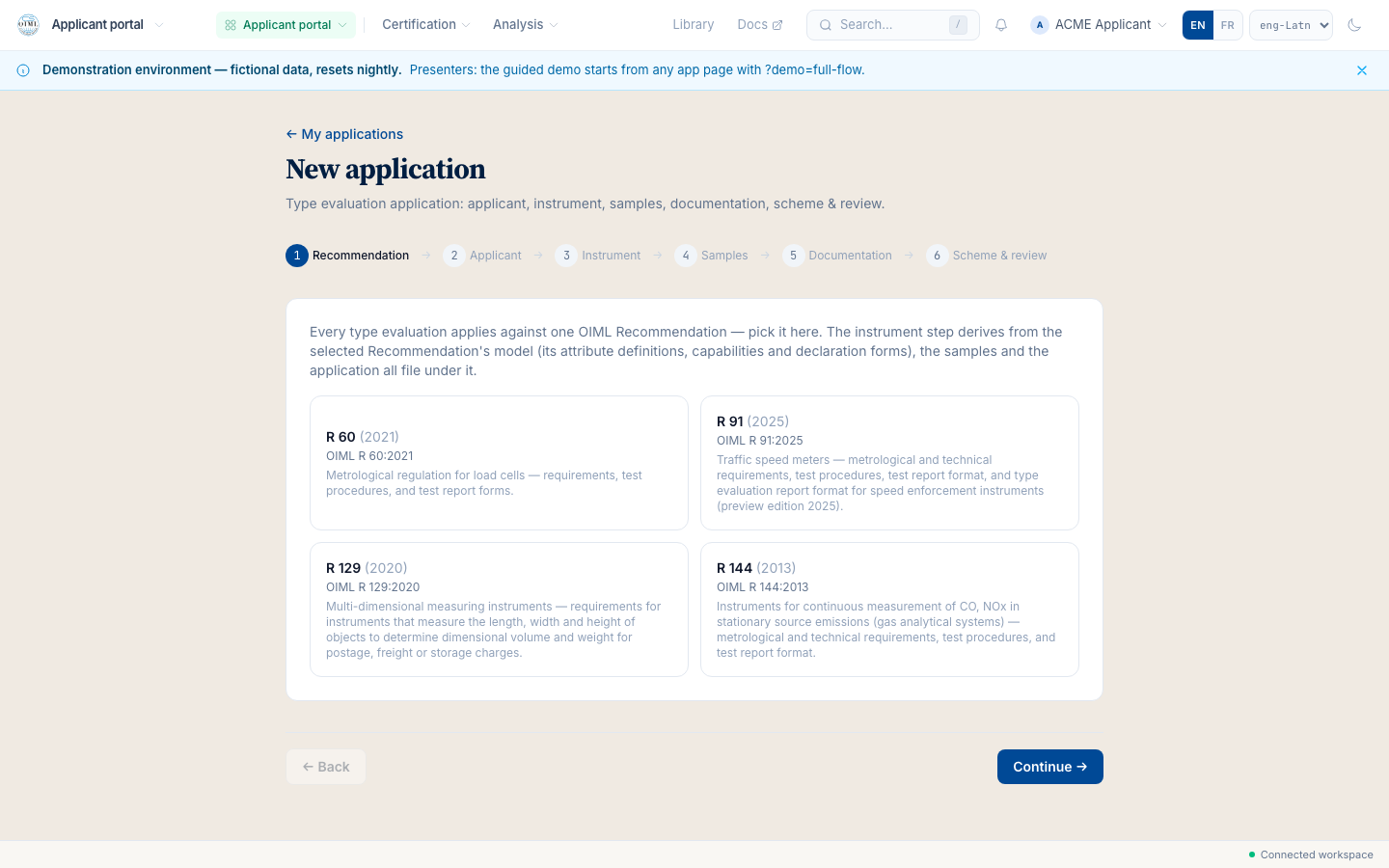
Apply in a six-step wizard whose first act is the Recommendation. Pick R 60, R 91, R 129, or R 144 and everything downstream derives from that Recommendation’s model.
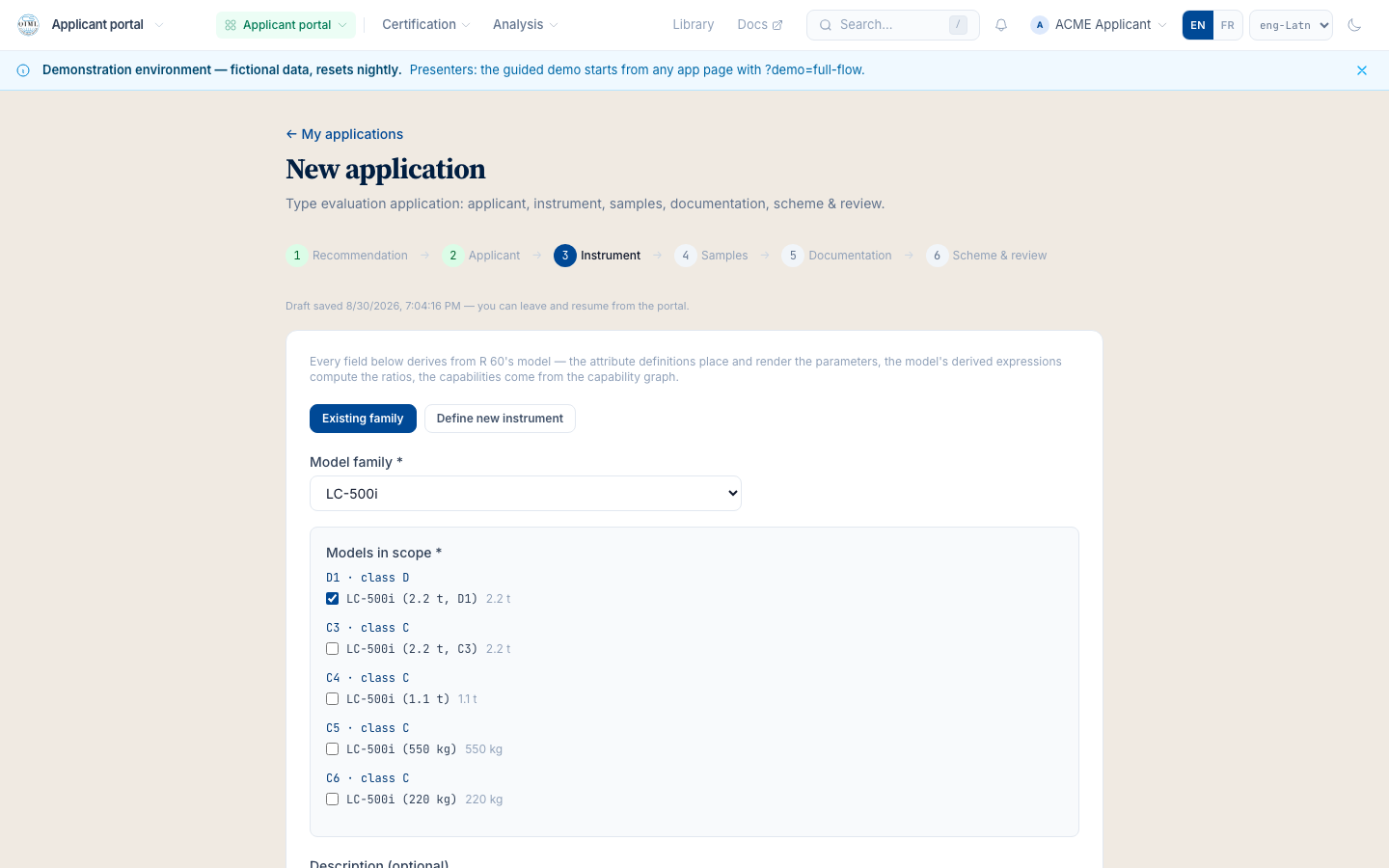
Fill the instrument step the model derives. Choose the model family, tick the models in scope; the attribute definitions and declaration forms come from the Recommendation, not from a free-text form.
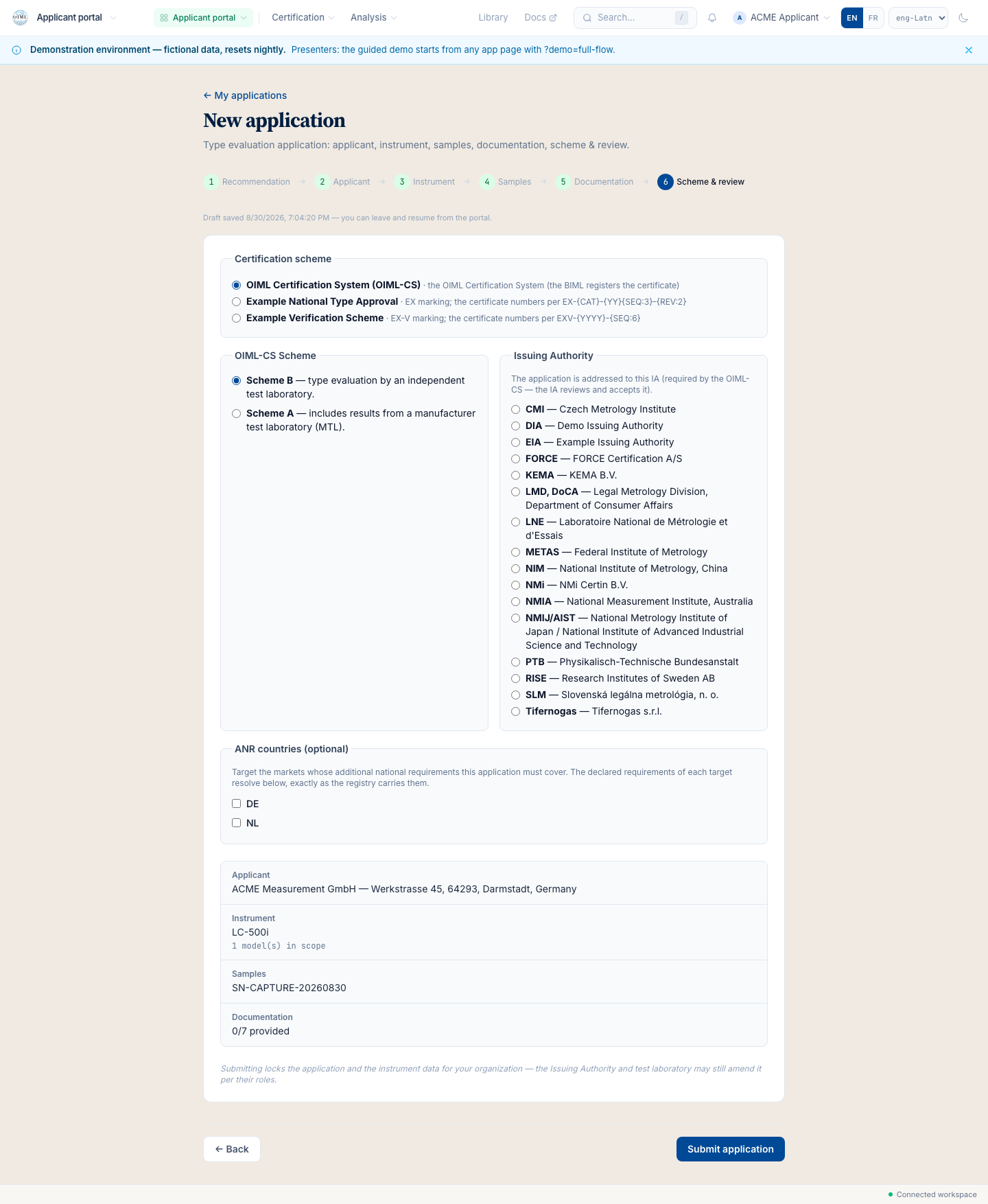
Address the application to a real Issuing Authority. The scheme step offers the OIML-CS (with its Scheme A / Scheme B choice) and the registered authorities’ cards: the same registry the OIML-CS publishes, not a typed-in name.
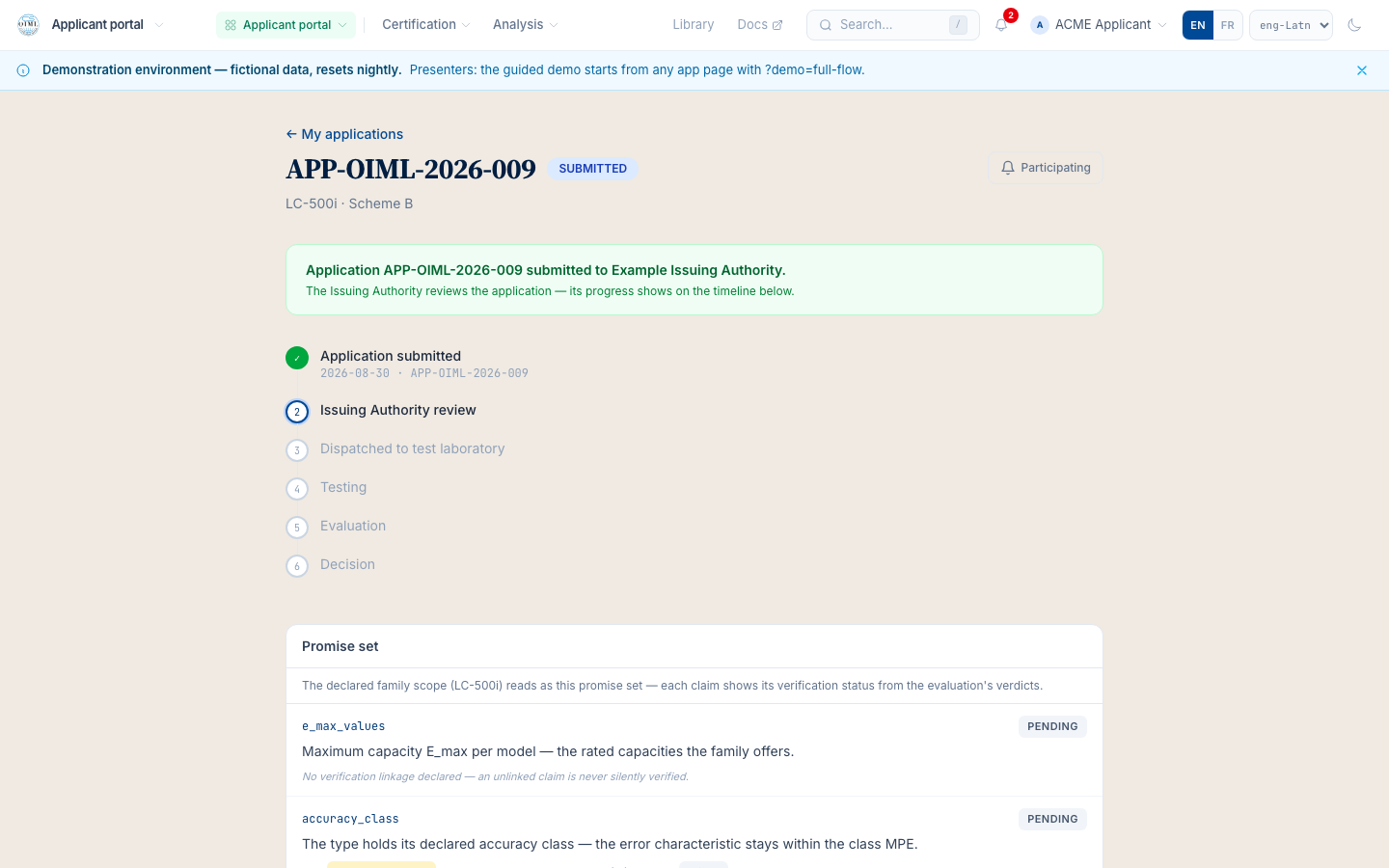
Submit and watch the journey open. The application lands as SUBMITTED with the Issuing Authority; every later stage (samples, dispatch, testing, evaluation, decision) updates the same page, and the notifications inbox carries each event.
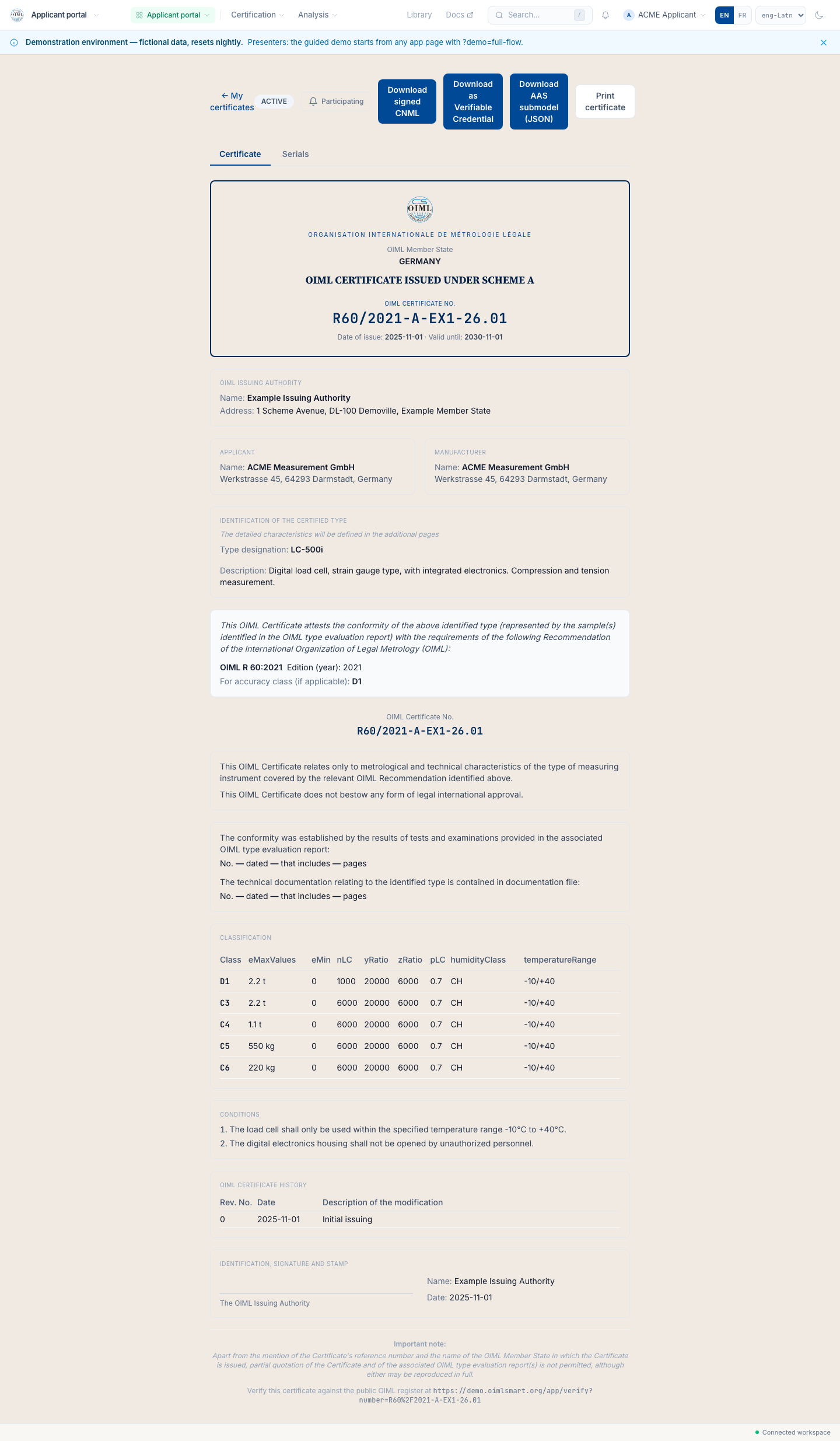
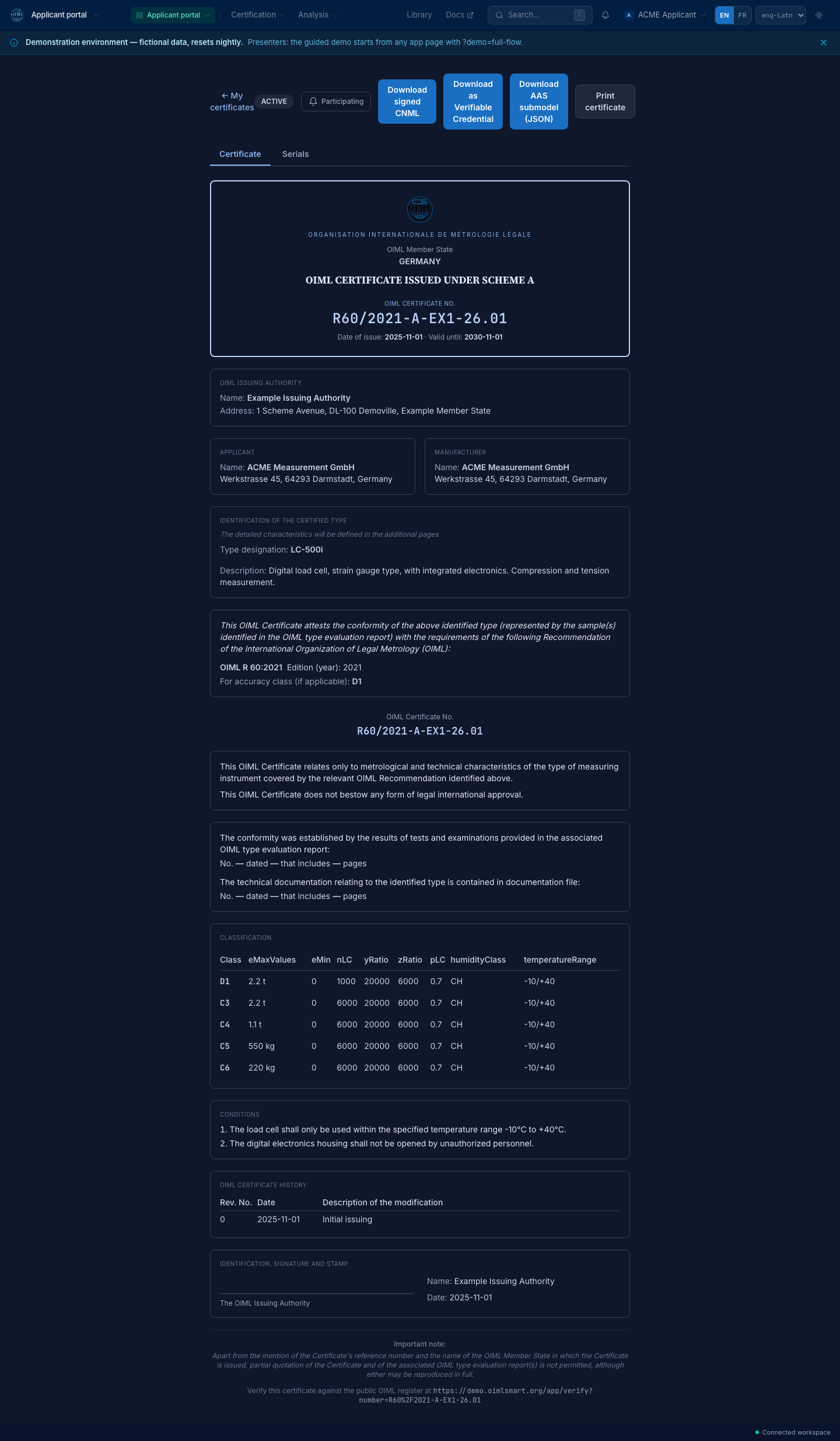
Download the certificate three ways. Signed CNML (the machine-readable original), a W3C Verifiable Credential, or an AAS submodel for your digital-product-passport toolchain. The downloads below were performed in the audit, and the downloaded VC file verifies on the public verify page.
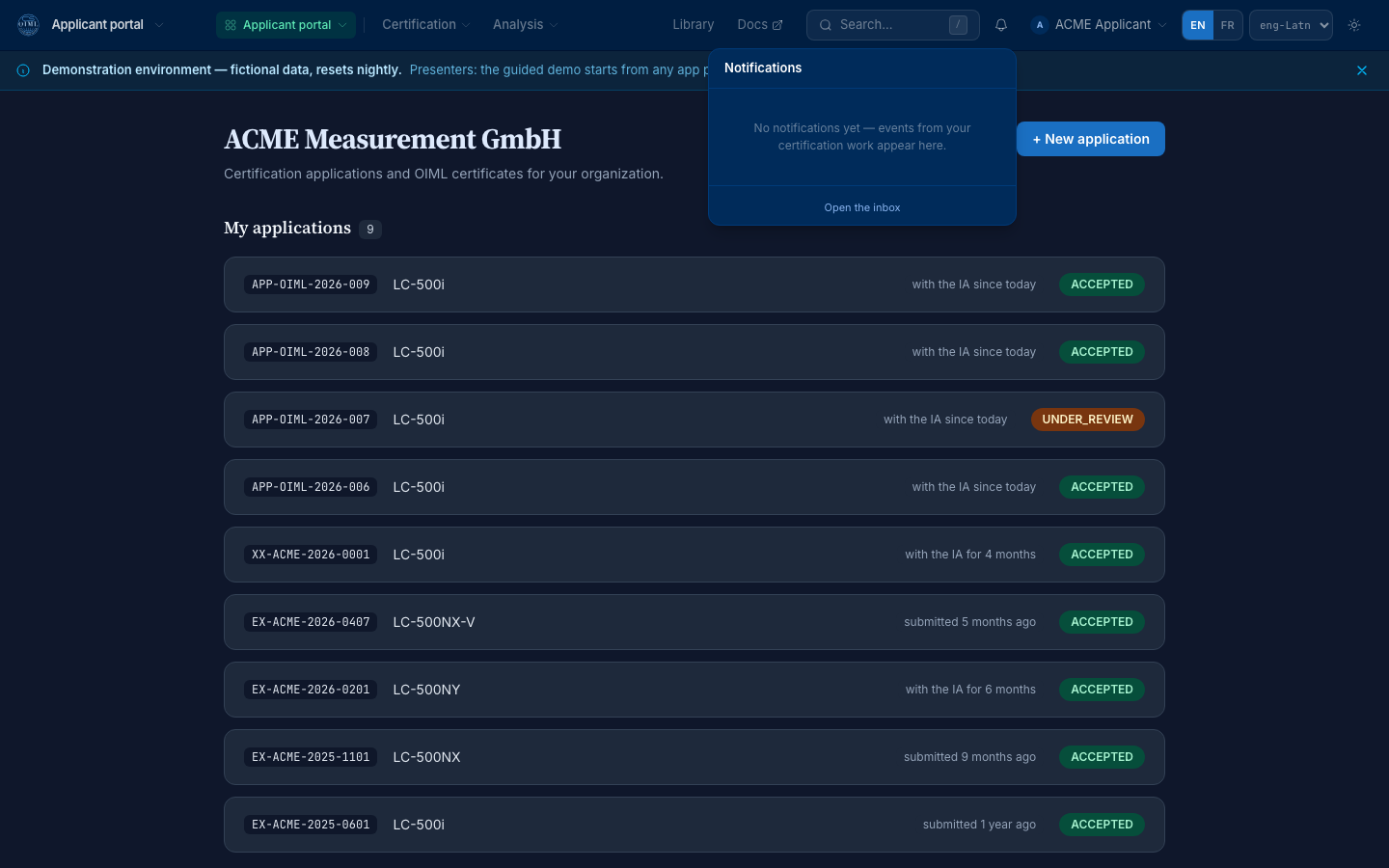
Get notified at every stage. The header bell carries the unread count the moment anything moves on your files (the submission figure above was captured seconds after filing and the badge already reads 2); the dropdown opens the inbox. In the audit capture the dropdown’s own list reads its honest empty state — the count lives on the bell; the dropdown panel is the entry point.
How it works
What this changes, and what it does not
Today a type evaluation is an episodic, expensive event: documentation by email, samples by courier, then silence until the report arrives, a photograph of one week in your product’s life. On the platform the application is data from the first step, and the file’s progress is yours to watch. What does not change: the Recommendation’s text, the IA’s decision, the legal meaning of the certificate. The model joins the text; it does not replace it.
Today (SMART) and the vision (SMART+)
Today · SMART
- The applicant portal: applications, the live journey, certificates, notifications. the portal ↗
- The certificate as signed CNML, W3C Verifiable Credential, and AAS submodel. the CNML page ↗
- Public verification of your certificates by anyone, without an account. verify ↗
- The library and the Recommendations as models your engineers can read. the library ↗
The vision · SMART+
- Ship a SMART twin with the instrument: the governed aspects served live. roadmap ↗
- The twin-certification program: your twin’s fidelity declared, probed, and signed. roadmap ↗
- Continuous compliance between assessments: the compliance engine re-judges as evidence arrives. roadmap ↗
- Rehearse your own certification on the SMI Simulation before hardware exists (it is local today; hosted is roadmap). roadmap ↗
What you can use, and what you can run
The applicant portal, the demo, the published SMART Recommendations, the Studio, the Vocabulary: the applicant’s surface on the services, quoted below from the program’s single entitlement source.
| Service | Applicant / public |
|---|---|
| OIML SMART account (the identity service) | ✅ join flow |
| Identity service software | source available — license pending |
| OIML-CS SMART Platform (cloud) | ✅ applicant portal |
| SMART Platform software (self-host) | - |
| The demo instance | ✅ public sandbox |
| The Studio viewer | ✅ public |
| The Vocabulary | ✅ public |
| The status service | ✅ public |
| Ommisa, the AI service | - |
| SMART Recommendations content | ✅ published |
| The trust registry (organization keys) | - |
| The SMI Simulation | - |
| The SMART Twin (SMART+) | roadmap |
- Use — hosted, on the official services
- Self-host — on-prem/cloud, under the category’s own entitlement
- Streaming updates — the rolling channel the deployment runbook names
- The upsell note — see the narratives below the matrix
Quoted from the program's single entitlement source; the full matrix, all member categories by all services, lives atWho can run what.
The honest questions
Does this change how we certify today?
No. The legal instruments are untouched: the Recommendation’s text stays, the IA decides, the certificate means what it meant. What changes is the mechanics around it: the application is structured data, the evaluation’s progress is visible, and the certificate you receive is machine-verifiable. PDFs never die; the model joins them.
Who sees our product data?
Only the parties to your evaluation, per the visibility cones the platform enforces: your application is addressed to one Issuing Authority; the test laboratory sees the dispatch it accepted; the BIML sees what is registered. Your fuller product documentation stays yours; the platform never publishes your file.
Is the Verifiable Credential real, or a demo prop?
Real. It verifies against the issuer’s DID document on the public verify page, which is exactly the check your customers will run. In the audit for this page we downloaded the VC from the certificate page and verified the file itself, with no account.
What does this cost us?
Using the hosted services costs you no infrastructure: the applicant portal is a hosted console, and the demo instance is a public sandbox. The self-host entitlements belong to Member States, not to applicants; you never run anything.
We certify families and variants. Does every variant reopen the file?
No. Variants and family members share the model’s common spine: the wizard’s instrument step picks the family and the models in scope, and the evaluation treats the delta, not the whole file again.
Where to go next
The Applicant persona, assumed through the identity service. The instance is fictional and resets nightly.
The reference-model guide: identity, holdings, behavior, mapped to the Recommendation's clauses.
info@oimlsmart.org: tell us your instrument category and the markets you certify for; the reference-model conversation starts there.