

Authoring · 07 of 17
Packaging
In this chapter: the deliverable itself. A Recommendation is shipped as a package with a fixed directory contract:
standard.yamlas the manifest, five content layers, root document files, a Layer-1 domain profile, JSON Schemas, a seeded sample flow, aprimmel-packagestwin for the.prlround-trip, and.prdfragment extracts whose reconstruction gate proves the model still says what the source says. Then the composition question: how a rec package consumes core and shared modules byuses, reference, never redefine.
7.1 The package is the deliverable
Everything the previous five chapters authored, subject, requirements, tests, forms, evaluation, must land somewhere a machine can find, validate, and build. That somewhere is the package: one directory per Recommendation, self-describing, registered, and complete. Two rules from Chapter 1 govern its shape:
- Primmel (PRL) is the single source of truth (chapter 11, the flip
landed). The
.prlpackages are authoritative; thedata/<rec>/YAML trees are generated artifacts (npm run gen:data, never hand-edited), and TypeScript inbrowser/src/data/generated/is derived from them at build time; services carry no domain content. A new Recommendation is a data addition, never a code change. - A new Recommendation is data, not schema. The metamodel is schema
only; the R 60 profile states the rule, “A new Recommendation = a new
profile file; zero schema changes” (
oiml-r60-loadcell-profile.yaml).
The contract below is the one R 60 ships today; R 91 and R 144 follow
the same layout, which is precisely what made the cross-standard
layering census (analysis/cross-standard-layering.md) measurable.
7.2 The data/<rec>/ directory contract ●
data/<rec>/
  standard.yaml         identity + structure registry + source
  terminology.yaml      terms; vocab_ref → viml-2022 / vim-2012
  references.yaml  notes.yaml  obligation.yaml  value-types.yaml
  navigation.yaml  parts.yaml  redirects.yaml  sample-data.yaml
  model/        instrument.yaml attributes.yaml capabilities.yaml
                behaviors.yaml conditions.yaml
  entities/     instrument.yaml parties.yaml workflow.yaml test-execution.yaml
  specification/ requirements/ conformance/ tables.yaml symbols.yaml
                calculations.yaml formulas.yaml verdicts.yaml
  execution/    forms/ subforms/ test-report.yaml test-report-checklist.yaml
  evaluation/   workflow.yaml state-machines.yaml processes.yaml gateways.yaml
                approvals.yaml roles.yaml certificate-template.yaml
                evaluation-dimensions.yaml evaluation-profiles.yaml
                lab-selection-criteria.yaml sample-selection-rules.yaml
                calculation-context.yaml
Each directory answers to one tier of the frame: model/ is the primary
tier (what the subject IS/HAS/DOES), entities/ its storable subject
chain and workflow records, specification/ the secondary tier
(constraints and operations), execution/ the evidence views,
evaluation/ the tertiary judgment and workflow config. The root files
are the document machinery (Layer 0 anchoring: terminology, obligation,
value types) plus app-facing concerns (navigation, redirects) and the
Layer-3 seed (sample-data.yaml, §7.6).
7.2.1 standard.yaml, the manifest ●
data/r60/standard.yaml is the package’s self-description, in three
blocks:
- Identity,
id,shortName,fullName,baseUrn,version,editions,description,publisher,docnumber,doctype. ThebaseUrn(urn:oiml:pub:r:60:2021) is the namespace every provenance reference in the package resolves against. structure:, the registry. Every file in the package is registered withpath+label+description, grouped by layer (model / entities / specification / execution / evaluation / root-level). The rule is absolute: a file not instandard.yamldoes not exist as far as the build is concerned. The generators discover content through the registry, never by walking the tree.source:, where the authoritative text lives: the Metanorma collection (sources/r060/collection.yml), the part documents, and the package’s Primmel twin (primmel: primmel-packages/oiml-r60).
The manifest is what turns “a directory of YAML files” into “a package”: identity, inventory, provenance.
7.3 The Layer-1 domain profile ●
The package’s data instantiates a schema it does not own. Above
data/<rec>/ sits the metamodel
(ontology-remix/OIML Core Models/Ontology/oiml-core-ontology.yaml,
schema only: classes, enumerations, INV-1..10), and beside it one
domain profile per Recommendation
(ontology-remix/OIML Recommendation Models/Ontology/R 60/oiml-r60-loadcell-profile.yaml)
, the Recommendation’s ontology-level data: subject taxonomy,
attribute-definition semantics, formulas, constraints, the error model.
The profile is data, not schema: adding R 91 or R 144 changed zero lines
of the metamodel (the OCP claim the gap audit verified in practice).
In the tier language of Volume I: the metamodel + profile are the Foundations-to-Primary bridge the rec package anchors to; the rec package never redefines metamodel classes, it instantiates them.
7.4 JSON Schemas for new file kinds ●
Every file kind in the package validates against a JSON Schema in
data/schemas/ (~40 schemas: standard-meta.yaml, model.yaml,
entities.yaml, rc.yaml, cc.yaml, form.yaml, verdicts.yaml,
tables.yaml, symbols.yaml, evaluation-*.yaml, …). The discipline
for a new file kind, say, the reference-materials.yaml R 144 added ,
is three steps, in order:
- author the schema in
data/schemas/; - register the file in
standard.yaml’sstructure:(and thestandard-metaschema, which enumerates the known structure keys); - only then author content.
Schema-first is what keeps “a new file kind” from becoming “a new
silent hole in validation”. The gates (npm run validate) run schema
validation before semantic validation; a file with no schema fails
loudly, never passes vacuously.
7.5 uses composition: core + modules + overlay ◐
One directory per Recommendation works, until the second and third
Recommendations exist and the census can measure what they share. The
measured facts (analysis/cross-standard-layering.md §0–1): 12 of
R 91’s 34 files are byte-identical to R 60’s; 8 of R 144’s are
structurally identical; and the identical class splits in two ,
genuinely shared skeletons (workflow entities, state machines,
approvals, roles, obligation) and copy residue that is wrong for the
rec (R 91 shipping R 60’s certificate template, gateways, notes and
checklist, the deep-audit’s R2 finding). The copy mechanism and the
bug mechanism are the same mechanism. Composition replaces both.
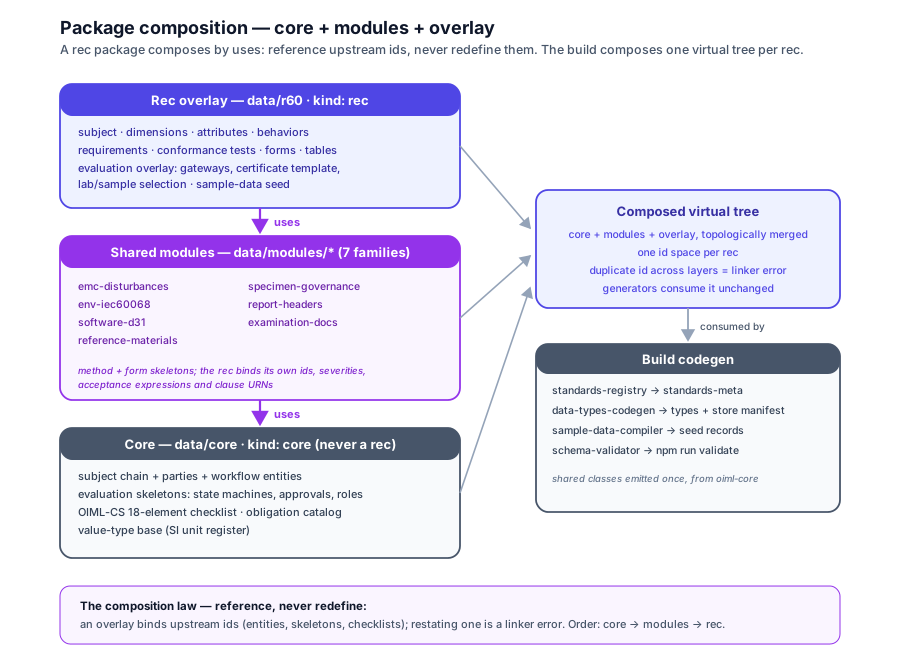
The design (layering census §5, ◐, scaffolding landed, wiring planned for v3):
- Core (
data/core/,id: core,kind: core), the Tier-1 verbatim content: subject-chain and workflow entities, parties, evaluation skeletons (state machines, approvals, roles, workflow, processes), the OIML-CS 18-element report checklist, obligation catalog, value-type base. Never a publishable rec; the registry excludeskind: corefrom rec listings. - Modules (
data/modules/<name>/,id: module-<name>,kind: module), seven parameterized test/form families measured out of the census:module-emc-disturbances,module-env-iec60068,module-software-d31,module-reference-materials,module-specimen-governance,module-report-headers,module-examination-docs. Each carries a manifest (provides:test patterns + form skeletons;requires:what the consumer must supply). The module freezes the skeleton; the rec binds its own attribute ids, severities, acceptance expressions and clause URNs. Parameterization is not new machinery: conformance-testvariablesand formbind:paths already do it, the module makes it a package boundary. - Rec overlay (
data/<rec>/), normative content only: subject, dimensions, attributes, requirements, tests, forms, tables, terminology, plus the rec overlay of evaluation config.
The scaffolding is shipped (● smart e80b349): data/core/layer.yaml
declares id: core (package oiml-smart-core) with the OIML-CS process
requirements as its first content, and each of the seven modules declares
its layer.yaml (package ids oiml-smart-module-<name>, kind module).
The composition wiring is live: the registry composes the virtual
effective tree per rec, layers first, the rec’s overlay merged REC-WINS
, and the existing generators consume the composed tree unchanged, so
“generated app data identical” stays a testable acceptance (the layering
snapshot tests pin it).
The consumption declaration lives on the rec’s manifest, the shipped
R 144 uses: (YAML face), verbatim:
# data/r144/standard.yaml (shipped)
uses:
  - iso-iec-17000      # the CASCO foundation, composed first …
  - iso-iec-17065
  - iso-iec-17025
  - iso-iec-17067
  - oiml-cs            # … then the scheme package …
  - core               # … then oiml-smart-core …
  - module-specimen-governance
  - module: module-reference-materials
    with: { subform: cgm-point }   # the rec binds its own subform id —
                                   # execution/subforms/cgm-point.yaml is
                                   # the thin overlay
In the package manifests the same composition reads uses { iso-iec-17000 … oiml-cs oiml-smart-core oiml-smart-module-specimen-governance oiml-smart-module-reference-materials }, the layer.yaml ids map to
package ids (Volume I, chapter 8).
The composition law is the one rule that makes this safe:
reference, never redefine. An overlay may reference core and
module ids; it may never redefine them. The build composes a virtual
effective tree per rec (core → modules → rec, topologically ordered)
and the law is enforced twice over (●): the standards registry’s
uses-no-redefine leg fails the build when a rec overlay restates a
layer’s identity scalar or unions an owned multilingual array (the old
“silent skip + warning” heuristic is exactly what composition deleted;
data-types-codegen.ts now errors on conflicting shapes), and the
layer-owned requirement namespaces (/req/cs/**) reject rec-side
declarations at composition. The existing generators consume the
composed tree unchanged, so “generated app data identical” stays a
testable acceptance. Composition also tolerates partial consumers:
every module provides must be consumed or explicitly waived, so a rec
that binds nothing yet (R 91’s preview edition) composes cleanly ,
“not yet modelled”, never an error.
Why not single inheritance? Because extends is a single string and a
rec is foundation + scheme + core + N modules. The v2 tree made the
point by dangling: every rec declared extends oiml-core while no such
package existed (layering census §5.2). The shipped answer is
multi-package uses, oiml-smart-core is a real package, and every
rec composes it.
7.5.1 A fourth package kind: product_reference (●)
core, module, rec, the three kinds above are all published from
the standards side. The model supply chain (Volume I, chapter
15, on the Primmel SMART docs site) adds a fourth, published by the
manufacturer, and it ships (● smart c24a644, task 36): the ACME
LC-500 package holds the product model, the instrument’s own
IS/HAS/DOES anatomy, authored by exactly this volume’s method, with
every conformance-relevant aspect mapped to the Recommendation’s
(maps_to { oiml-r60 } + model/r60-map.prl). Note what the package
does not do: it composes nothing from the rec, no uses edge; the
two are related by mapping only. Which is one more reason the id
discipline of chapters 2–4 matters: the manufacturer’s conformance
claim resolves into your anchors.
Two consumption modes follow for the instrument user (chapter 15,
§15.3), both shipped, both demonstrated by the quarry belt-scale
package: abstract import, static, version-pinned
(uses { acme-lc500@2021 }, reference-only under the chain checks),
design-time, and live integration, the deployed unit serves a
live twin inside the user’s own model. The rec author’s part is only to
know the package they ship is the mapping target; the certificate it
issues is what the product model cites as promises-as-verified.
7.6 Seed one full flow: sample-data.yaml ●
A package without instances is a claim; a package with a seeded flow is a demonstration. The checklist (methodology §9.2, item 26) requires one full flow, end to end:
family → group → model → sample → application → request
       → report → evaluation → certificate
R 60 ships thirteen such flows (data/r60/sample-data.yaml), compiled
from fifteen real certificate PDFs in reference-docs/certificates/ ,
one manufacturer, one family, one group per certificate classification
label (C3/C4/C6), one model per classification-row E_max, 1–2
samples, then the workflow chain to an ACTIVE certificate. The seed is
what makes every downstream claim checkable: the store manifest builds,
the verdict matrix has evidence to re-execute, the certificate template
has classifications to print. R 144 ships two flows, and proves the
chain tolerates missing levels (family → model → sample, no groups;
Chapter 9).
The seed is also a regression instrument: the sample-data compiler normalizes flows into store records at build time, so a modelling edit that breaks the seed breaks the build, not the demo.
7.7 primmel-packages/, the single source of truth ●
Every rec package has a native-language twin under primmel-packages/
(primmel-packages/oiml-r60/, 88 .prl files plus the
package.primmel manifest), mirroring the YAML
layout by convention (docs/primmel-v2-plan.md §3):
oiml-r60/
  package.primmel            # the only required file — manifest
  model/  entities/  specification/  execution/  evaluation/
  terminology.prl  references.prl  value-types.prl
  layers.prl                   # GENERATED include list (layer files used verbatim)
  payload/                     # codec exclusions shipped inside the package
  sources-prd/                 # .prd extracts + coverage/congruence payloads
The shipped manifest carries identity, composition and lifecycle:
package {
  id oiml-r60
  kind rec
  title "OIML R 60:2021 — R 60 package"
  version "2021"
  editions { 2021 2017 2000 1996 }
  baseUrn "urn:oiml:pub:r:60:2021"
  uses { iso-iec-17000 iso-iec-17065 iso-iec-17025 iso-iec-17067
         oiml-cs oiml-smart-core oiml-smart-module-specimen-governance }
  supersedes { urn:oiml:pub:r:60:2017 }
  validity { from 2021-01-01 }
  status current
  source { collection "sources/r060/collection.yml" parts { 1 2 3 } }
}
Rules: merged by convention (directory names fixed, file names free);
cross-file references by stable ids only (/req/..., /conf/...,
attribute ids, never paths). The semantic round-trip YAML ⇔ native is
implemented and CI-tested (browser/build/yaml-to-primmel.ts and
primmel-to-yaml.ts, construct-symmetric codecs, TODO.refactor/16),
and the runtime plug is proven: a full build from
primmel-packages/oiml-r60 with zero validation errors
(SMART_STANDARDS_SOURCE=primmel, W6).
The migration phases have landed: A, YAML authoritative, converter
proves round-trip, done; B, YAML becomes generated output of the
native package, done (the task-31b SSOT flip, smart a549dab: the
packages are authoritative, npm run gen:data regenerates the YAML
trees, and npm run test:ssot proves both directions byte-clean; the
documented codec exclusions, pair_list blocks, formula engine
variants, the common-test-conditions register, ship inside the package
as payload/*.yaml and compose back, drift failing loudly); C, new
recs authored Primmel-native only, the standing rule (R 129 is the
first, task 22).
7.8 Registering the standard so the build sees it ●
Packaging ends in registration. The build’s standards registry
discovers packages by scanning data/*/ for standard.yaml and keying
on its id, no central list to edit. Two consequences the author must
know:
- Id collisions shadow. The registry resolves duplicate ids by sort
order (later entry wins):
data/r144shadows the legacydata/oiml-r144. Deliberate for migration, dangerous by accident , choose ids deliberately, and prefer deleting stale trees to out-sorting them. - Non-rec packages need a kind.
kind: core/kind: modulekeep core and modules out of rec listings, navigation and search (the layering census’s registration rule).
Then the gates decide whether the package is a package:
cd browser && npm run validate   # JSON-Schema + semantic (x-refs, anchors) + sample-data
cd browser && npm run build      # full codegen; YAML errors fail here
cd browser && npx vitest run     # unit tests over the generated data
A package that passes all three is registered, generated, seeded and executable. Anything less is a directory.
7.9 Fragment provenance: .prd extracts and the reconstruction gate ●
Clause provenance (every element carries a clause URN) tells you which
clause, not which sentence, and it cannot prove the model still says
what the source says. Fragment provenance closes that loop: each source
document is decomposed into addressable fragments, published as a
.prd file (Primmel Document, the formal successor of the Demo
.sdc seed), model elements bind fragment addresses, and a congruence
gate reconstructs the document from the model.
The .prd artifact
One file per source document part, at data/<rec>/sources-prd/ <part>.prd.yaml (schema data/schemas/prd.yaml):
prd: "0.1.0"
document:
  urn: "urn:oiml:pub:r:60-1:2021"
  title: "Metrological regulation for load cells — Metrological and technical requirements"
  edition: "2021"
  part: "1"
  source: { adoc: "sources/r060/1/document.adoc",
            presentation: "data/r60/documents/1/document.presentation.xml",
            extractor: "scripts/extract-prd.py" }
fragments:
  - path: clause-5.2.1        # address = document.urn + "#" + path
    kind: provision           # provision | definition | table | figure | note | example | front-matter
    normative: true           # coverage counts normative fragments
    clause: "5.2.1"
    title: "Minimum load of the measuring range (D_{\"min\"}) (see 3.5.12)"
    parent: clause-5.2
    text: |-                  # near-verbatim: math as asciimath, xrefs resolved
      The value of the smallest load applied to a load cell during test which
      is expressed in units of mass shall not be less than E_{"min"} (see 3.5.9).
  - path: clause-5.3/note-1   # block sub-addresses within a clause
    kind: note
    normative: false
    parent: clause-5.3
    text: MPE is applicable after increasing as well as decreasing …
  - path: table-4             # numbered tables/figures are document-level
    kind: table
    normative: true
    parent: clause-5.3.2
    text: …
Extracts are regenerable artifacts, never hand-edited
(scripts/extract-prd.py reads the compiled Metanorma presentation XML
of the sources/<rec>/ tree, the presentation materializes the printed
clause numbering, obligations and captions the raw adoc lacks). Where
extraction is imperfect, curations go in the extractor’s OVERRIDES
table with a clause-referenced reason; prd.test.ts re-runs the
extractor and fails on any drift.
The binding protocol
Every provenance form an element already carries is a fragment address,
and the linker’s R27 fragment-references rule resolves all of them
against the cited document’s .prd:
reference: "urn:…#clause-5.2", the coarse, human-legible citation;source: { doc, clause, fragment? }, the machine-checkable binding (rc/cc schemas): a single map, or a list when the element realizes a whole clause family (a test binding its procedure’s step clauses 2.10.1.1–16). The optionalfragmentkey composes sub-addresses (…#clause-5.2/s2) once finer fragments exist;- form
references: [{ urn, role }], the report form realizes its R 60-3 section (role: report-format) and the calculation procedures behind its derivations (role: calculation); - terminology
source:, a URN list citing both the vocabulary origin (VIML/VIM) and the Recommendation’s own clause-3 definition fragment; - tables’
source: { doc, clause }maps (a table address liketable-1passes through as-is).
A citation that resolves to no declared fragment is a build error, the
rule burned every dangling pseudo-address the corpus carried (lettered
list items, -option/-cond suffices, a pre-2021 renumbering), each
remapped to the clause the content actually resides at, with the remap
recorded in the file’s header comment.
The congruence gate
The model emits an ordered fragment stream per document, every .prd
fragment in document order, carrying its bound elements (clause tree →
provisions → supplements), and the gate (a npm run validate section,
browser/build/prd-congruence.ts) proves it on three axes:
- coverage, every normative fragment is bound by ≥1 model
element. Deliberate absences are named gaps in
sources-prd/congruence.yamlwith clause-referenced reasons; a gap that becomes bound is STALE and fails. - order, the model does not reorder the document’s logic: an
element’s bindings follow source order, and each document-following
file’s elements follow source order by first bound fragment. Thematic
registries (per-class variants, symbol/calculation registers) take
order_exceptions, stale-guarded. Form files are evidence views keyed by the report structure and are exempt. - text identity, a bound statement/definition appears verbatim, up
to normalization (asciimath → plain symbols, punctuation dropped), in
its fragment’s subtree text. Paraphrase drift fails; deliberate
condensations and per-class specializations take
text_exceptions, stale-guarded.
The acceptance discipline: the R 60 reconstruction covers 100 % of
normative fragments, bound or documented gap (R 60-1: 132 bound +
7 gaps of 139; R 60-2: 142 + 9 of 151; R 60-3: 275 + 16 of 291, the
census is test-pinned), and the gate is mutation-proven
(prd-congruence.test.ts: seeded coverage gaps, order inversions, text
mismatches and stale named gaps each fail it). The sentence layer on
the same extracts (task 26) refines the census to 274/293 normative
sentences bound (93.5 %), 19 sentence-pinned allowances, 0 unresolved
duplicates, gated ratio 100 % per part (Volume I, chapter 9).
7.10 Grammar sketch (the shipped forms)
# ── the rec manifest (PRL face) ────────────────────────────
package {
  id oiml-r144
  kind rec
  baseUrn "urn:oiml:pub:r:144:2013"
  editions { 2013 }
  uses { iso-iec-17000 iso-iec-17065 iso-iec-17025 iso-iec-17067
         oiml-cs oiml-smart-core
         oiml-smart-module-specimen-governance
         oiml-smart-module-reference-materials }
  source { collection "sources/r144/collection.yml" parts { 1 2 3 } }
}
# ── the module binding (YAML layer-manifest face) ──────────
uses:
- module: module-reference-materials
with: { subform: cgm-point } # slot binding; an each: slot
# binds a list of maps# ── the module manifest ────────────────────────────────────
package {
id oiml-smart-module-emc-disturbances
kind module
uses { oiml-smart-core }
requires { oiml-smart-core }
provides { disturbance-test-skeletons disturbance-form-skeletons
disturbance-verdict-variants }
# the rec binds: observable ids, severities, acceptance expressions, clause URNs
}7.11 Validation rules
Package-level checks the linker and gates enforce:
- every file in the tree is registered in
standard.yamlstructure:, and every registered path exists (no ghosts, no orphans); - every file validates against its
data/schemas/schema, a new file kind without a schema is an authoring error; - every
uses:entry resolves to a declared core/module package;requires:of every consumed module is satisfied by core + earlier modules + the rec itself; - no id is defined twice across the composed tree, the overlay references upstream ids, never redefines them;
- every module
providesis consumed by the rec or explicitly waived; sample-data.yamlseeds at least one complete flow: every workflow entity in the chain present, every FK resolving,standard_idconsistent throughout;source:resolves: the declared parts exist undersources/, and theprimmel:twin (when declared) loads with zero errors.
7.12 Summary
- One directory per Recommendation, self-describing via
standard.yaml: identity block,structure:registry (unregistered files do not exist),source:provenance. - The Layer-1 domain profile carries ontology-level data per rec; the metamodel never changes for a new Recommendation.
- New file kinds are schema-first; the gates fail loudly on the unregistered and the unvalidated.
- Composition is
uses: [core, modules…]with one law, reference, never redefine, producing a virtual effective tree the existing generators consume unchanged (●, core + the seven modules ship askindpackages; R 60, R 144, R 129 are the proving consumers; the census measured why). sample-data.yamlseeds one full flow family → … → certificate; the.prltwin underprimmel-packages/is the single source of truth , the YAML trees regenerate from it, byte-clean in both directions (task-31b flip).sources-prd/holds the.prdfragment extracts, regenerable from the Metanorma presentation byscripts/extract-prd.py, schema-checked bydata/schemas/prd.yaml; every element’s provenance resolves against them (linker R27), and the reconstruction gate proves coverage + order + text identity at 100 % of normative fragments, bound or documented named gap (TODO.roadmap/24).- Registration is discovery by manifest id plus the three gates: validate, build, vitest.
- A fourth package kind,
product_reference(●), lets a manufacturer ship the product model mapped to the rec, the package you author is the mapping target, consumed by abstract import or live integration (Volume I, chapter 15; §7.5.1).
Next: Chapter 8, Walkthrough: OIML R 60: the worked example, end to end, from three source documents to a running package.