

Authoring · 04 of 17
Conformance Tests
In this chapter: the conformance test, an operation on the subject , with its anatomy: targeted requirements, sourced variables, method steps, enforced conditions and run-validity preconditions, composite acceptance criteria, class inheritance, and the kinds/obligation/ statistics axes v3 adds. Then the phase-9 layer the R 60 SSOT review bought: behavior coverage (R37), test sequences with the admissibility gate (R39), structured runs-per-class with prose congruence (R40), the evaluation-formula trace (R41), and the required-competence facet (R29).
4.1 What a conformance test is
A conformance test is an operation on the subject: it constrains the inputs (stimuli), the environmental context (conditions to enforce), and the state (run-validity preconditions), then observes outcomes as typed observables. The asymmetry with chapter 3 is the law: tests observe outcomes; only requirements constrain them. A test never invents a limit, its parameters are derived from the requirements’ limits and the subject’s parameters, and its acceptance criteria target requirements. When you find yourself typing a threshold into a test, you are authoring a requirement in the wrong file.
Tests live in data/<rec>/specification/conformance/, in scopes
/conf/<area>; the full id is scope + identifier_fragment
(/conf/metrological-tests/creep). The scope header declares its target
requirement scope and may declare test_subject, the entity and
classification space the tests operate over.
4.2 Anatomy
The anchor example is R 60’s base metrological procedure (●
data/r60/specification/conformance/metrological.yaml ,
measurement-error-repeatability-mdlo):
    - name: Determination of measurement error, repeatability error and
            temperature effect on MDLO
      identifier_fragment: measurement-error-repeatability-mdlo
      reference: "urn:oiml:pub:r:60-2:2021#clause-2.10.1"
      targets:
      - /req/metrological/mpe
      - /req/metrological/repeatability
      - /req/metrological/temperature-effect-mdlo
      - /req/metrological/temperature-limits
      - /req/metrological/special-temperature-limits
      binds_to:
      - group.parameters.mpe
      - group.classification.accuracy_class
      - family.parameters.p_lc
      - group.parameters.v_min
      - family.parameters.t_min
      - family.parameters.t_max
      purpose: |
        Verify that load cell errors do not exceed the MPE values given in
        Table 4, …
      method: |
        Apply increasing and decreasing test loads at four temperatures …
      type: Testing
      instances:
        by: accuracy_class
        values:
          A: { n_runs: 5 }
          B: { n_runs: 5 }
          C: { n_runs: 3 }
          D: { n_runs: 3 }
      variables: [ … ]          # §4.3
      steps: [ … ]              # §4.4
      preconditions: [ … ]      # §4.5
      acceptance_criteria: [ … ] # §4.6
result_forms: [load-cell-errors, repeatability, temperature-mdlo]- targets, the requirements this test verifies. The link runs both
ways: the requirement’s
verification.method: testingexpects a test; capabilities reference the test id inverified_by_tests; behaviors reference it inverified_by. The linker resolves all three. - binds_to, the subject items the test exercises or inspects
(§2.12): the HAS-inventory paths in the requirement
binds_tovocabulary (§3.3). An executed test binds the attributes/dimensions its variables measure against; an examination binds the aspects it inspects (model.aspects.markings,model.aspects.software, …).targetsnames the requirements verified;binds_tonames the subject touched, linker rule R28 resolves every entry and requires ≥1 per test. - purpose / method, the normative procedure prose (R 60-2 §2.10.1),
provenance included. Prose for humans; the machine-readable procedure
is
variables+steps+acceptance_criteria. - method_ref, the test’s executable method (● smart ce10a43;
kernel facet primmel-ts e5fd083): the id of the model-layer process
(chapter 2’s behavior anatomy, steps, gateways, preconditions) that
runs the test. Additive beside the required narrative
method, the prose stays, flat tests without the ref stay legal. Linker rule R34 test-method-link errors on a dangling ref and emits one summarizing warning per test for the coverage delta, the process’s signature I/O and registers should cover the test’s declared variables, its invariants the test’s precondition checks; a real delta (the R 60-3 evaluation-level error quantities derived from the process’s indication output; a lab-environment precondition) is documented by a linker-allowlist entry, never by silence. The R 60 pilot ismeasurement-error-repeatability-mdlo → load_weight. - design, specimen rules:
count: 1,continuity: same_eut, one equipment-under-test across the procedure’s steps. - type, ◐ today
Testing | Inspectionin the R 60 data; the metamodel’s richerkindtaxonomy is §4.8. - result_forms, which report forms this test’s evidence lands in (chapter 5). The declaration is the test’s evidence contract, the one home of the test→form completeness relation (§5.5, task 55). A test with no form leaves no evidence; that is a coverage finding.
4.3 Variables and sources
Every quantity a test computes or records is a declared variable with a source. The source taxonomy is the author’s contract about where the value comes from:
| source | meaning | R 60 example |
|---|---|---|
declared |
a subject parameter, read through the chain | d_max (maximum test load, 90–100 % of e_max) |
measured |
a run input, raw evidence | initial_dmax_indication, creep_readings (time series) |
derived |
computed by an OCL derivation over other variables | e_r = (max(runs→collect(r | r.indication)) − min(…)) / conversion_factor_f |
computed |
produced by a table/profile lookup | mpe = ocl{lookupMPE(test_load, accuracy_class, p_lc)} |
Each derived/computed variable carries its derivation OCL and a
description naming the source clause’s symbol (E_L, E_R, C_M). The
discipline that keeps tests honest: variables are derived parameters
and observables, computed from the requirement’s limits and the
subject’s parameters, never restated by hand. When the MPE appears in
a test it is looked up from mpe_tiers, not written as 0.5 v; when
n appears it is derived (e_max − e_min) / v_min, not redeclared.
This is the anchoring rule applied to operations, and it is what lets
evaluation re-execute a test’s arithmetic against recorded evidence
without trusting the lab’s arithmetic.
The observable ids a test produces (e_l, e_r, c_c, c_m, c_p,
c_hmin, c_hmax, c_dr) are registered in symbols.yaml, the same
ids requirements bind as observable:<symbol>. Test output and
requirement input meet at the symbol, by id.
4.4 Method, steps, and repetitions
The steps block is the ordered procedure. Each step carries order,
action (the normative instruction), and input_variables /
output_variables naming the variables it consumes and produces (● the
creep test’s step 4: “Hold D_max for 30 minutes, recording at intervals”
outputs creep_readings, c_c, creep_30min, creep_20min). Inputs/outputs
make the dataflow checkable: a variable consumed before any step produces
it is a linker finding.
Repetitions are explicit, not implied by prose. The procedure-step
vocabulary carries them (repeat_per_accuracy_class,
repeat_per_temperature), and the per-class parameterization is data on
the test as an instances: declaration (● above): by: accuracy_class,
with A/B → n_runs: 5, C/D → n_runs: 3 (R 60-2 §2.10.1.12). The
applicability engine expands the declaration per subject at runtime, so
one test definition serves all four classes and the class A/B forms
materialize five run rows while C/D materialize three. The same numbers
exist once more as the test_runs profile in tables.yaml, mirrored,
not duplicated: the profile serves expression lookup, the instances:
block serves runtime expansion. The structured map is scheduler-facing
data, and it is now checked both ways, §4.11’s R40 coverage rule and
the prose≡data congruence leg.
4.5 Conditions, preconditions, and equipment
A test constrains the environmental context it enforces, the state it requires, and the equipment it runs on, three different slots:
- Enforced conditions reference the designed tiers and the shared
procedural conditions of
model/conditions.yaml: reference conditions for performance tests (20 °C ± 2), pluscommon_test_conditions(calibrated traceable equipment, axial shock-free loading, stabilisation periods). Referenced, never restated per test. - Preconditions are run-validity rules, evaluated before any limit
(●
temperature-stabilityon the MDLO and creep tests):
      preconditions:
      - id: temperature-stability
        check: ocl{temperature_variation <= min(2, 0.2 * (family.parameters.t_max - family.parameters.t_min))}
        description: "… (R 60-2, 2.7.3.1). A run recorded under unstable
          temperature is INVALID — not a fail."
A violated precondition voids the run, outcome invalid, never
fail, because the instrument’s goodness was never on trial; the
setup’s was. A check whose inputs are missing never fires. This is the
constraint/requirement distinction of §3.4 made operational at
execution time, following inherits_from chains so an inherited test
keeps its parent’s preconditions.
- Equipment is per run, not per test: the TestRun records
TestRunEquipmententries, a lab-local id plus calibration certificate reference (cal_cert), identity and traceability only (●data/r60/entities/test-execution.yaml). Equipment suitability itself is modelled as conditions, not as an entity hierarchy.
4.6 Acceptance criteria
The acceptance criteria are composite: a top-level pass_if over
named items, each item targeted at the requirement it serves (● the
MDLO test):
      acceptance_criteria:
        type: composite
        pass_if: "ocl{mpe_criterion and repeatability_criterion and mdlo_criterion}"
        items:
        - name: mpe_criterion
          target: /req/metrological/mpe
          pass_if: "ocl{abs(e_l) <= abs(mpe)}"
        - name: repeatability_criterion
          target: /req/metrological/repeatability
          pass_if: "ocl{abs(e_r) <= abs(mpe)}"
        - name: mdlo_criterion
          target: /req/metrological/temperature-effect-mdlo
          accepts:
            verdict: mdlo_normalized
            op: lte
            limit: "ocl{p_lc}"
Three rules make this structure load-bearing. Every target resolves to
a requirement in the test’s targets, the test judges nothing the
Recommendation did not require. Every pass_if expression reads only
declared variables and bound paths, the same closed-world uses
discipline as requirement limits. And where a quantity is shared with a
requirement’s registered VerdictQuantity, the item references the
registry (accepts:, as the MDLO item does) rather than re-deriving it ,
the mdlo_normalized lesson of §3.7 applies here with full force,
because form, test, and requirement must compute the same number.
4.7 Class inheritance
Generic procedures are defined once in the base scopes; per-class
aggregations inherit and re-scope (●
data/r60/specification/conformance/class-specific.yaml):
    - name: Measurement error (Class A)
      identifier_fragment: measurement-error
      inherits_from: /conf/metrological-tests/measurement-error-repeatability-mdlo
      reference: "urn:oiml:pub:r:60-2:2021#clause-2.10.1"
      targets:
      - /req/class-a/mpe
      - /req/class-a/special-temperature-limits
The class scope (/conf/class-a) carries applicability: { accuracy_class: [A] } and the inherited test restates only deltas:
the class-scoped targets, the run count (5 for A/B vs 3 for C/D), the
MDLO temperature increment (2 °C for A vs 5 °C), and exclusions, class
A declares no span-stability aggregation while B/C/D add one inheriting
/conf/electronic-tests/span-stability. Everything else, variables,
steps, preconditions, acceptance structure, comes down the
inherits_from chain untouched. The authoring rule mirrors attribute
delegation: inherit by default, restate only what the class changes.
A delta that restates the parent’s procedure is drift waiting to happen;
a delta that names the class’s requirements is the taxonomy working.
4.8 Kinds, obligation, and statistics
Three axes complete the test model; mark them honestly:
- kind, the metamodel taxonomy is
ConformanceTestKind: [performance, influence, disturbance, durability, span-stability](● metamodel), mapping to the error model: influence factors within rated conditions are judged against MPE, disturbances outside them against fault limits, durability over use. ◐ The R 60 data still tags teststype: Testing | Inspection, for a new Recommendation, fillkindfrom the enumeration and expect to normalize R 60 the same way. The v3 kinds the R 91 audit surfaced are ◐ as well:field(in-situ verification) andsimulation(executor is a simulator, not a lab) ship in the R 91 data (/conf/field/stationary-field-testand its moving/ego siblings;dynamic-performance,acceleration-test, §9.2.5), and the cc schema vocabulary already names all three;software-examinationhas no carrier yet, R 91’s own software examination still shipstype: Inspection, its D 31 item matrix as guidance prose. - obligation ○,
mandatory | optional | conditional, withconditionalcarrying its applicability condition. R 60 approximates this today at the report layer (required: always | conditionalon forms, chapter 5); v3 moves the declaration onto the test, where the Recommendation states it. - statistics ●, landed in the R 91 data (gap G6 resolved,
§9.2.5):
design.countscarries the measurement-count rule with itsoverride: statistical_analysisescape (R 91-2 §4.4), andacceptance.statisticsdeclares the distribution-analysis method by which a sample of N stands for the type (§4.7 ,method: error_distribution, engine primitivesstddev/m_sigma_coveragebehind it). R 60 needs no statistics block; Recommendations that accept statistical evidence declare it as data on the test, not as prose.
4.9 Behavior coverage, every stimulus-response test verifies a behavior ●
The methodology rule of §2.9, tests observe behaviors; a behavior joins
the coverage chain through verified_by, was honestly unanchored on
the electronic side: the R 60-2 disturbance and influence tests
(2.10.5–2.10.7) probed the instrument’s response to humidity, warm-up,
and electromagnetic events, but no model-side behavior declared what
they probe. Phase 9 closed that (task 56, ● smart f51c5a9):
model/behaviors.prl now carries 21 behaviors, the phase-9 set
adding dead-load-output-return plus the nine electronic/influence
responses, warm-up-drift, humidity-cyclic-response,
humidity-steady-response, and the six response-to-* disturbance
responses (bursts, surges, ESD, RF EM fields, power-voltage variation,
short-time power reduction). Each is clause-anchored (R 60-2
2.10.7.4–2.10.7.9 with its applied IEC 61000-4-x / IEC 60068 method
standard) and links verified_by to its electronic test, the behavior
declares the stimulus–response law; the test verifies it.
Linker rule R37 behavior-coverage makes the expectation structural:
every stimulus-response conformance test, the five metamodel
ConformanceTestKind kinds (performance, influence, disturbance,
durability, span-stability) with type: Testing, must be the
verified_by target of ≥1 declared behavior. The scope is deliberate:
- Examinations stay out by type (
Inspection), not by kind, the R 60 examination tests declarekind: performance, sokindis not the discriminator. - The extension kinds stay out,
field/simulation(R 91-2’s in-situ and simulated regimes) andsoftware-examination(D 31) are not stimulus-response probes. - Coverage inherits over
inherits_from, a class specialization shares its base test’s anchor. - A violation is a warning, a designed delta is allowlist-documented (the R34 discipline), and the rule is silent when the standard declares no behavior registry at all.
4.10 Test sequences and the admissibility gate ●
R 60-2 implies a required ordering on the same sample: the
increasing/decreasing-load, creep, repeatability and DR tests are
conducted per temperature (2.10), the per-temperature sequence of
figures 2/3 is recommended (2.11.1/2.11.2), and the DR measurement is
physically chained to the creep loading, DR is defined against the
D_min reading taken after the D_max application (2.9.2). Until phase
9 that ordering lived nowhere as data (task 60, ● smart a98039e);
specification/test-sequences.yaml declares it:
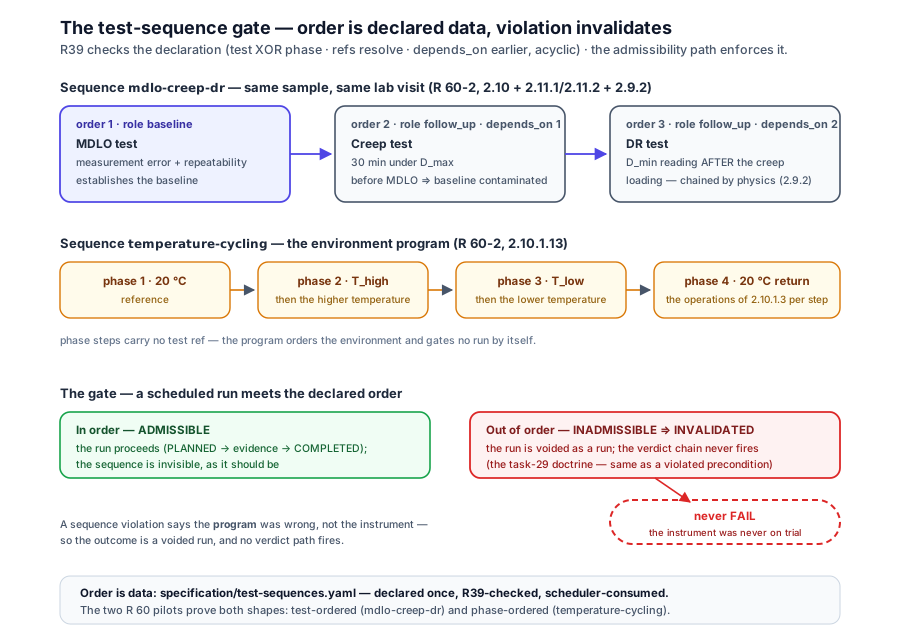
A sequence is an ordered step list; each step carries test XOR
phase. Test steps reference a declared conformance test and may
carry role: baseline | follow_up and depends_on: <order of an earlier step>. Phase steps name an environment-program phase, legal only in
programs like temperature cycling. The two R 60 pilots:
mdlo-creep-dr, the MDLO test (measurement error, repeatability) asbaseline, creepfollow_upon it, DRfollow_upon creep (sample_applicability: all). Running creep before MDLO contaminates the baseline, the order is physics, not bureaucracy.temperature-cycling, the environment program of the MDLO test (20 °C reference → T_high → T_low → 20 °C return, R 60-2 2.10.1.13). Phase-shaped steps carry no test ref; the program orders the environment and gates no run by itself.
Two honest scopings (Response 3 §60). The declaration is checked by
linker rule R39 test-sequence-integrity: unique step orders, test
XOR phase, test refs resolve, depends_on references an earlier order
and the graph is acyclic, role in vocabulary. And runtime enforcement
rides the existing admissibility path of the test-run service: a run
scheduled out of order computes INADMISSIBLE → INVALIDATED, never a
fail. This is §4.5’s precondition doctrine one level up: an
out-of-order run says the program was wrong, not the instrument, the
instrument’s goodness was never on trial, so no verdict path fires.
(Authoring note: there is no PRL test_sequence construct yet, the
file is hand-authored app config outside the generated set, riding the
supplemental list so the from-packages build composes it identically;
the kernel construct is a kernel-lane follow-up.)
4.11 Runs per class, structured and congruent ●
§4.4’s instances: declaration is the structured, scheduler-consumable
form of the per-class run counts, and phase 9.5 (Response 4 item 3, ●
smart 4a9b5db) pinned it from both sides:
- R40 instance-coverage, for any test declaring
instances { by D, values }, every declared value ofDthe test is applicable to must be a key ofvalues. The workflow scheduler dispatches a sample’s run count by its dimension value; a missing key is an undispatchable sample. Applicability scopes the demand: span-stability applies to classes B/C/D and keys exactly those, class A is never dispatched to it, so it needs no key. (The by-dimension reference and the key set ⊆ declared values are R7’s legs; R40 is silent for tests withoutinstances.) - The prose≡data congruence test, the repetition counts also live
in the test’s
method:prose (“Classes C/D: 3 identical load applications. Classes A/B: 5 …”, R 60-2 2.10.1.3), and the prose stays the normative text. A data-level leg (src/__tests__/runs-per-accuracy-class.test.ts) pins 5/5/3/3 both ways, so the structured map and the normative sentence cannot drift , drift being exactly what the structured form exists to prevent.
4.12 The evaluation-formula trace: formulas_used ●
Which registry formulas does a test’s evaluation invoke? The answer was
implicit in the variables’ derivations; phase 9.5 made it a first-class
trace (Response 4 item 4, ● smart 4a9b5db):
specification/formulas-used.yaml records per test the calculation and
formula ids its evaluation consumes, for the MDLO test,
conversion_factor_f, e_l, e_r, c_m (R 60-3, 2.1).
The placement is the semantic point: these are evaluation-level
quantities, computed from the indication output, never by the
instrument’s signal chain. load_weight (the MDLO test’s method_ref)
is the instrument’s signal-level anatomy (R 60-1, 4 Figure 2); putting
evaluation formulas on it would falsely claim the instrument computes
them. The trace therefore hangs on the test, and it discharges part
of the R34 designed delta’s documentation: the delta, the process’s
signature covers the instrument vocabulary, the test’s variables are the
derived error quantities, stops being allowlist prose and becomes
resolvable data. Linker rule R41 formulas-used-resolve binds every
entry to a declared test (one trace per test) and resolves every formula
id against the union of the calculations and formulas registries (entry
name or output name). Traceability is the payoff: a formula change now
propagates visibly to every test that uses it.
One entry closed honestly: c_m was a declared test variable with no
named registry entry, the task added the mdloStepChange calculation
(R 60-3, 2.1.4: the raw per-step temperature effect C_M = (I_2 − I_1) / f, before the normalization that lives exactly once in the
mdlo_normalized VerdictQuantity) rather than letting the trace dangle
or documenting around it. (Same authoring posture as test sequences:
hand-authored app config pending a kernel formulas_used facet.)
4.13 The required-competence facet ●
A test also declares what executing it demands of the laboratory
(task 48, ● BUG.R60-SSOT gap 1; ISO/IEC 17025 §6.4/§6.6, OIML-CS PD-05
§5.3). The required_competence: block lists abstract ability entries ,
[{ kind, range?, method_standard?, resolution?, stability? }], never
named equipment (labs declare capabilities, not equipment; §8.2 of
Volume II). The MDLO test’s declaration:
      required_competence:
      - kind: force_measurement
        range: { max: e_max, unit: kg }      # subject-parameter bound
        description: Force-generating system applying test loads over the
          measuring range (R 60-2, 2.7.2), mass standards traceable per 2.7.3.2
      - kind: temperature_control
        range: { min: t_min, max: t_max, unit: degC }
        stability: { value: 2, unit: degC }
        description: Climatic chamber conditioning at 20 °C, T_high, T_low
          and return (R 60-2, 2.10.1), stable within one fifth of the cell's
          range, never more than 2 °C (R 60-2, 2.7.3.1)
Three declaration rules keep the facet honest:
- Bounds are numbers or subject-parameter ids,
max: e_maxis resolved against the dispatch context, not restated as a number. Required force ranges are deliberately one-sided (maxonly): capacity is the upper-bound question, and amin: 0requirement would refuse real laboratory scopes whose ranges start above zero. - Inheritance follows
inherits_from, a class-specific test keeps its base test’s entries, exactly like preconditions (§4.5). The R 60 pilot: all 62 tests declare, 19 directly and 43 through the chain. - Kinds come from one registry, the cross-Recommendation
specification/competence-kinds.yamlof the core package, nine kinds:force_measurement,temperature_control,humidity_testing,pressure_control,emc_testing,power_supply_variation,indication_readout,documentation_review,software_examination. ISO/IEC 17025 defines no taxonomy, so each kind anchors its §6.2/§6.4 clauses;method_standardids (IEC 60068-2-30, IEC 61000-4-2…-4-11, titled) resolve against the registry’smethod_standards.
Linker rule R29 competence-references resolves kinds and standards,
requires every test of a declaring standard to resolve a non-empty
competence set, and checks every in-tree seeded dispatch assignment for
cover with the model’s parameters as context. What the declaration
buys is the dispatch-side cover relation, the laboratory’s
accreditation_scope, the cover calculus, and the refusal discipline
are chapter 10’s subject (§10.8).
4.14 Grammar sketch (illustrative v3 syntax)
conformance_test /conf/metrological-tests/creep {
  is {
    source "urn:oiml:pub:r:60-2:2021#clause-2.10.2"
    kind performance                     # ● metamodel taxonomy (◐ in R 60 data)
    obligation mandatory                 # ○
    design { specimens { count 1  continuity same_eut }
             schedule { duration PT30M } }
  }
  has {
    targets [ /req/metrological/creep, /req/metrological/creep-20-30 ]
    variables {
      d_max : mass  source declared      # subject parameter via the chain
      creep_readings : collection  source measured
      c_c : v  source derived
        derive ocl{ creep_readings->collect(r | r.change_v)->max() }
      mpe_at_dmax : v  source computed
        derive ocl{ lookupMPE(d_max, accuracy_class, 0.7) }
    }
    conditions { reference ref_conds  common common_test_conditions }
    preconditions {
      temperature-stability:
        check ocl{ temperature_variation
                   <= min(2, 0.2 * (family.parameters.t_max
                                    - family.parameters.t_min)) }
        on_violation invalid             # void run, never a fail
    }
  }
  does {
    steps {
      1 record initial indication at D_min
      2 apply D_max                     in  [d_max]
      3 record initial indication       out [initial_dmax_indication]
      4 hold 30 min, record at intervals out [creep_readings, c_c, …]
      5 remove load, return to D_min
    }
    acceptance {
      composite pass_if ocl{ creep_30min_criterion and creep_20_30_criterion }
      item creep_30min_criterion  target /req/metrological/creep
           pass_if ocl{ abs(c_c) <= 0.7 * abs(mpe_at_dmax) }
      item creep_20_30_criterion  target /req/metrological/creep-20-30
           pass_if ocl{ abs(creep_30min - creep_20min) <= 0.15 * abs(mpe_at_dmax) }
    }
    result_forms [ creep-dr ]
  }
}

conformance_test /conf/class-a/measurement-error {
  inherits_from /conf/metrological-tests/measurement-error-repeatability-mdlo
  applicability { accuracy_class: [A] }
  targets [ /req/class-a/mpe, /req/class-a/special-temperature-limits ]
  # restate only deltas — run count, temperature increment, exclusions
}
4.15 Validation rules
- every
targetsentry resolves to a declared requirement, and every acceptance item’stargetis among them; every requirement withverification.method: testingis targeted by at least one test (coverage); everybinds_toentry resolves against the subject’s HAS inventory, and every test binds ≥1 such home (R28); - every stimulus-response test (the five metamodel kinds,
type: Testing) is theverified_bytarget of ≥1 declared behavior (R37); - every sequence step carries
testXORphase; test refs resolve to declared tests;depends_onreferences an earlier order, acyclically;role ∈ {baseline, follow_up}when present (R39); an out-of-order run computes INVALIDATED, never a fail; - every
instances.bynames a declared dimension,instances.valueskeys every dimension value the test is applicable to (R40), and the counts stay congruent with the method prose; - every
formulas_usedentry binds a declared test (one trace per test); every formula id resolves against the calculations ∪ formulas registries (R41); - every
required_competenceentry names a kind of the competence-kind registry and resolvable method standards; every test resolves a non-empty competence set (R29); - every variable declares a
source;derived/computedvariables carry OCLderivationreading only declared variables, bound paths, and resolvable lookups; stepinput_variables/output_variablesname declared variables, produced before consumed; - precondition
checkexpressions read bound paths and declared variables; their violation yieldsinvalid, never a verdict outcome; inherits_fromresolves to a declared test; the child restates deltas only, a child redeclaring the parent’s variables or steps verbatim is a drift finding;- every
result_formsentry resolves to a declared form (chapter 5), and every performance test lands its evidence in at least one form; - every
method_refresolves to a declared model-layer process (R34); a coverage delta between the process anatomy and the test’s declared variables/preconditions is documented in the linker allowlist, never left silent; - quantities shared with a VerdictQuantity are referenced, not
re-derived (
verdict-no-shadow,verdict-restatement).
4.16 Summary
- A conformance test is an operation on the subject: it constrains inputs, environmental context, and state, then observes outcomes as typed observables. Tests observe; only requirements constrain.
- Variables carry a source (
declared | measured | derived | computed) and OCL derivations, derived from requirement limits and subject parameters, never restated. Test outputs and requirement inputs meet at registered observable ids. - Steps declare their input/output variables; repetitions are explicit
and parameterized per class through
instances:, expanded at runtime by the applicability engine. - Preconditions are run-validity rules: a violation voids the run
(
invalid), it never fails the instrument. Equipment is recorded per run with calibration references. - Acceptance criteria are composite with per-item
targetrequirements; inheritance viainherits_fromrestates only class deltas. - Kinds (● metamodel taxonomy; ◐ R 60 tagging and the new field/simulation kinds, software-examination pending), obligation levels (○), and statistics blocks (●, landed from the R 91 gap) complete the model.
- The phase-9 layer (●, the R 60 SSOT review): every stimulus-response
test is a behavior’s
verified_bytarget (R37); required orderings are declared test sequences (R39) enforced through the admissibility path, out-of-order ⇒ INVALIDATED, never fail; runs-per-class is structured data keyed for every applicable class (R40) and pinned congruent with the normative prose; and each test traces the registry formulas its evaluation consumes (R41), evaluation-level quantities on the test, never on the instrument’s process. - Tests declare what they demand of the laboratory:
required_competenceentries against the nine-kind registry (R29), one-sided parameter-bound ranges, inherited down the class chain, the dispatch-side cover relation of chapter 10 is their consumer.
Next: Chapter 5, Forms and Reports: the evidence views, bind paths, measurement methods, pass/fail blocks, the test-report skeleton, checklists, and omissions.